
CNC Machining vs Injection Molding: How to Pick the Best One and Save Money
CNC machining vs injection molding is a decision about volume, geometry, material and time. CNC machining cuts each part from solid stock, with no tool cost and fast first parts. Injection molding needs a mold first, but then makes each part in seconds at a low cost. The right answer for a given part often changes as the project moves from prototype to production.
Choosing too early in either direction costs money. For example, building a mold for 200 parts of a design that is still changing wastes the tooling budget. On the other hand, machining 20,000 housings a year from solid plastic can cost many times more than molding them. In this guide, we compare CNC machining vs injection molding for plastic and some metal-replacement parts: cost, break-even quantity, geometry, materials, tolerances, lead time and how to switch between them. For plastic machining in detail, see our guide to CNC plastic machining.
CNC machining vs injection molding: CNC machining has no tooling cost, delivers parts in days and suits low volumes, thick parts, tight-tolerance features and design changes, but its part cost stays high. Injection molding needs a mold, typically 4–8 weeks to build, but gives low part cost, consistent parts and features such as thin walls, clips and living hinges. The break-even point is roughly the mold cost divided by the part cost saving, often between a few hundred and a few thousand parts. Many projects machine prototypes, then mold production.
In short: machine for low volume, changing designs and thick or very precise parts; mold for stable designs at volume.
Key points:
- Tool cost: none for machining; a mold for molding.
- Part cost: high for machining; low for molding.
- Break-even: mold cost ÷ part cost saving.
How Do CNC Machining vs Injection Molding Work?
CNC machining vs injection molding work in opposite ways. Machining removes material from a block; molding fills a cavity with molten plastic.
| Factor (typical) | CNC machining | Injection molding |
|---|---|---|
| Tooling | None (fixtures only) | Mold required |
| First parts | Days | Weeks (after mold build) |
| Part cost | High | Low at volume |
| Design changes | Easy (change the program) | Costly (change the steel) |
| Thin walls, clips | Difficult | Easy |
| Thick sections | Easy | Sink and voids risk |
| Material choice | Wide stock range | Wide resin range |
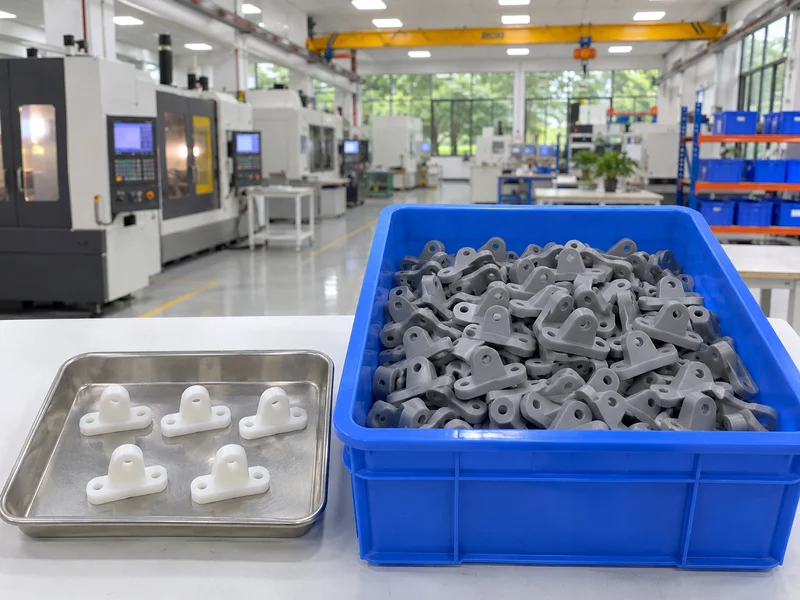
For example, a 10 mm thick PEEK block with cross holes suits machining well. In contrast, a 2 mm wall ABS housing with snap-fits is a natural molded part. Our CNC machining services and plastic injection molding can quote both routes.
Key Takeaway: The part’s geometry often decides the process before cost does.
Where Is the Break-Even Between CNC Machining vs Injection Molding?
The break-even between CNC machining vs injection molding is the quantity where the total cost of molding equals the total cost of machining.
Break-even quantity ≈ mold cost ÷ (machined part cost − molded part cost)
A worked example (illustrative):
- Mold cost: 6,000 (currency units)
- Machined part cost: 18 per part
- Molded part cost: 1.5 per part
- Break-even ≈ 6,000 ÷ (18 − 1.5) ≈ 364 parts
Above about 360 parts, molding is cheaper in this example. However, the real numbers depend on the part, material and tool. We do not publish fixed prices; each quote follows the drawing. Our guide to how to estimate injection molding cost explains the inputs.
Key Takeaway: Ask for quotes for both processes, then calculate the break-even for your real volume.
Which Geometry Suits CNC Machining vs Injection Molding?
Geometry suits CNC machining vs injection molding differently, because each process has natural shapes.
CNC machining suits:
- Thick sections and solid blocks
- Deep, precise bores and threads
- Flat, square features without draft
- Internal channels made by drilling
Injection molding suits:
- Thin, uniform walls
- Snap-fits, clips and living hinges
- Complex outer shapes and textures
- Bosses and ribs in one shot
For example, a molded housing needs draft on its walls, while a machined housing does not. When converting a machined design to molding, walls must often be cored out to avoid sink. Our guide to basics of injection molding design explains the main rules.
Key Takeaway: A part designed for machining usually needs redesign before molding. Plan time for it.
How Do Tolerances Compare?
Tolerances compare in favor of CNC machining for individual features, while injection molding gives better part-to-part consistency at volume once the process is stable.
- CNC machining: tight on features cut in one setup; plastics limited by material stability.
- Injection molding: depends on shrinkage, mold accuracy and process; typical tolerances are wider but very repeatable.
- Critical features: molded parts can have a few features machined afterward.
For example, a molded part with one precise bearing bore can be molded, then the bore reamed or machined. That combines low part cost with a precise fit. Our guide to injection molding tolerances explains typical ranges, and general tolerances such as ISO 2768 apply to machined parts.
Key Takeaway: Put tight tolerances only on functional features. Then both processes become cheaper.
How Do Lead Time and Design Changes Compare?
Lead time and design changes favor CNC machining early in a project and injection molding later.
- Machining: parts in days; design changes cost only programming time.
- Molding: mold build typically 4–8 weeks; changes need steel work.
- After the mold: molding delivers large quantities quickly.
For example, a startup may machine 50 parts for testing in two weeks, update the design twice, then order a mold. Meanwhile, the first molded parts arrive about two months later. Our guide to rapid CNC machining explains how to speed up machined parts.
Key Takeaway: Machine while the design is changing. Mold when it is frozen.
How Do You Move From Machining to Molding?
You move from machining to molding by freezing the design, adapting it for molding and validating the molded parts.
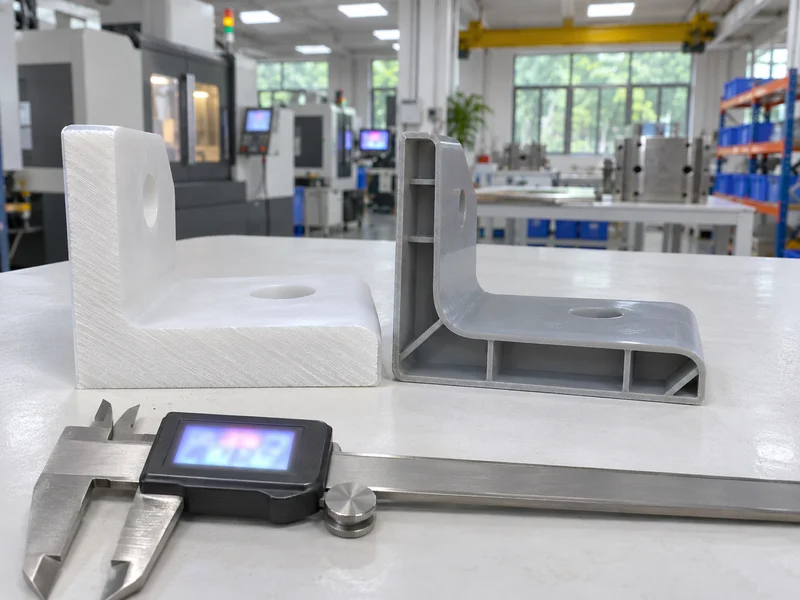
Steps:
- Freeze function and key dimensions using machined prototypes.
- Adapt for molding: add draft, core out thick walls, add radii.
- Review DFM with the molder before tooling.
- Build the mold and run T1 trials.
- Compare molded and machined parts for fit and function.
- Approve samples and start production.
For example, a machined bracket with 8 mm walls may become a molded bracket with 2.5 mm walls and ribs, giving the same stiffness at lower weight. Our standard mold quote includes up to 3 trials and 10-shot samples, and our low volume injection molding guide explains the step between the two.
Key Takeaway: Treat the switch as a redesign, not a copy. Molded parts need molded geometry.
FAQ
- Q: Is CNC machining cheaper than injection molding?
- For low volumes, yes. Above the break-even quantity, injection molding is cheaper per part.
- Q: What is the break-even quantity?
- Roughly the mold cost divided by the difference in part cost, often a few hundred to a few thousand parts.
- Q: Which process is faster?
- CNC machining gives first parts in days; injection molding needs weeks for the mold, then produces quickly.
- Q: Can a machined part be injection molded without changes?
- Usually not. It needs draft, uniform walls and radii for molding.
- Q: Which gives tighter tolerances?
- Machining for individual features; molding gives better consistency at volume once the process is stable.
Conclusion
CNC machining vs injection molding depends on volume, geometry, tolerance and how stable the design is. Machine early and at low volume, calculate the break-even, then redesign for molding when volume justifies a tool. To compare both routes for your part, send your 3D model and 2D drawing to our engineers.