
High Volume CNC Machined Parts: How to Get It Right
High volume CNC machined parts are small and medium precision components ordered in thousands or tens of thousands per year, such as fittings, connectors, sensor housings, shafts, valve bodies and brackets. At these quantities, the goal shifts from “can it be made?” to “can every part be the same, at a stable cost and on time?” Repeatability depends on design, process planning, fixturing, tool management and inspection.
Many parts move to volume after a prototype phase, but the prototype process is rarely the right volume process. For example, a part machined in three manual setups for prototypes may be redesigned for one-setup machining on a mill-turn center, cutting cycle time and variation. In this guide, we explain how to plan high volume CNC machined parts for repeatability: design choices, process selection, fixtures, tool life control, inspection, cost and when molding or casting becomes better. For the comparison with molding, see our guide to CNC machining vs injection molding.
High volume CNC machined parts are made repeatably by designing for fewer setups, choosing the right process (turning, mill-turn, multi-axis milling, bar-fed lathes), using dedicated or modular fixtures, controlling tool life with planned changes, using statistical process control on critical features, and freezing a validated process. Cost per part falls with optimized cycle times and stable yields. Above certain quantities, processes such as injection molding, die casting or cold forming may be cheaper, so the break-even should be checked.
In short: design for one-setup machining, freeze a validated process and monitor critical features statistically.
Key points:
- Setups: fewer setups mean less variation.
- Process freeze: validated settings stay fixed.
- SPC: critical features are monitored, not just inspected at the end.
What Makes High Volume CNC Machined Parts Different From Prototypes?
High volume CNC machined parts differ from prototypes because repeatability and cycle time matter more than flexibility.
| Aspect | Prototype | High volume |
|---|---|---|
| Goal | Prove the design | Repeat it at stable cost |
| Setups | Several, manual | Minimized, often one |
| Fixtures | Vises, soft jaws | Dedicated or modular fixtures |
| Programs | Changed often | Frozen after validation |
| Inspection | First pieces | SPC and sampling plans |
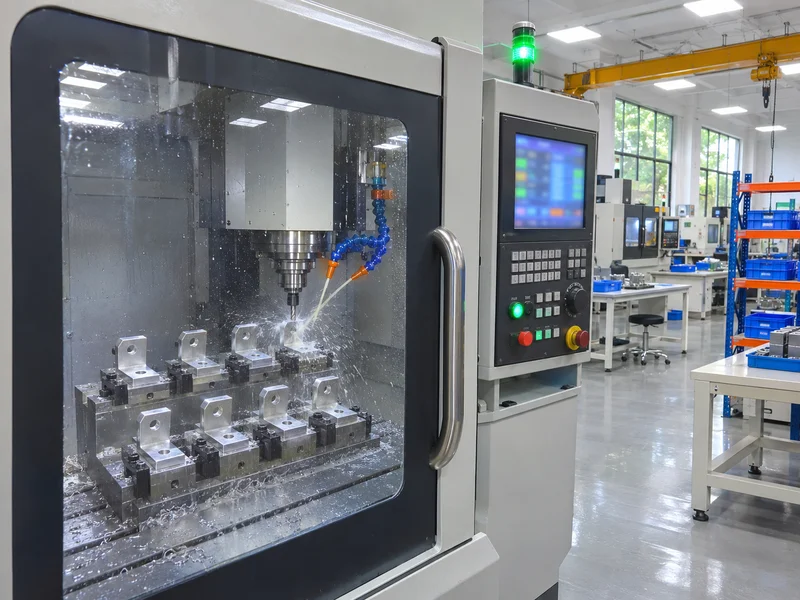
For example, a prototype aluminum housing may be machined in a vise in three setups, while the volume version uses a tombstone fixture holding many parts. Our guide to rapid CNC machining covers the prototype stage.
Key Takeaway: Plan a separate volume process. Do not simply repeat the prototype process.
How Should High Volume CNC Machined Parts Be Designed?
High volume CNC machined parts should be designed so that they can be machined quickly, in few setups, with standard tools.
Design rules:
- Keep features accessible from one or two directions.
- Use standard hole sizes and threads.
- Add internal corner radii that match standard tools.
- Avoid deep, narrow pockets that slow machining.
- Design for bar stock where possible, for turned parts.
- Apply tight tolerances only where needed.
For example, changing a 2.7 mm internal radius to 3 mm may let a standard tool finish the pocket in one pass. Our guide to tight tolerance machining explains tolerance placement.
Key Takeaway: Small design changes can save seconds per part, which add up at volume.
Which Processes Suit High Volume CNC Machined Parts?
The right process for high volume CNC machined parts depends on part shape and size.
- Bar-fed CNC lathes: shafts, pins, fittings and round parts
- Mill-turn and Swiss-type lathes: complex turned parts finished in one cycle
- Multi-axis milling with pallets: prismatic housings and brackets
- Horizontal machining centers: multi-face parts with tombstone fixtures
- Secondary operations: deburring, washing, finishing
For example, a stainless sensor body with cross holes may be finished complete on a mill-turn center, avoiding a second milling setup. Our guide to multi axis CNC turning explains live tooling.
Key Takeaway: Choose the process that finishes the part in the fewest handlings.
How Do Fixtures and Tool Life Control Keep Volume Parts Repeatable?
Fixtures and tool life control keep volume parts repeatable by removing variation from clamping and cutting.
Fixture practice:
- Dedicated or modular fixtures locating on functional datums
- Error-proofing so parts load only one way
- Multiple parts per fixture to reduce cycle time
Tool life practice:
- Planned tool changes before wear affects dimensions
- Tool presetting to known lengths and diameters
- Sister tools in the magazine for long runs
- Offset adjustments based on measured trends
For example, a reamer may be changed every fixed number of holes, based on measured bore growth during validation. Our CNC milling service plans fixtures around the part’s functional datums.
Key Takeaway: Change tools by plan, not by failure.
How Should High Volume CNC Machined Parts Be Inspected?
High volume CNC machined parts should be inspected with a control plan that combines first-piece checks, in-process checks and statistical monitoring.
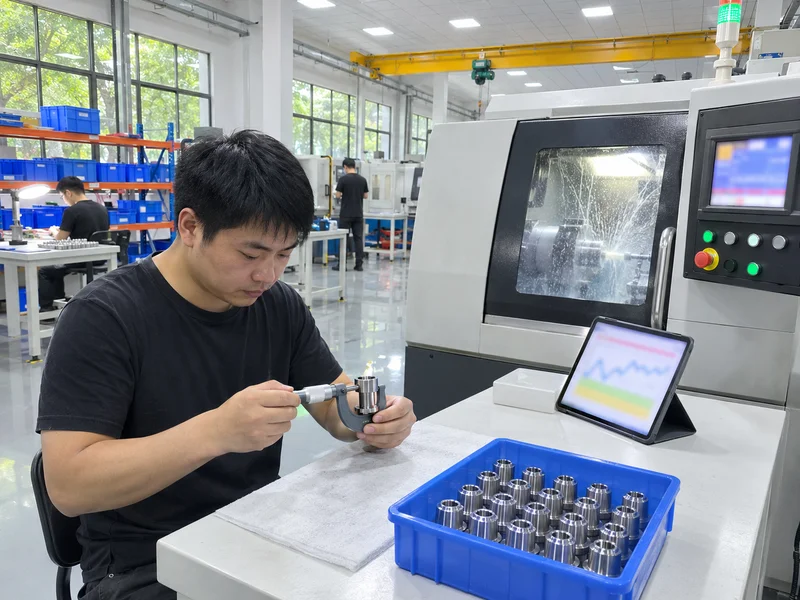
Inspection elements:
- First article inspection after setup and changes
- In-process gauging of critical features at a set frequency
- SPC charts for critical dimensions
- Go/no-go gauges for fast checks
- Final sampling before shipment
- Records linked to lots
For example, a bore with a ±0.01 mm tolerance may be checked every 20 parts and plotted on an SPC chart, so drift is corrected before parts go out of tolerance. Statistical process control methods are described in standards from ISO. Our guide to the control plan explains how checks are defined.
Key Takeaway: Monitor trends on critical features; do not wait for rejects.
How Does Volume Change the Cost of CNC Machined Parts?
Volume changes the cost of CNC machined parts by spreading setup and programming costs and rewarding cycle-time savings.
Cost effects:
- Setup and programming are amortized over more parts.
- Cycle time becomes the main cost driver.
- Material becomes a larger share of the cost.
- Fixtures and special tools pay back quickly.
- Yield matters more, because scrap is multiplied.
For example, saving 20 seconds per part on 50,000 parts per year saves about 280 machine hours. Our guide to CNC machining cost for custom parts explains cost drivers.
Key Takeaway: At volume, invest in cycle time and yield.
When Should Volume Parts Move Away From CNC Machining?
Volume parts should move away from CNC machining when another process gives the required quality at lower total cost.
Alternatives:
- Injection molding: plastic parts at high volume
- Die casting: complex aluminum or zinc parts, often with machined features
- Cold forming or stamping: simple metal shapes
- Metal injection molding: small, complex steel parts
For example, an aluminum housing at 100,000 parts per year may be die cast and then machined only on critical faces. Our guide to casting vs machining explains the break-even.
Key Takeaway: Review the process choice whenever annual volume grows significantly.
FAQ
- Q: What are high volume CNC machined parts?
- Precision parts machined in thousands or more per year, made with repeatable, validated processes.
- Q: How do you keep CNC parts consistent at volume?
- Use dedicated fixtures, planned tool changes, frozen programs and SPC on critical features.
- Q: Is CNC machining cost-effective at high volume?
- Often yes for metal precision parts, but molding or casting may be cheaper above certain volumes.
- Q: Which machines are used for high volume turned parts?
- Bar-fed lathes, Swiss-type lathes and mill-turn centers.
- Q: What inspection is used for high volume machining?
- First article inspection, in-process gauging, SPC and final sampling.
Conclusion
High volume CNC machined parts stay repeatable when the design, process, fixtures, tools and inspection are planned for volume rather than copied from prototypes. Freeze a validated process and monitor critical features. To plan a volume part, send your 3D model and 2D drawing to our engineers.