
Recycled Plastic Injection Molding: Regrind and Testing
Recycled plastic injection molding uses post-consumer or post-industrial recycled resin, or the molder’s own regrind, in place of some or all virgin material. It lowers material cost and carbon footprint and helps meet recycled-content targets. However, recycled resin varies more from lot to lot, so a part that molds well with one lot may show short shots, color shifts or weaker properties with the next.
The key is to specify recycled resin before it enters the program, not after. For example, adding 30% post-consumer PP to an existing part without testing can change shrinkage enough to move critical dimensions. In this guide, we explain recycled plastic injection molding: resin types, how recycled content affects parts, regrind limits, material change qualification, lot and cavity traceability, and what to put in the specification. For material basics, see our injection molding material selection guide.
Recycled plastic injection molding uses post-consumer recycled (PCR), post-industrial recycled (PIR) or in-house regrind material. Recycled content can change melt flow, color, odor, contamination level and mechanical properties, and these vary between lots. Successful programs define the allowed recycled content and source, set incoming checks such as melt flow index and moisture, qualify the material change with dimensional and functional tests, limit regrind percentage, and keep lot and cavity traceability so problems can be traced.
In short: define recycled content, check every lot, qualify changes and keep traceability.
Key points:
- Variation: recycled lots vary more than virgin resin.
- Qualification: treat a recycled-content change as a material change.
- Traceability: link parts to resin lots and cavities.
What Is Recycled Plastic Injection Molding?
Recycled plastic injection molding is molding with resin that has been used or processed before.
Three main sources:
- Post-consumer recycled (PCR): collected from used products and packaging.
- Post-industrial recycled (PIR): scrap from other manufacturing processes.
- In-house regrind: sprues, runners and rejects from the same molding process.
For example, a PP storage box may use 50% PCR PP, while a technical PA66 part may only allow a small percentage of its own regrind. European policy on recycled content in packaging and products is published on EUR-Lex.
Key Takeaway: Name the recycled source. PCR, PIR and regrind behave differently.
How Does Recycled Content Affect Molded Parts?
Recycled content affects molded parts because the polymer has been degraded and mixed with other materials.
Common effects:
- Melt flow changes, usually higher flow from shorter polymer chains
- Lower impact strength and elongation
- Color variation and darker tones
- Contamination such as other polymers, paper or metal
- Odor from previous use
- Shrinkage changes that move dimensions
For example, a PCR PP with higher melt flow may fill faster and flash more easily, while impact strength drops. Our guide to injection molding flash explains how flow changes cause flash.
Key Takeaway: Expect differences in flow, strength and color, and test for them.
How Much Regrind Percentage Is Acceptable in Injection Molding?
The acceptable regrind percentage in injection molding depends on the material, part function and customer requirement.
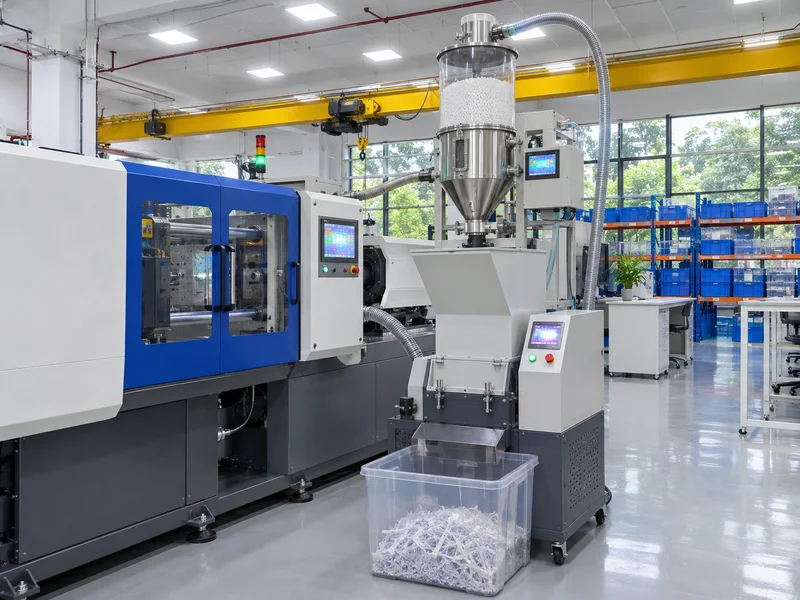
Typical guidance:
- Commodity parts (PP, PE, ABS): often up to about 20–25%, if tested.
- Engineering resins (PA, PBT, PC): often 10–20%, with drying control.
- Critical, safety or cosmetic parts: often 0% or a strictly limited percentage.
- Glass-filled grades: limited, because fibers shorten with each pass.
Regrind control points:
- Same grade and color only
- Dried as required
- Fines removed
- Blended at a fixed ratio
For example, a glass-filled PA66 bracket using too much regrind may lose stiffness because the fibers are shorter. Our guide to plastic resin drying explains moisture control for regrind.
Key Takeaway: State the maximum regrind percentage on the drawing or specification.
How Do You Qualify a Material Change to Recycled Resin?
You qualify a material change to recycled resin by testing it against the same requirements as the original material.
Qualification steps:
- Document the change: source, grade, recycled content.
- Check incoming properties: melt flow index, moisture, ash or filler content.
- Run a process study to set a stable window.
- Measure dimensions across cavities.
- Test function: impact, snap fits, assembly, color.
- Approve formally, with records kept.
For example, a PP housing moving from virgin to 30% PCR may need new pack pressure settings and a color approval. A formal approval prevents surprises in production. Our guide to scientific molding explains process windows.
Key Takeaway: Approve recycled resin like any new material, with process, dimensional and functional evidence.
How Do Lot and Cavity Traceability Support Recycled Plastic Injection Molding?
Lot and cavity traceability support recycled plastic injection molding by linking each part to its resin lot, date and cavity, so problems can be isolated quickly.
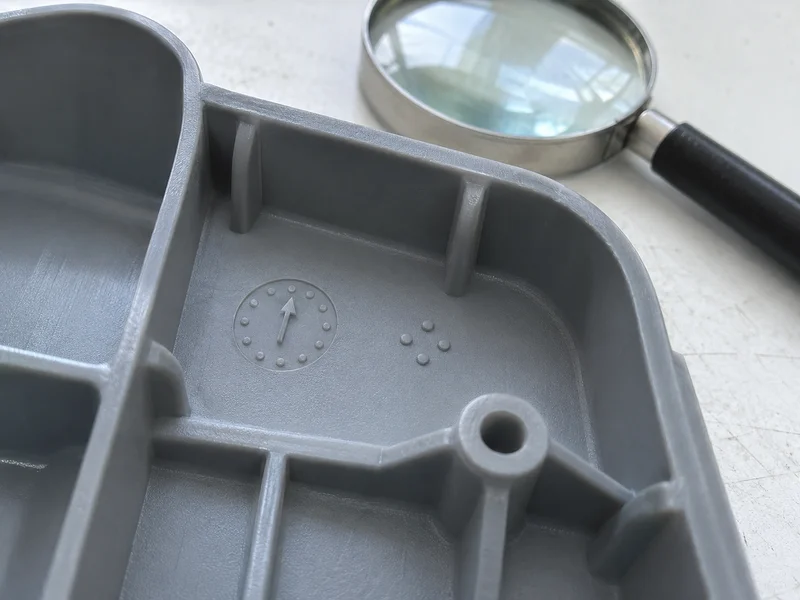
Traceability elements:
- Resin lot traceability: lot numbers recorded at the press
- Date codes or lot codes molded or marked on the part
- Cavity numbers molded into multi-cavity parts
- Batch records linking lots, settings and inspection results
- Retained samples for each lot
For example, if parts from one week show cracking, lot records can show whether a specific recycled lot was used. Our guide to multi-cavity injection molding explains cavity identification.
Key Takeaway: Recycled programs need stronger traceability than virgin programs.
When Is Recycled Plastic Injection Molding Not Suitable?
Recycled plastic injection molding is not suitable when the part needs tightly controlled properties that recycled lots cannot guarantee.
Typical limits:
- Safety-critical parts with strict mechanical requirements
- Food-contact or medical parts without approved recycled grades
- Transparent or light-colored cosmetic parts
- Flame-rated parts unless the recycled grade is rated
- Tight-tolerance parts sensitive to shrinkage variation
For example, a clear PC lens or a UL 94 V-0 housing normally needs virgin or specifically certified recycled grades. Our guide to flame retardant plastics explains rating evidence.
Key Takeaway: Use recycled resin where variation is acceptable, not where it could cause failure.
How Should You Specify Recycled Content?
You should specify recycled content with clear limits, sources and checks.
Specification items:
- Recycled content percentage and type (PCR, PIR, regrind)
- Approved grades or suppliers
- Incoming checks such as melt flow range
- Regrind limit and handling rules
- Color and appearance limits
- Traceability requirements
- Change notification for source changes
For example, “PP, 30% PCR from approved source, MFI 15–25 g/10 min, regrind ≤10%, lot traceability required” is clear. We mold to the specified material requirements and confirm grade and process per project. See our plastic injection molding service.
Key Takeaway: Put recycled content rules in writing before the first production lot.
FAQ
- Q: Can recycled plastic be injection molded?
- Yes. PCR, PIR and regrind are widely used, with checks for lot variation.
- Q: What is the difference between PCR and regrind?
- PCR comes from used consumer products; regrind is the molder’s own scrap from the same process.
- Q: How much regrind can be used?
- Often 10–25% for many materials, but critical parts may allow none.
- Q: Does recycled plastic reduce part strength?
- Often yes, especially impact strength. Test the specific grade.
- Q: How is recycled resin traced?
- By recording resin lots at the press and marking parts with lot or date codes.
Conclusion
Recycled plastic injection molding works when recycled content is defined, every lot is checked, material changes are qualified and traceability is kept. Use it where property variation is acceptable. To review recycled content for your part, send your 3D model and 2D drawing to our engineers.