
Creep Deformation in Plastics: Causes and Design Tips
Creep deformation is the slow, permanent change in shape of a material under a constant load over time. In plastics it can happen at room temperature, and it speeds up with heat and stress. A molded clip that holds tight on day one may loosen after months, a screw boss may lose preload, and a snap-fit arm held in deflection may relax until it no longer retains its mate.
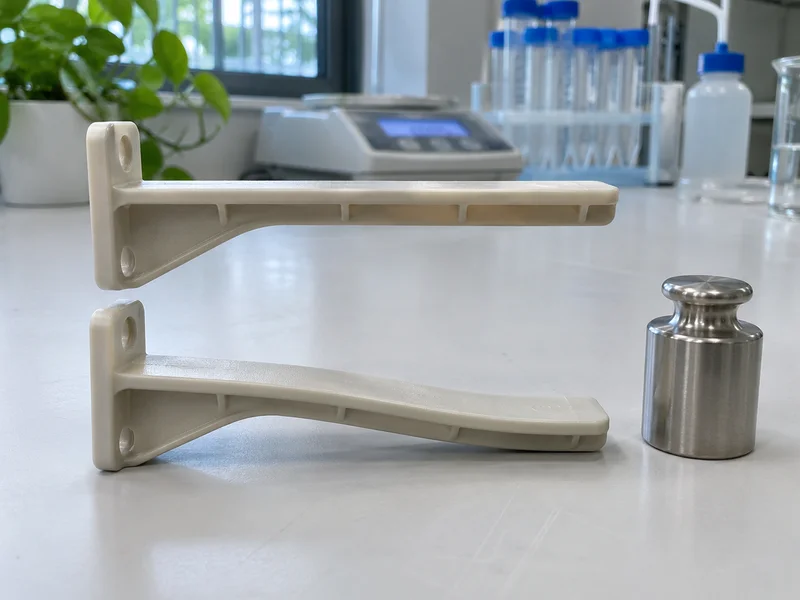
Creep is often missed because short-term tests look fine. For example, a PP bracket may carry a load easily in a one-minute test but sag several millimeters after weeks at 60 °C. In this guide, we explain creep deformation in molded plastic parts: what it is, how it differs from stress relaxation, which factors drive it, which materials resist it, how to design for it, including snap-fit arms, and how to test and specify it. For snap fits, see our guide to snap fit design.
Creep deformation is time-dependent strain under constant stress; stress relaxation is the loss of stress under constant strain. Both are significant in plastics, especially semi-crystalline resins above their glass transition, at elevated temperature and under sustained loads near the material’s limits. Creep is reduced by lowering stress (thicker sections, ribs, larger contact areas), choosing creep-resistant materials (glass-filled grades, PEEK, PPS, PBT, POM over PP or PE), avoiding sustained deflection in snap fits, and designing with long-term creep modulus data rather than short-term modulus. Testing uses tensile or flexural creep tests and part-level load tests at temperature.
In short: plastics deform slowly under load; design with long-term data, lower stress and choose creep-resistant grades.
Key points:
- Creep: strain grows under constant load.
- Relaxation: force drops under constant deflection.
- Temperature: speeds both strongly.
What Is Creep Deformation?
Creep deformation is the gradual, permanent strain that develops in a material held under constant stress.
Three stages:
- Primary creep: fast initial deformation that slows down
- Secondary creep: slow, steady deformation
- Tertiary creep: accelerating deformation leading to failure
For example, a plastic shelf bracket under a constant weight bends a little at first, then continues to sag slowly. Creep test methods for plastics are published by ASTM International, such as ASTM D2990.
Key Takeaway: Above all, short-term stiffness overstates how plastics behave under long-term load.
What Is the Difference Between Creep and Stress Relaxation?
The difference between creep and stress relaxation is what stays constant.
| Behavior | Held constant | What changes | Typical example |
|---|---|---|---|
| Creep | Load (stress) | Deformation grows | Bracket sagging under weight |
| Stress relaxation | Deformation (strain) | Force drops | Snap fit or press fit losing grip |
For example, a press-fit bushing in a plastic boss keeps the same interference, but the holding force falls over time because the plastic relaxes. Our guide to the screw boss explains preload loss in bosses.
Key Takeaway: In other words, clips and fits suffer relaxation; loaded structures suffer creep.
What Factors Drive Creep Deformation in Plastic Parts?
Creep deformation in plastic parts is driven by stress level, temperature, time, material and moisture.
Main factors:
- Stress level: higher stress, faster creep
- Temperature: creep rises sharply near the glass transition or softening point
- Time: creep continues for years
- Material structure: amorphous vs semi-crystalline, fillers
- Moisture: nylon creeps more when conditioned
For example, a nylon clip in a humid, warm engine bay creeps faster than the same clip in a dry office. Our guide to glass filled nylon explains moisture effects.
Key Takeaway: For this reason, design for the worst combination of stress, temperature and humidity.
Which Materials Resist Creep Deformation Best?
Materials that resist creep deformation best are stiff, high-temperature or fiber-reinforced resins.
- Glass- or carbon-filled grades: PA, PBT, PPS with fibers
- High-performance resins: PEEK, PPS, LCP
- POM: good creep resistance among unfilled resins
- PC: moderate, better at room temperature
- PP and PE: high creep, especially when warm
- Thermosets (BMC/DMC): very low creep
For example, replacing a PP support with PA66-GF30 can sharply reduce long-term sag at 80 °C. Our guide to what plastics are best for hot temperatures compares heat performance.
Key Takeaway: Overall, fibers and high-temperature polymers reduce creep the most.
How Do You Design Molded Parts Against Creep?
You design molded parts against creep by lowering sustained stress and using long-term material data.
Design methods:
- Use creep modulus (apparent modulus at the design time and temperature)
- Increase section size or add ribs to lower stress
- Spread loads with larger bearing areas and washers
- Avoid sustained deflection in snap fits and clips
- Use metal inserts for long-term clamping loads
- Allow for clearance changes over time
For example, a plastic housing fastened with screws can use metal compression limiters so the plastic does not carry the full clamping load. Our guide to the insert molding process explains metal inserts.
Key Takeaway: Equally, design with the modulus the part will have after years, not minutes.
How Does Creep Relaxation Affect Molded Snap-Fit Arms?
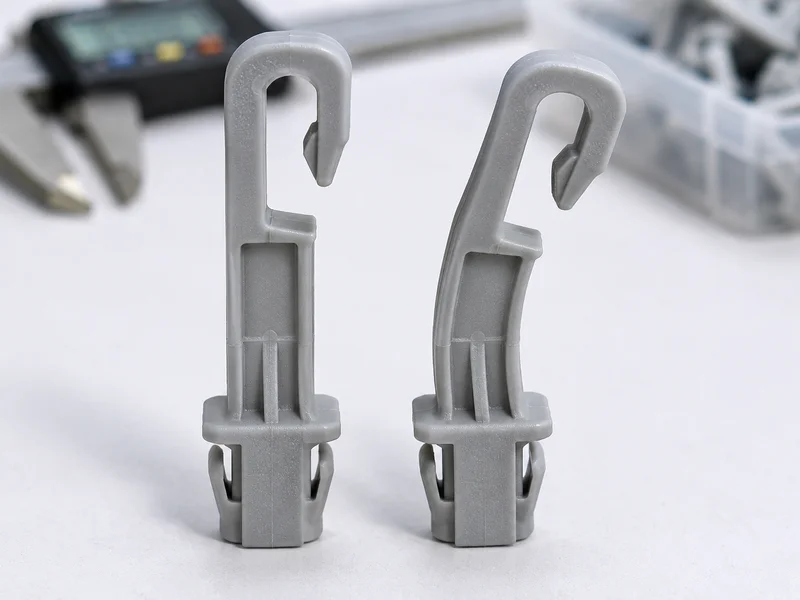
Creep relaxation affects molded snap-fit arms when they stay deflected after assembly.
Risks:
- Loss of retention force over time
- Gaps and rattles as preload drops
- Faster loss at temperature
Design rules:
- Return to undeflected position after the hook engages
- Avoid preloaded snaps that hold parts under constant force
- Use stiffer, creep-resistant materials where preload is needed
- Test retention after aging at temperature
For example, a battery cover snap that stays bent to hold the cover tight may loosen after months; redesigning it to relax fully after engagement keeps it secure.
Key Takeaway: As a rule, snap-fit arms should not stay deflected in service.
How Should Creep Be Tested and Specified?
Creep should be tested with material and part-level tests at the use temperature, and specified as long-term performance requirements.
Tests:
- Tensile or flexural creep tests over hundreds or thousands of hours
- Stress relaxation tests for fits and clips
- Part load tests at temperature, measuring deflection over time
- Retention force after aging
Specification items:
- Load, temperature and duration
- Maximum allowed deformation
- Minimum retained force
For example, “bracket deflection ≤1 mm after 500 h under 20 N at 70 °C” is testable. Our plastic injection molding service supplies samples for long-term tests.
Key Takeaway: Finally, specify creep as load, temperature, time and allowed change.
FAQ
- Q: What is creep deformation?
- Slow, permanent deformation of a material under constant load over time.
- Q: What is the difference between creep and stress relaxation?
- Creep is growing strain under constant load; relaxation is falling force under constant strain.
- Q: Which plastics creep the least?
- Glass-filled grades, PEEK, PPS, LCP and thermosets such as BMC.
- Q: Does temperature affect creep?
- Yes. Creep increases sharply with temperature.
- Q: How do you prevent creep in molded parts?
- Lower sustained stress, use creep-resistant materials and design with long-term modulus data.
Conclusion
Creep deformation and stress relaxation change molded parts over time. Design with long-term data, lower sustained stress, choose creep-resistant materials and test at temperature. To review a loaded plastic part, send your 3D model and 2D drawing to our engineers.