
Custom CNC Milling Cost: Features, Tolerances, Quantity
Custom CNC milling cost depends on how long the part spends on the machine, how many times it must be set up, what material it is made from and what happens after milling. For small and medium milled parts, such as brackets, housings, plates, manifolds and fixtures, most of the price is decided by geometry and requirements, not by the shop’s hourly rate alone.
Milling has its own cost drivers compared with turning or general machining. For example, a pocket with a 1 mm internal radius forces a tiny end mill to cut slowly, while a 4 mm radius lets a larger tool clear it several times faster. In this guide, we explain custom CNC milling cost: how milling time is built up, which features drive it, how 3-axis and multi-axis milling compare, the effect of material, quantity and finishing, and how to request accurate milling quotes. For a wider view, see our guide to CNC machining cost for custom parts.
Custom CNC milling cost is the sum of programming, setup, fixtures, machine time, tooling, material, finishing, inspection and handling, divided across the batch. Machine time depends on material removal volume, tool size (set by internal radii and pocket depth), number of faces and setups, surface finish, tolerances and machine type. 3-axis milling has a lower hourly rate but may need more setups; 5-axis has a higher rate but fewer setups. Larger radii, shallower pockets, fewer faces, standard features and larger batches lower the price.
In short: milling cost is mostly machine time and setups, both shaped by geometry.
Key points:
- Tool size: internal radii and depth decide cutting speed.
- Setups: each face direction may add a setup.
- Batch: fixed costs fall with quantity.
How Is Custom CNC Milling Cost Built Up?
Custom CNC milling cost is built up from fixed and variable elements.
| Cost element | Fixed or per part |
|---|---|
| Programming and CAM | Fixed (mostly first order) |
| Setup and first-piece inspection | Fixed per batch |
| Fixtures and soft jaws | Fixed, reusable |
| Machine cycle time | Per part |
| Cutting tools | Per part (wear) |
| Material | Per part |
| Finishing | Per part or per batch |
| Inspection and documents | Per part or per batch |
For example, a bracket with 1.5 hours of programming and setup and 12 minutes of cycle time is much cheaper per part at 100 pieces than at 5. Our CNC milling service quotes each part from its drawing.
Key Takeaway: Above all, separate fixed and per-part costs when comparing quantities.
Which Features Drive Custom CNC Milling Cost?
Features that drive custom CNC milling cost are those that force small tools, slow cutting or extra setups.
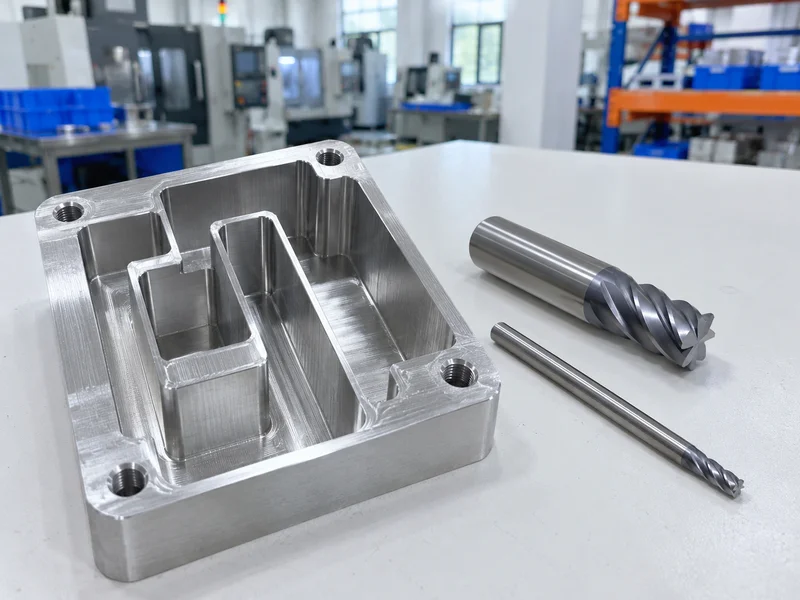
Costly features:
- Small internal radii in deep pockets
- Deep, narrow slots and pockets
- Thin walls needing light cuts
- Features on many faces
- Fine surface finishes on large areas
- 3D freeform surfaces
- Engraved text
Cheaper alternatives:
- Radii matching standard end mills
- Pocket depth up to about 3–4 × tool diameter
- Through features instead of blind ones
- Features grouped on one or two faces
For example, specifying 0.5 mm internal corner radii in a deep housing pocket can triple finishing time. Our engineering and DFM review flags such features.
Key Takeaway: In other words, internal radii and pocket depth are the first places to save.
How Do 3-Axis and Multi-Axis Milling Compare on Cost?
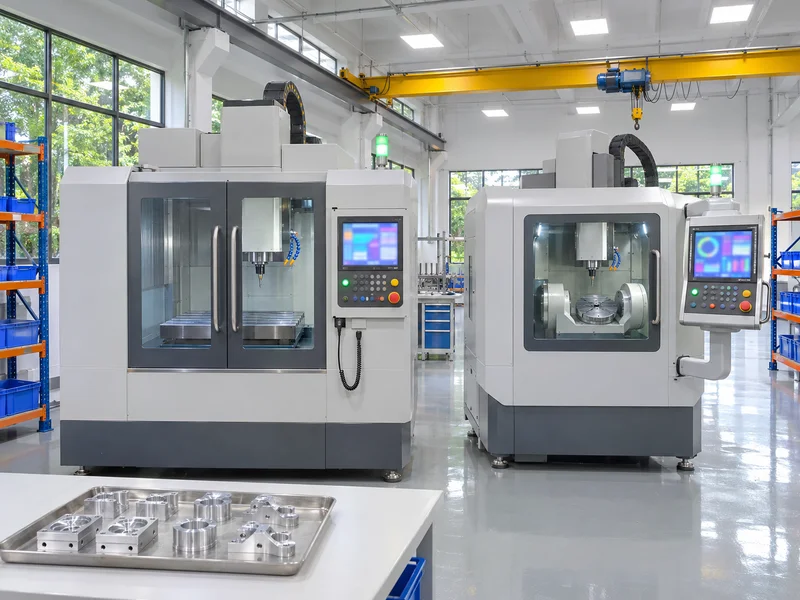
3-axis and multi-axis milling compare on cost by hourly rate versus number of setups.
| Factor | 3-axis | 3+2 / 5-axis |
|---|---|---|
| Hourly rate | Lower | Higher |
| Setups for multi-face parts | More | Fewer |
| Fixtures | Several | Often one |
| Programming | Simpler | More complex |
| Accuracy between faces | Lower (re-clamping) | Higher |
For example, a manifold with ports on four faces may be cheaper overall on a 5-axis machine because it needs one setup instead of four. Our guide to multi axis CNC machining explains configurations.
Key Takeaway: For this reason, judge milling cost per finished part, not per hour.
How Do Material and Tolerances Affect Milling Cost?
Material and tolerances affect milling cost by changing cutting speed, tool life and inspection.
Material effects:
- Aluminum: fastest milling, lowest tool wear
- Brass: fast, clean
- Carbon and alloy steels: moderate
- Stainless steel: slower, more tool wear
- Titanium: slowest, highest tool wear
- Plastics: fast but need care for heat and stress
Tolerance effects:
- Tight tolerances add finishing passes and inspection
- General tolerances such as ISO 2768 keep cost low
For example, the same housing may cost noticeably more in 316 stainless than in 6061 aluminum. Our guide to CNC machining materials compares machinability.
Key Takeaway: Overall, choose the most machinable material that meets the function.
How Do Quantity and Finishing Affect Milling Cost?
Quantity and finishing affect milling cost by spreading fixed costs and adding processing steps.
Quantity:
- Small batches carry full setup cost
- Repeat orders reuse programs and fixtures
- Larger batches justify better fixtures and optimized toolpaths
Finishing:
- Anodizing, plating, powder coating add per-batch cost and lead time
- Masking adds labor
- Bead blasting adds a step before anodizing
For example, combining three monthly orders into one quarterly batch can lower unit cost noticeably. Our guide to low-volume CNC machining explains batching.
Key Takeaway: Equally, share annual volume so batches can be planned efficiently.
How Do You Request an Accurate Custom CNC Milling Quote?
You request an accurate custom CNC milling quote by giving complete, consistent information.
Quote inputs:
- 3D model (STEP) and 2D drawing (PDF)
- Material and temper
- Quantities, including repeat volume
- Critical tolerances marked
- Surface finish and coating
- Inspection and document requirements
- Target date
For example, a quote request that includes “6061-T6, 200 pcs/year in 4 lots, black anodize, FAI on first lot” allows a precise price and batch plan. We do not publish fixed prices; every quote is based on the drawing.
Key Takeaway: As a rule, complete inputs give accurate milling quotes.
How Can You Reduce Custom CNC Milling Cost?
You can reduce custom CNC milling cost with design and ordering changes.
Practical steps:
- Enlarge internal radii to standard tool sizes.
- Reduce pocket depth or open pockets to one side.
- Group features on fewer faces.
- Relax non-critical tolerances.
- Limit fine finishes to functional faces.
- Choose machinable materials.
- Order in larger, planned batches.
For example, a redesign that removes one setup and enlarges radii can cut milling time by a third. Our quality control and inspection process scales inspection to the risk of each feature.
Key Takeaway: Finally, most milling savings are designed in before the first quote.
FAQ
- Q: What affects custom CNC milling cost?
- Programming, setup, machine time, tools, material, finishing, inspection and quantity.
- Q: Why do small internal radii increase cost?
- They force small tools that cut slowly and wear quickly.
- Q: Is 5-axis milling more expensive?
- The hourly rate is higher, but fewer setups often lower total cost.
- Q: Which material is cheapest to mill?
- Aluminum and brass are usually the fastest to mill.
- Q: How can I get an accurate milling quote?
- Send a STEP model, a drawing, material, quantities, finish and inspection requirements.
Conclusion
Custom CNC milling cost is driven by machine time and setups, which geometry largely decides. Use standard radii, shallow pockets, fewer faces, machinable materials and planned batches to lower the price. To get a milling quote, send your 3D model and 2D drawing to our engineers.