
Multi Axis CNC Machining: Accuracy, Cost and Design
Multi axis CNC machining uses machines with more than three axes, such as 4-axis, 5-axis and mill-turn centers, to reach several faces of a part in fewer setups. For small and medium precision parts, such as valve bodies, manifolds, sensor housings, medical-style components and parts with angled holes, it often improves accuracy and reduces cost by removing re-clamping. It is not always the right choice, however; simple prismatic parts may be cheaper on 3-axis machines.
Choosing the right number of axes is a balance of accuracy, cycle time and machine rate. For example, a manifold with ports on five faces may need five setups on a 3-axis machine but one on a 5-axis machine, keeping port positions related to the same datum. In this guide, we explain multi axis CNC machining: the main machine types, when extra axes help, how they affect accuracy and cost, design tips and how to choose the right configuration. For specific methods, see our guides to 5-axis milling and simultaneous 5-axis machining.
Multi axis CNC machining includes 4-axis milling (one rotary axis), 3+2 or positional 5-axis milling, simultaneous 5-axis milling and mill-turn machining (turning with live tools and a C- or Y-axis). Extra axes reduce setups, keep features related to common datums, allow shorter tools and reach angled features, which improves accuracy for multi-face parts. Trade-offs are higher machine rates, more complex programming and fixturing, and simulation needs. Choose the simplest configuration that machines the part in the fewest setups.
In short: use extra axes to remove setups on multi-face parts, not by default.
Key points:
- Setups: fewer clampings, better feature relationships.
- Configurations: 4-axis, 3+2, simultaneous 5-axis, mill-turn.
- Cost: higher machine rate, often lower total cost.
What Is Multi Axis CNC Machining?
Multi axis CNC machining is machining with one or more rotary axes in addition to the three linear axes.
Main configurations:
- 4-axis: a rotary table or indexer (A-axis) for parts around one axis
- 3+2 (positional 5-axis): two rotary axes tilt the part, then lock for cutting
- Simultaneous 5-axis: all five axes move during cutting
- Mill-turn: a lathe with live tools, C-axis and often Y-axis and sub-spindle
For example, a hex-shaped valve body with holes on each flat suits 4-axis indexing, while a manifold with compound-angle ports suits 3+2. Our guide to 4 axis CNC explains indexing.
Key Takeaway: Above all, “multi-axis” covers several distinct machine types.
When Does Multi Axis CNC Machining Help?
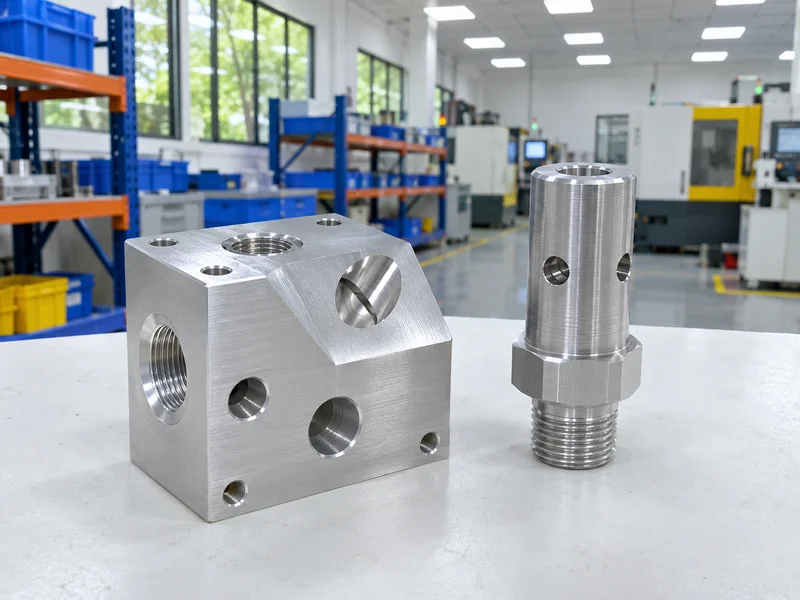
Multi axis CNC machining helps when a part has features on several faces or at angles.
Good fits:
- Multi-face housings and manifolds
- Angled holes and compound angles
- Deep pockets reachable with short tilted tools
- Turned parts with milled flats and cross holes
- Freeform surfaces
Less helpful:
- Flat plates with features on one face
- Simple brackets with two or three setups
For example, a turned sensor body with cross holes and flats can be finished complete on a mill-turn machine. Our guide to multi axis CNC turning covers live tooling.
Key Takeaway: In other words, extra axes pay off when they remove setups.
How Does Multi Axis CNC Machining Affect Accuracy?
Multi axis CNC machining affects accuracy mainly by reducing setups and keeping features on common datums.
Accuracy benefits:
- Fewer re-clampings remove alignment error
- Common datums for all features
- Shorter tools reduce deflection
- Better tool angles improve surface finish
Accuracy limits:
- Rotary axis accuracy and calibration
- Thermal growth in long cycles
- Workholding stiffness at tilted angles
For example, port-to-port position on a manifold machined in one 3+2 setup is usually tighter than after five separate setups. Machine capability is not finished-part tolerance; tolerances are confirmed per drawing. Machine accuracy tests are defined in standards from ISO, such as ISO 10791.
Key Takeaway: For this reason, the biggest accuracy gain comes from fewer setups.
How Does Multi Axis CNC Machining Affect Cost?
Multi axis CNC machining affects cost through machine rate, programming, setups and cycle time.
| Factor | 3-axis | Multi-axis |
|---|---|---|
| Machine hourly rate | Lower | Higher |
| Programming | Simpler | More complex |
| Setups per part | More | Fewer |
| Fixtures | Several | Often one |
| Inspection | More features to relate | Fewer setup errors |
For example, a part needing four 3-axis setups may be cheaper on a 5-axis machine in one setup, even at a higher hourly rate. Our guide to CNC machining cost for custom parts explains cost drivers.
Key Takeaway: Overall, compare total cost per part, not hourly rate.
How Should Parts Be Designed for Multi Axis CNC Machining?
Parts should be designed for multi axis CNC machining with tool access, workholding and datums in mind.
Design tips:
- Leave a clamping area or stock for workholding
- Avoid features hidden behind others at extreme angles
- Use standard tool sizes for angled holes
- Define datums that one setup can reach
- Avoid unnecessary compound angles
For example, adding a small machining tab to a housing gives a stable clamping point for one-setup 5-axis machining; the tab is removed at the end. Our engineering and DFM review checks access before quoting.
Key Takeaway: Equally, design the workholding into the part when one-setup machining is the goal.
How Do You Choose the Right Multi-Axis Configuration?
You choose the right multi-axis configuration by matching the part’s features to the simplest capable machine.
Decision guide:
- Features around one axis → 4-axis indexing
- Features on several faces at fixed angles → 3+2
- Continuous curved surfaces → simultaneous 5-axis
- Round parts with milled features → mill-turn
- Flat, one-face parts → 3-axis
For example, a small medical-style bracket with angled holes but flat faces suits 3+2, not simultaneous 5-axis. Our Dongguan factory includes a Makino 5-axis machining center, and our CNC milling service covers 3-, 4- and 5-axis work.
Key Takeaway: As a rule, use the simplest configuration that removes extra setups.
What Inspection Suits Multi-Axis Parts?
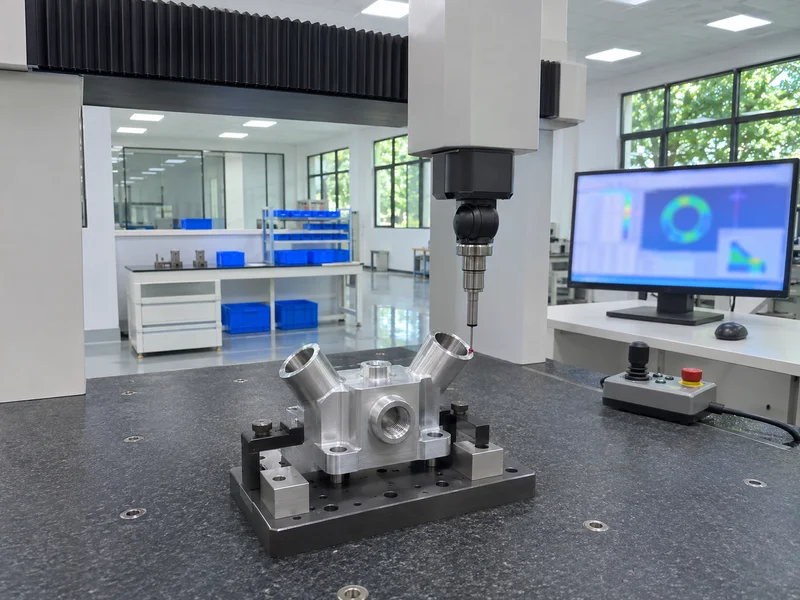
Inspection for multi-axis parts should check features from the same datums used in machining.
Practice:
- CMM measurement of angled features and positions
- Datum alignment matching the machining setup
- First article inspection on new programs
- Profile checks for freeform surfaces
For example, a CMM program using the same A-B-C datums as the 5-axis setup confirms port positions directly. Our quality control and inspection process supplies reports on request.
Key Takeaway: Finally, measure from the machining datums to confirm the benefit of one setup.
FAQ
- Q: What is multi axis CNC machining?
- Machining with rotary axes in addition to X, Y and Z, such as 4-axis, 5-axis and mill-turn.
- Q: What is the difference between 3+2 and simultaneous 5-axis?
- In 3+2 the rotary axes lock during cutting; in simultaneous 5-axis they move.
- Q: Is multi-axis machining more expensive?
- The hourly rate is higher, but fewer setups often lower total cost.
- Q: Does multi-axis machining improve accuracy?
- Yes, mainly by reducing setups and keeping features on common datums.
- Q: When is 3-axis machining enough?
- For flat parts with features on one or two faces.
Conclusion
Multi axis CNC machining improves accuracy and often cost on multi-face precision parts by removing setups. Choose the simplest configuration that machines the part in the fewest clampings, design for access and measure from the machining datums. To review a multi-face part, send your 3D model and 2D drawing to our engineers.