
CNC Machining Fixtures: Types, Locating and Clamping
CNC machining fixtures hold the workpiece in a known position while it is cut, so every part is located, supported and clamped the same way. For small and medium precision parts, the fixture often decides accuracy and cost as much as the machine: a good fixture locates on the right datums, resists cutting forces without distorting the part and loads quickly. A poor one causes vibration, distortion and scrap.
Fixture choice depends on quantity, part shape and tolerance. For example, a vise with soft jaws may be perfect for 20 aluminum brackets, while 2,000 brackets justify a dedicated multi-part fixture that halves cycle time. In this guide, we explain CNC machining fixtures: their functions, common types, locating principles, clamping without distortion, when dedicated fixtures pay back, fixture design tips and how fixtures support inspection. For volume production, see our guide to high volume CNC machined parts.
CNC machining fixtures locate, support and clamp parts repeatably. Common types include vises with standard or soft jaws, modular fixture plates, dedicated fixtures, vacuum fixtures, tombstones and pallet systems, and collet or chuck systems for turned parts. Good fixtures follow the 3-2-1 locating principle on functional datums, clamp against solid supports close to cutting forces, avoid distorting thin walls and allow tool access. Dedicated fixtures pay back with volume, complex parts or tight tolerances, while vises and modular systems suit prototypes and small batches.
In short: locate on functional datums, clamp without distortion and match fixture cost to volume.
Key points:
- Locate: 3-2-1 on functional datums.
- Clamp: firm, close to supports, without distortion.
- Pay back: dedicated fixtures for volume and precision.
What Do CNC Machining Fixtures Do?
CNC machining fixtures do three jobs: locate, support and clamp the workpiece.
- Locate: put the part in a known, repeatable position.
- Support: resist cutting forces and prevent vibration.
- Clamp: hold the part firmly without moving or distorting it.
Additional functions:
- Fast loading for production
- Error-proofing so the part loads only one way
- Access for tools in one setup
For example, a fixture that locates a housing on its two dowel holes ensures all features relate to the assembly datums. Our guide to GD&T position tolerance explains datum reference frames.
Key Takeaway: Above all, a fixture turns the drawing’s datums into physical reality.
Which Types of CNC Machining Fixtures Are Common?
Common types of CNC machining fixtures suit different quantities and part shapes.
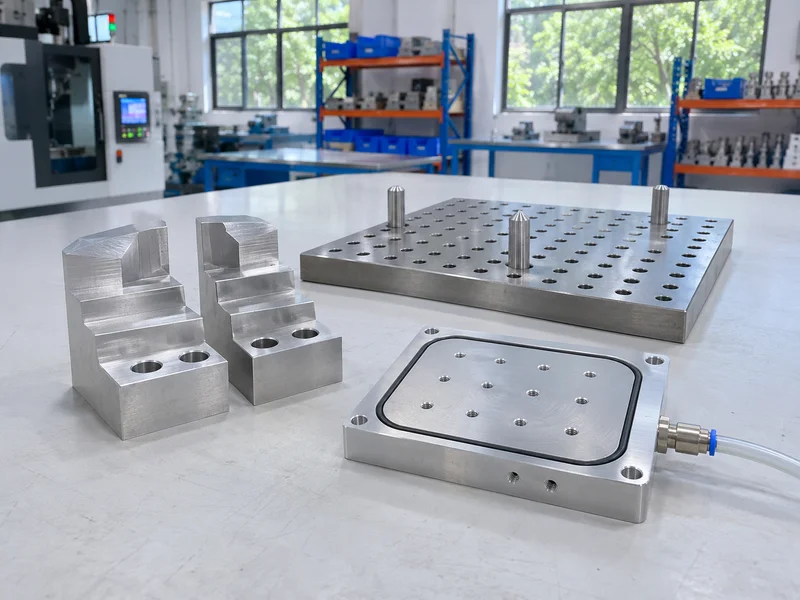
| Fixture type | Best for | Notes |
|---|---|---|
| Vise with hard jaws | Simple prismatic parts | Fast, flexible |
| Vise with soft jaws | Small batches, irregular shapes | Jaws machined to the part |
| Modular fixture plate | Varied parts, small batches | Reusable components |
| Dedicated fixture | Volume, precision parts | Designed for one part |
| Vacuum fixture | Thin plates, plastics | No clamp marks |
| Tombstone / pallet | Multi-part production | Reduces idle time |
| Collet / chuck | Turned parts | Concentric holding |
For example, thin aluminum covers can be held on a vacuum fixture to avoid clamp distortion. Our CNC milling service uses vises, soft jaws, modular and dedicated fixtures.
Key Takeaway: In other words, choose the fixture type by part shape and batch size.
How Should CNC Machining Fixtures Locate Parts?
CNC machining fixtures should locate parts using the 3-2-1 principle on functional datums.
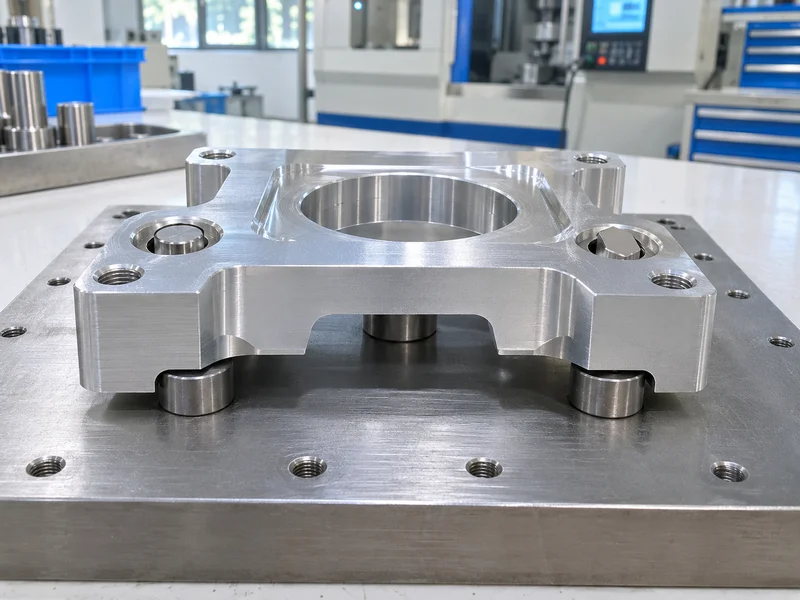
The 3-2-1 principle:
- 3 points on the primary datum face
- 2 points on the secondary face
- 1 point on the tertiary face
Good practice:
- Locate on machined datums after the first operation
- Use pins in functional holes
- Avoid over-constraint that forces parts into position
- Keep locators clean and wear-resistant
For example, a bracket located on its machined bottom face, one dowel hole and one slot is fully constrained without forcing. Our guide to CMM measurement shows the same datums in inspection.
Key Takeaway: For this reason, locate where the part locates in its assembly.
How Do You Clamp Without Distorting the Part?
You clamp without distorting the part by placing clamps over solid supports and using only the force needed.
Methods:
- Clamp over supports, not over unsupported areas
- Limit clamping force on thin walls
- Use soft jaws shaped to the part
- Use vacuum or low-profile clamps for thin parts
- Release and re-clamp lightly for finishing passes
- Support thin walls with fillers or wax where needed
For example, a thin-walled housing clamped hard in a vise may be in tolerance on the machine and out of tolerance after release. Light finishing clamping fixes it. Our guide to tight tolerance machining explains distortion control.
Key Takeaway: Overall, a part measured in the fixture is not the same as a released part.
When Do Dedicated CNC Machining Fixtures Pay Back?
Dedicated CNC machining fixtures pay back when they save more time or scrap than they cost.
Pay-back drivers:
- Higher volumes spread fixture cost
- Multi-part fixtures cut idle time
- Complex parts that are hard to hold in vises
- Tight tolerances that need repeatable location
- Repeat orders that reuse the fixture
For example, a fixture holding eight brackets per cycle can cut handling time sharply on a repeat order of 2,000 parts. Our guide to low-volume CNC machining explains when simpler holding is better.
Key Takeaway: Equally, compare fixture cost with time saved over the expected volume.
How Should CNC Machining Fixtures Be Designed?
CNC machining fixtures should be designed for rigidity, access, fast loading and long life.
Design tips:
- Rigid base and short load paths
- Clear tool access for all operations in the setup
- Chip evacuation paths
- Error-proofing pins to prevent wrong loading
- Hardened or replaceable locators
- Identification with part number and revision
For example, adding a poka-yoke pin that matches an asymmetric feature prevents parts loading backward. Our Dongguan factory uses Siemens NX for fixture and toolpath design.
Key Takeaway: As a rule, design fixtures so operators cannot load parts wrongly.
How Do Fixtures Support Inspection?
Fixtures support inspection by holding parts the same way for measurement as for machining.
Uses:
- Inspection fixtures for CMM or gauges
- Check fixtures with go/no-go features
- Restrained measurement for flexible parts, when the drawing allows
- Repeatability in SPC measurements
For example, a thin plastic part may be measured in a fixture that mimics its assembled state, if the drawing specifies restrained inspection. Our quality control and inspection process uses inspection fixtures where specified. Restrained-condition rules are described in GD&T standards from ISO.
Key Takeaway: Finally, agree whether parts are measured free or restrained.
FAQ
- Q: What are CNC machining fixtures?
- Devices that locate, support and clamp workpieces during machining.
- Q: What is the 3-2-1 locating principle?
- Three points on the primary face, two on the secondary and one on the tertiary to fully locate a part.
- Q: When is a dedicated fixture worth it?
- For higher volumes, complex parts, tight tolerances or repeat orders.
- Q: How do you avoid clamping distortion?
- Clamp over supports, limit force and use soft jaws or vacuum for thin parts.
- Q: What is a soft jaw?
- A machinable vise jaw cut to match the part’s shape.
Conclusion
CNC machining fixtures decide repeatability: locate on functional datums, clamp without distortion and match fixture investment to volume and tolerance. Design them for access and error-proofing, and use them for inspection too. To review fixturing for your part, send your 3D model and 2D drawing to our engineers.