
Chemical Resistance of Plastics: Chart and Stress Cracking
The chemical resistance of plastics decides whether a molded or machined part survives contact with cleaners, fuels, oils, solvents, acids, bases and disinfectants. A plastic can look fine in a chemical compatibility chart and still crack in service, because real parts carry stress, run warm and see chemicals intermittently. For housings, fluid parts, connectors, medical-style devices and automotive components, chemical resistance is often the property that decides the material.
The most common failure is environmental stress cracking, not dissolving. For example, a PC housing wiped daily with an alcohol-based disinfectant may crack around its screw bosses after a few weeks, even though PC is rated as “resistant” to alcohol in a simple immersion chart. In this guide, we explain the chemical resistance of plastics: how plastics are attacked, a practical resistance chart, environmental stress cracking under load, the effect of temperature and molding, how to test resistance and how to specify it. For material families, see our injection molding material selection guide.
The chemical resistance of plastics depends on polymer type, chemical, concentration, temperature, exposure time and stress. Semi-crystalline plastics (PP, PE, PA, POM, PBT, PPS, PEEK) generally resist solvents and fuels better than amorphous plastics (PC, ABS, PMMA, PC/ABS), which are prone to environmental stress cracking (ESC) when stressed and exposed to oils, solvents or cleaners. Acids and bases attack specific chemistries, such as strong acids on POM and PA, and bases on PC. Charts give a starting point, but parts should be tested under realistic stress, temperature and exposure, ideally per ISO 22088 or ASTM D543.
In short: charts shortlist materials; stress, temperature and molding decide real chemical resistance.
Key points:
- Polymer type: semi-crystalline usually resists solvents better.
- ESC: stress plus chemical causes cracking.
- Testing: use real parts, stress and temperature.
How Do Chemicals Attack Plastics?
Chemicals attack plastics in several ways, from swelling to cracking.
Main mechanisms:
- Swelling and softening: solvent absorbed into the polymer
- Dissolution: polymer dissolves in a strong solvent
- Chemical degradation: acids, bases or oxidizers break polymer chains
- Environmental stress cracking (ESC): cracks form under stress with an active chemical
- Extraction: plasticizers or additives leach out
For example, PMMA can crack quickly when exposed to alcohol under stress, while PP simply resists it. Test methods for chemical resistance are published by ASTM International, such as ASTM D543.
Key Takeaway: Above all, cracking under stress is more common than visible dissolving.
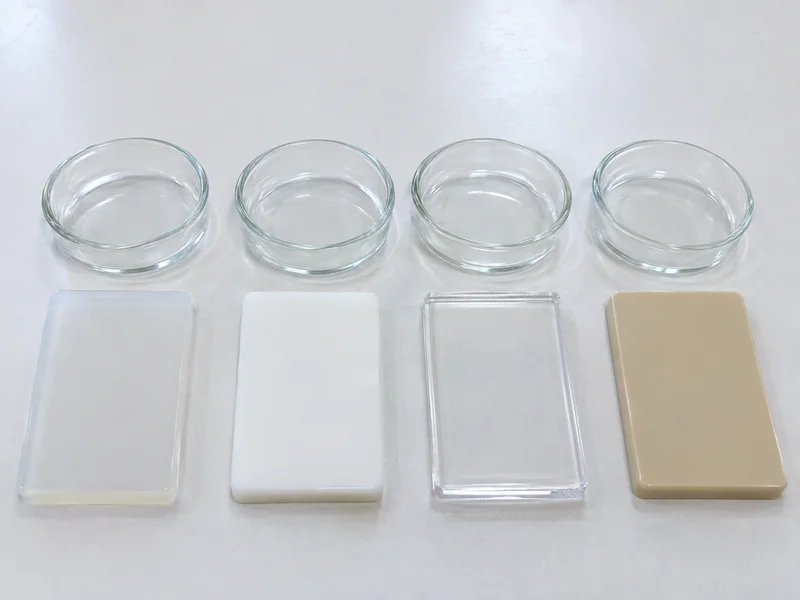
What Does a Chemical Resistance of Plastics Chart Show?
A chemical resistance of plastics chart gives general ratings for common polymers and chemical families (guidance only, at room temperature):
| Plastic | Dilute acids | Strong acids | Bases | Alcohols | Fuels / oils | Aromatic solvents |
|---|---|---|---|---|---|---|
| PP | Good | Fair–good | Good | Good | Fair | Poor |
| HDPE | Good | Good | Good | Good | Fair | Fair |
| PA66 | Fair | Poor | Good | Good | Good | Good |
| POM | Fair | Poor | Good | Good | Very good | Good |
| PBT | Good | Fair | Fair | Good | Good | Fair |
| PC | Good | Fair | Poor | Fair (ESC risk) | Poor–fair (ESC) | Poor |
| ABS | Good | Fair | Good | Fair (ESC) | Fair | Poor |
| PPS | Very good | Good | Very good | Very good | Very good | Good |
| PEEK | Very good | Good | Very good | Very good | Very good | Very good |
For example, POM suits fuel system parts but not strong acids, while PP suits many acids but not aromatic solvents. Our guide to HDPE vs Delrin compares two of these materials.
Key Takeaway: In other words, use charts to shortlist, not to approve.
What Is Environmental Stress Cracking of Plastics Under Load?
Environmental stress cracking of plastics under load is cracking caused by the combined effect of tensile stress and an active chemical.
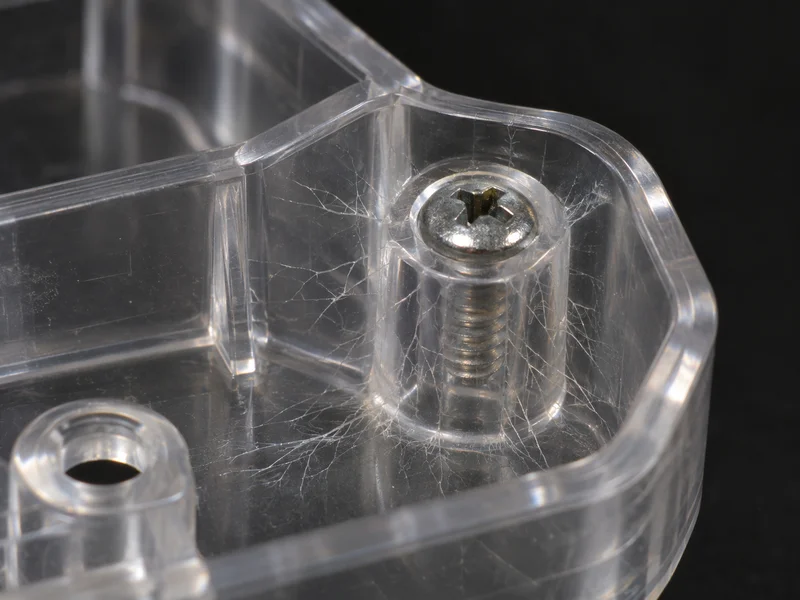
Key facts:
- Stress sources: assembly loads, snap fits, screw bosses, press fits, molded-in stress
- Common agents: oils, greases, alcohols, cleaners, plasticizers, surfactants
- Most sensitive: amorphous plastics such as PC, ABS, PC/ABS, PMMA, PS
- Timing: cracks may appear days or months after exposure
For example, a PC/ABS housing assembled with high screw torque and cleaned with an alcohol wipe may crack at the bosses. Lower torque, larger bosses and a more resistant grade prevent it. Our guide to screw boss design covers boss stresses. ESC test methods are described in ISO 22088 from ISO.
Key Takeaway: For this reason, test chemical resistance under the stresses the part actually carries.
How Do Temperature and Molding Affect the Chemical Resistance of Plastics?
Temperature and molding affect the chemical resistance of plastics because heat accelerates attack and molded-in stress adds to applied stress.
Temperature effects:
- Higher temperature speeds absorption and reactions
- Ratings drop sharply above room temperature
- Thermal cycling adds stress
Molding effects:
- Residual stress near gates and in thin walls
- Weld lines are weak points
- Overpacking increases stress
- Annealing can reduce molded-in stress
For example, a PC part molded with high residual stress near the gate may crack in a cleaner that a well-molded part tolerates. Our guide to injection molding holding pressure explains overpacking.
Key Takeaway: Overall, good molding is part of chemical resistance.
Which Plastics Offer the Best Chemical Resistance?
Plastics with the best chemical resistance are usually semi-crystalline or high-performance polymers.
- PEEK, PPS, PVDF: excellent across most chemicals
- PP and PE: excellent for acids, bases and water, weaker for some solvents and oils
- POM: excellent for fuels and solvents, weak against strong acids
- PA: good for oils and fuels, weak against acids
- PBT: good general resistance
- Amorphous plastics: generally weaker, ESC-sensitive
For example, a pump part handling hot chemicals may need PPS or PEEK, while a detergent bottle part uses PP. Our guide to PEEK 450G machinability covers PEEK parts.
Key Takeaway: Equally, choose the cheapest polymer that passes realistic tests.
How Should the Chemical Resistance of Plastics Be Tested?
The chemical resistance of plastics should be tested on molded parts or specimens under realistic conditions.
Test approaches:
- Immersion tests: weight, dimension and property changes
- Strain jig tests: specimens bent to fixed strain with chemical applied
- Part-level tests: assembled parts exposed to real cleaners or fluids
- Temperature and duration matching service
- Inspection: cracks, crazing, swelling, color change
For example, a medical-style housing may be wiped with the actual disinfectant twice daily for a simulated year while assembled with its screws. Our plastic injection molding service supplies sample parts for such tests.
Key Takeaway: As a rule, test with the actual chemical and the actual assembly stress.
How Should Chemical Resistance Be Specified?
Chemical resistance should be specified with chemicals, conditions and acceptance criteria.
Specification items:
- Chemical names and concentrations
- Exposure type: immersion, splash, wipe, vapor
- Temperature and duration
- Stress state: assembled, strained or free
- Acceptance: no cracks, maximum weight or property change
For example, “No cracking after 7 days at 23 °C with 70% isopropanol wipe twice daily, part assembled at nominal torque” is testable.
Key Takeaway: Finally, specify the real chemical and conditions, not just “chemically resistant”.
FAQ
- Q: Which plastics have the best chemical resistance?
- PEEK, PPS and PVDF overall; PP and PE for acids and bases; POM for fuels and solvents.
- Q: What is environmental stress cracking?
- Cracking caused by stress combined with an active chemical, common in amorphous plastics.
- Q: Is polycarbonate chemically resistant?
- It resists many dilute chemicals but is prone to stress cracking with solvents, oils and some cleaners.
- Q: Does temperature affect chemical resistance?
- Yes. Resistance generally drops as temperature rises.
- Q: How should chemical resistance be tested?
- With the real chemical, temperature and stress, ideally on molded parts.
Conclusion
The chemical resistance of plastics depends on polymer, chemical, temperature and stress. Use charts to shortlist, design and mold to minimize stress, and test real parts with real chemicals. To review material for a chemically exposed part, send your 3D model and 2D drawing to our engineers.