
HDPE vs Delrin: How to Pick the Best One and Save Money
HDPE vs Delrin is a common comparison when choosing a plastic for molded or machined parts that slide, carry loads or contact chemicals. HDPE (high-density polyethylene) is low-cost, tough, chemically resistant and slippery, but relatively soft and dimensionally loose. Delrin, the well-known acetal homopolymer (POM-H), is much stiffer, stronger and more dimensionally stable, with excellent wear and low friction, but it costs more and has weaker resistance to some chemicals.
The choice usually comes down to precision and load versus cost and chemical exposure. For example, a precision gear or snap-fit clip is usually POM, while a chemical tank liner, cutting board or low-load wear strip is often HDPE. In this guide, we compare HDPE vs Delrin: properties, strength and stiffness, wear and friction, chemical resistance, molding and machining behavior, cost and how to choose for HDPE vs POM injection molded parts. For acetal grades, see our guide to acetal homopolymer vs copolymer.
HDPE vs Delrin: HDPE has lower density (about 0.95 g/cm³), lower stiffness (about 0.8–1.5 GPa) and tensile strength (about 20–30 MPa), excellent impact toughness, very good chemical and moisture resistance and low cost, but high shrinkage and creep. Delrin (POM homopolymer) has higher density (about 1.41 g/cm³), much higher stiffness (about 3 GPa) and strength (about 65–70 MPa), excellent fatigue, wear and low friction, and good dimensional stability, but it is attacked by strong acids and some oxidizers and costs more. Choose Delrin for precision mechanical parts; HDPE for low-cost, chemically exposed or low-load parts.
In short: Delrin for stiffness, precision and wear; HDPE for chemicals, impact and low cost.
Key points:
- Stiffness: Delrin is roughly two to three times stiffer.
- Chemicals: HDPE resists acids better.
- Precision: Delrin holds tolerances far better.
What Is the Difference Between HDPE vs Delrin?
The difference between HDPE vs Delrin starts with their polymer families.
| Property (typical) | HDPE | Delrin (POM-H) |
|---|---|---|
| Density | ~0.95 g/cm³ | ~1.41 g/cm³ |
| Tensile strength | ~20–30 MPa | ~65–70 MPa |
| Flexural modulus | ~0.8–1.5 GPa | ~2.9–3.1 GPa |
| Continuous use temperature | ~80 °C | ~90–100 °C |
| Moisture absorption | Very low | Low |
| Mold shrinkage | ~1.5–3% | ~1.8–2.2% |
| Relative cost | Low | Medium |
Values vary by grade. Plastic property test methods are published by ASTM International.
Key Takeaway: Above all, Delrin is a stiff engineering plastic; HDPE is a tough commodity plastic.
How Do HDPE vs Delrin Compare in Strength and Stiffness?
HDPE vs Delrin compare very differently in strength and stiffness.
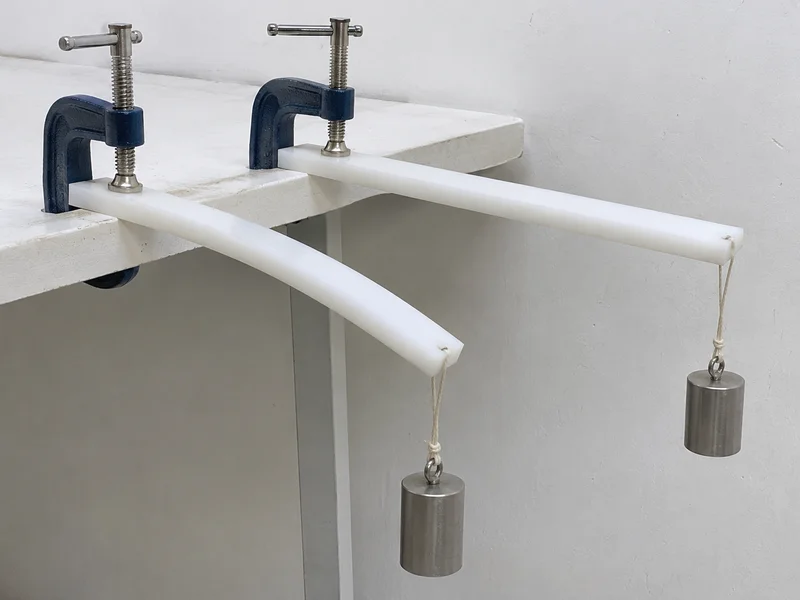
- Delrin: high stiffness and strength; holds shape under load.
- HDPE: flexible, bends rather than breaks.
- Creep: HDPE creeps much more under sustained load.
- Fatigue: Delrin has excellent fatigue resistance for springs and clips.
- Impact: HDPE is extremely tough; Delrin is tough but notch sensitive.
For example, a snap-fit clip that must keep its force over years is better in POM, because HDPE would relax. Our guide to creep deformation explains long-term behavior.
Key Takeaway: In other words, load-bearing precision parts favor Delrin.
How Do Wear and Friction Compare?
Wear and friction compare well for both, but in different applications.
- Delrin: low friction, excellent wear against steel, good for gears, bushings and slides.
- HDPE: low friction, good abrasion resistance at low loads; UHMW-PE is better still for abrasive wear.
- Speed and load: Delrin handles higher PV (pressure × velocity) values.
- Noise: POM gears run quietly when well designed.
For example, a small POM gear train in an appliance outperforms HDPE, while an HDPE or UHMW chute liner handles abrasive bulk material better. Our guide to POM injection molding covers gear design.
Key Takeaway: For this reason, choose Delrin for loaded sliding parts and PE for low-load abrasion.
How Does Chemical Resistance Compare?
Chemical resistance compares differently by chemical class.
| Chemical type | HDPE | Delrin (POM) |
|---|---|---|
| Strong acids | Good | Poor |
| Bases | Good | Good (copolymer better) |
| Fuels and oils | Fair | Very good |
| Solvents | Good for many | Good for many |
| Chlorine / oxidizers | Fair | Poor |
| Water and moisture | Excellent | Very good |
For example, a part exposed to dilute acid suits HDPE, while a fuel system part suits POM. Our injection molding material selection guide covers chemical exposure in material choice.
Key Takeaway: Overall, check the specific chemical, concentration and temperature for either material.
How Do HDPE vs POM Injection Molded Parts Compare?
HDPE vs POM injection molded parts compare differently in tolerances, design rules and processing.
- Shrinkage: HDPE shrinkage is high and variable; tolerances are wider.
- Warpage: HDPE warps more on flat parts.
- Snap fits: POM holds snap force; HDPE flexes easily.
- Living hinges: PE can form hinges; POM generally cannot.
- Processing: POM needs careful temperature control and venting to avoid degradation.
For example, a precise POM bushing can hold a tight bore, while an HDPE cap is designed with generous tolerances. We mold POM routinely; PE projects are reviewed case by case, with grade and process confirmed per project. Our guide to polyethylene injection molding covers PE design.
Key Takeaway: Equally, plan wider tolerances for HDPE molded parts.
How Do HDPE vs Delrin Compare in Machining?
HDPE vs Delrin compare in machining by stability and surface finish.
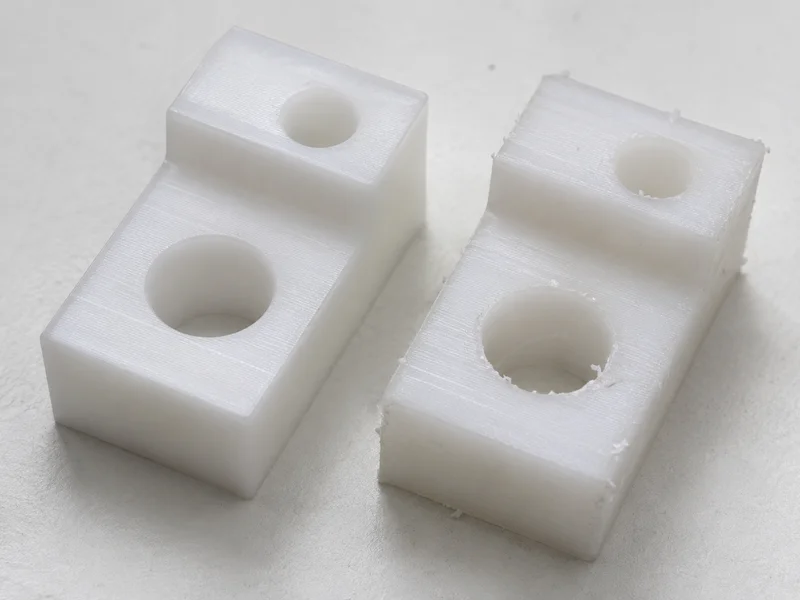
- Delrin: one of the best plastics to machine; crisp edges, stable dimensions.
- HDPE: cuts easily but is stringy, burrs and moves with temperature.
- Tolerances: Delrin holds much tighter tolerances.
- Finish: Delrin gives smooth, clean surfaces.
For example, a machined POM manifold block can hold fine bores, while an HDPE block needs looser tolerances and deburring. Our guide to machining acetal explains POM machining.
Key Takeaway: As a rule, machine precision plastic parts from POM, not HDPE.
How Do You Choose Between HDPE and Delrin?
You choose between HDPE and Delrin by load, precision, chemicals and cost.
Decision guide:
- Gears, bushings, clips, precision parts → Delrin
- Chemical containers, liners, low-load parts → HDPE
- Cost-sensitive, large simple parts → HDPE
- Fuel and oil contact → Delrin
- Acid contact → HDPE
- Sustained load → Delrin
For example, a sliding guide in a packaging machine under moderate load is usually POM, while a guard plate exposed to washdown acids may be HDPE. Our CNC machining services machine POM, nylon and PEEK parts to drawing.
Key Takeaway: Finally, write the exact grade on the drawing, such as POM-H or a specific HDPE grade.
FAQ
- Q: What is the difference between HDPE and Delrin?
- Delrin (POM) is stiffer, stronger and more stable; HDPE is tougher, cheaper and more chemically resistant.
- Q: Is Delrin stronger than HDPE?
- Yes, roughly two to three times stronger and stiffer.
- Q: Which is better for gears?
- Delrin, for its stiffness, fatigue resistance and low wear.
- Q: Which resists acids better?
- HDPE resists strong acids better than POM.
- Q: Which is easier to machine to tight tolerances?
- Delrin.
Conclusion
HDPE vs Delrin comes down to load and precision versus chemicals and cost. Use Delrin for stiff, precise, wear-resistant parts and HDPE for tough, chemically exposed, low-cost parts, and specify the exact grade. To review material for your part, send your 3D model and 2D drawing to our engineers.