
Wire EDM: How It Works, Accuracy and Design Tips
Wire EDM (wire electrical discharge machining) cuts conductive metal with a thin, electrically charged wire that never touches the part. Sparks between the wire and the workpiece erode material along a programmed path, so wire EDM can cut hardened tool steel, carbide and other hard metals into precise profiles, sharp internal corners and narrow slots that milling cannot reach. It is a core process for mold inserts, punches, dies, gauges and small precision parts.
Wire EDM is precise but slow, so it pays to use it where it adds value. For example, a hardened ejector plate pocket with sharp inside corners is a natural wire EDM job, while a simple aluminum bracket is not. In this guide, we explain wire EDM: how it works, what it does well, achievable accuracy and finish, materials, design rules, cost drivers and how it compares with sinker EDM and milling. For the related process, see our guide to sinker EDM.
Wire EDM cuts electrically conductive materials using a continuously fed brass or coated wire (typically 0.1–0.3 mm diameter) as an electrode in deionized water. It machines hardened steels, carbide and exotic alloys without cutting forces, producing through-profiles, sharp internal corners (limited by wire radius plus spark gap), narrow slots and tapers. Multiple skim passes improve accuracy and finish; process capability can reach a few microns, with surface finishes around Ra 0.2–0.8 µm after skim cuts. It needs a start hole for internal profiles and is slower than milling for bulk removal.
In short: use wire EDM for hard materials, precise through-profiles and sharp corners; mill everything else.
Key points:
- No cutting force: thin, hard and delicate parts stay accurate.
- Hard materials: hardened steel and carbide cut directly.
- Through-features only: the wire must pass through the part.
How Does Wire EDM Work?
Wire EDM works by eroding metal with controlled electrical sparks between a moving wire and the workpiece.
Process basics:
- Wire electrode: brass or coated wire, fed continuously from a spool
- Dielectric: deionized water flushes debris and controls sparking
- Spark gap: a small gap is kept between wire and part
- CNC path: the wire follows the programmed contour
- Skim cuts: follow-up passes improve accuracy and finish
For example, a punch profile is cut with a roughing pass and then two or three skim passes to reach final size and finish. Our Dongguan factory uses Makino wire EDM machines for mold and tooling work.
Key Takeaway: Above all, wire EDM removes metal by sparks, not by force.
What Is Wire EDM Best Used For?
Wire EDM is best used for features that are hard to mill accurately or impossible to mill at all.
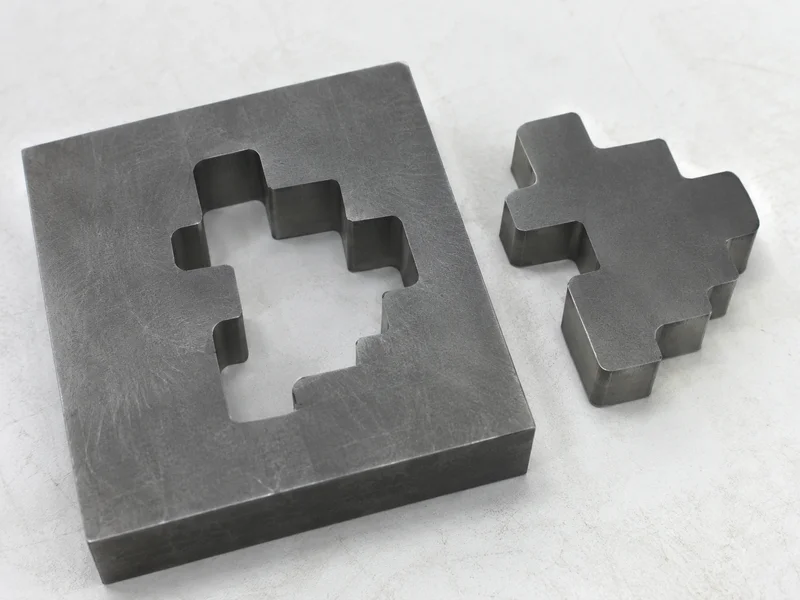
Typical uses:
- Hardened mold inserts and core pins
- Punches, dies and stripper plates
- Sharp internal corners in pockets and slots
- Narrow slots and thin ribs
- Gauges and fixtures with precise profiles
- Carbide and exotic alloys
For example, a hardened H13 cavity insert with a rectangular through-opening can be cut after heat treatment, avoiding distortion from hardening. Our guide to injection mold steel material explains common insert steels.
Key Takeaway: In other words, wire EDM shines on hard, precise, through-profile features.
How Accurate Is the Wire-Cut Process?
Wire EDM is very accurate, but finished-part accuracy depends on the part, material and number of passes.
Typical capabilities:
- Process capability: a few microns with multiple skim passes
- Surface finish: about Ra 0.2–0.8 µm after skim cuts; rougher after a single pass
- Corner radius: at least wire radius plus spark gap
- Taper cutting: possible with angled wire guides
Our Makino wire EDM process capability is ±0.003 mm, but machine capability is not finished-part tolerance; finished tolerances depend on thickness, material and setup and are confirmed per drawing. Our guide to tight tolerance machining explains how tolerances are placed.
Key Takeaway: For this reason, specify tight tolerances only where the profile truly needs them.
Which Materials Can Wire EDM Cut?
Wire EDM can cut any electrically conductive material, regardless of hardness.
- Tool steels: H13, S136, D2, SKD11, hardened or soft
- Stainless steels
- Carbide
- Titanium and nickel alloys
- Copper, brass and aluminum
- Graphite
Not suitable:
- Plastics, ceramics and glass (non-conductive)
For example, a D2 punch hardened to 60 HRC can be cut directly, which milling would struggle with. Our guide to how to choose mold steel covers tool steel choice.
Key Takeaway: Overall, conductivity matters, not hardness.
How Should Parts Be Designed for Wire EDM?
Parts should be designed for wire EDM with through-features, start holes and realistic corner radii.
Design rules:
- Through-features: the wire must pass completely through
- Start holes for internal profiles, drilled or EDM-drilled
- Internal corner radius at least about 0.1–0.2 mm, depending on wire
- Thickness: thicker parts cut more slowly
- Recast layer: allow for removal on critical surfaces if needed
For example, a die opening with a 0.15 mm internal radius suits a 0.2 mm wire; a perfectly sharp corner is not possible. Our engineering and DFM review checks EDM features.
Key Takeaway: Equally, add start holes and allow small radii on internal corners.
What Drives Wire-Cut Part Cost?
Wire EDM cost is driven by cutting length, thickness, number of skim passes and setup.
Cost drivers:
- Perimeter length of the profile
- Part thickness
- Skim passes for accuracy and finish
- Start holes and threading the wire
- Material conductivity and hardness
- Setup and fixturing
For example, a 50 mm thick profile with three skim passes takes far longer than a 10 mm thick profile with one pass. Our guide to CNC machining cost for custom parts explains general cost drivers.
Key Takeaway: As a rule, request extra skim passes only on surfaces that need them.
How Does Wire EDM Compare With Sinker EDM and Milling?
Wire EDM compares with sinker EDM and milling by the shapes and materials each handles best.
| Process | Best for | Limits |
|---|---|---|
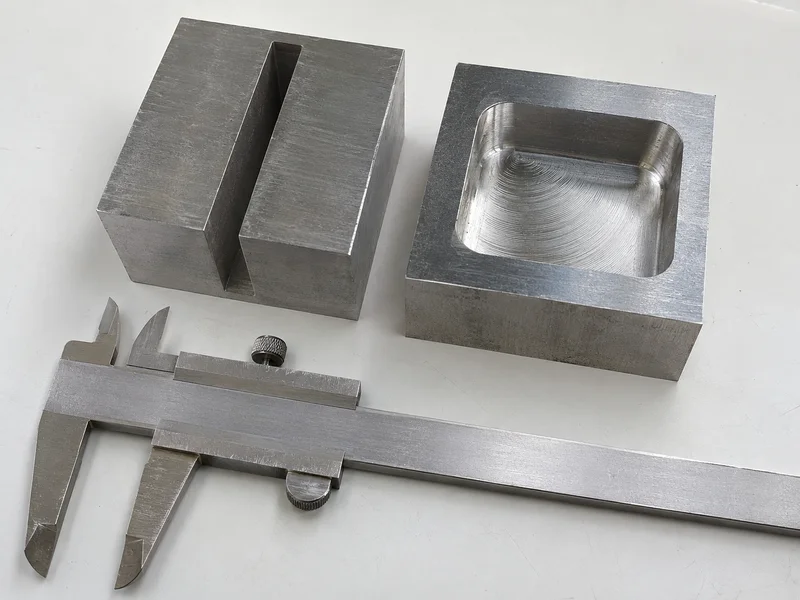
| Wire EDM | Through-profiles, sharp corners, hard metals | Through-features only, slower |
| Sinker EDM | Blind cavities, ribs, textures in hard steel | Needs electrodes |
| Milling | Fast removal, most features | Hard materials and sharp corners |
For example, a mold insert may be milled to near shape, hardened, wire cut for its through-openings and sinker EDM’d for blind ribs. Our CNC machining services include wire and sinker EDM. EDM terminology is also described in standards from ISO.
Key Takeaway: Finally, combine processes so each feature uses the most efficient one.
FAQ
- Q: What is wire EDM?
- A process that cuts conductive metal with a thin wire electrode using electrical sparks.
- Q: How accurate is wire EDM?
- Process capability can reach a few microns with skim passes; finished tolerances depend on the part.
- Q: Can wire EDM cut hardened steel?
- Yes. Hardness does not matter, only electrical conductivity.
- Q: Can wire EDM make blind pockets?
- No. It needs through-features; sinker EDM makes blind cavities.
- Q: Why is wire EDM slower than milling?
- It removes material by sparks, so bulk removal is slower; it is used for precise profiles.
Conclusion
Wire EDM cuts hard, conductive materials into precise through-profiles and sharp corners without cutting forces. Use it where it adds value, design with start holes and small radii, and combine it with milling and sinker EDM. To review a precision part, send your 3D model and 2D drawing to our engineers.