
Knurling: Patterns, Form vs Cut and Pitch Selection
Knurling creates a regular pattern of ridges on a turned surface, usually to give fingers or tools a better grip or to create a press-fit surface for inserts. Knobs, thumb screws, adjustment rings, tool handles, threaded inserts and instrument parts often carry a knurl. It looks simple, but pitch, pattern, diameter and the knurling method decide whether the result is crisp and consistent or torn and uneven.
Knurling problems usually come from the wrong pitch for the diameter or the wrong method for the material. For example, a fine diamond knurl on a small brass knob may double-track and look blurred if the circumference does not suit the pitch, while a slightly different blank diameter gives a clean pattern. In this guide, we explain knurling: types and patterns, form vs cut knurling, pitch and diameter selection, materials, knurling for press fits and inserts, and how to specify knurls on drawings. For turned parts in general, see our guide to high precision CNC turning.
Knurling produces straight, diagonal or diamond patterns on cylindrical surfaces by either forming (pressing hardened wheels into the material, which displaces it and increases diameter) or cutting (removing material with sharp knurl wheels, with little diameter growth). Pattern pitch is chosen for the diameter and grip, commonly about 0.5–1.5 mm. To avoid double tracking, the blank circumference should suit the pitch. Soft, ductile materials such as brass, aluminum and mild steel knurl well; hard or brittle materials are harder. Drawings should state pattern, pitch, standard (such as DIN 82), length and diameter before and after knurling.
In short: choose pattern and pitch for the job, match blank diameter to pitch, and specify the knurl fully on the drawing.
Key points:
- Patterns: straight, diagonal, diamond.
- Methods: form knurling grows diameter; cut knurling does not much.
- Diameter: must suit the pitch to avoid double tracking.
What Is Knurling?
Knurling is a machining process that creates a textured pattern of ridges on a round surface.
Main purposes:
- Grip on knobs, handles and thumb screws
- Press fits for inserts, pins and plastic overmolding
- Retention of plastic or rubber parts on shafts
- Appearance on consumer and instrument parts
For example, brass threaded inserts for plastic parts are knurled so the plastic locks into the pattern. Our guide to the insert molding process explains insert retention.
Key Takeaway: Above all, a knurl adds grip or retention to round parts.
Which Knurling Patterns Are Common?
Knurling patterns are named by their ridge direction and shape.
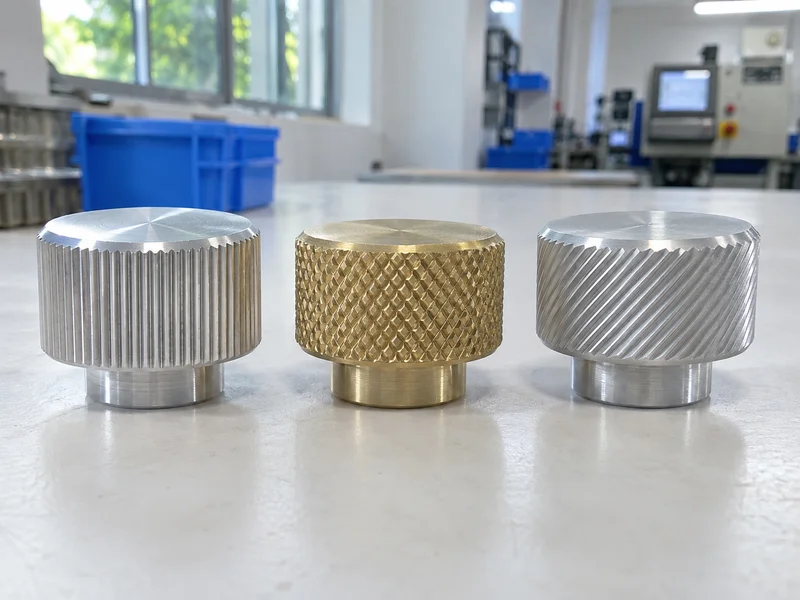
| Pattern (DIN 82 code) | Description | Typical uses |
|---|---|---|
| Straight (RAA) | Ridges parallel to axis | Press fits, torque resistance |
| Diagonal left/right (RBL, RBR) | Angled ridges | Grip, decorative |
| Diamond male (RGE) | Raised pyramids | Grip on knobs and handles |
| Diamond female (RGV) | Recessed pyramids | Grip, smoother feel |
| Crossed (RKE, RKV) | Crossed straight ridges | Grip |
For example, a straight knurl resists rotation of a pressed-in insert, while a diamond knurl gives better finger grip on a knob. Knurl profiles are standardized in DIN 82, published through DIN.
Key Takeaway: In other words, pick straight knurls for torque and diamond knurls for grip.
What Is the Difference Between Form and Cut Knurling?
The difference between form and cut knurling is whether material is displaced or removed.
- Form knurling: hardened wheels press into the surface; diameter grows; high forces; works well on ductile materials.
- Cut knurling: sharp wheels cut the pattern; little diameter change; lower forces; better for CNC lathes, thin walls and harder materials.
For example, a thin-walled aluminum sleeve may deform under form knurling but knurl cleanly with a cut knurling tool. Our CNC turning service uses both methods depending on part and material.
Key Takeaway: For this reason, use cut knurling for thin walls and tight diameters.
How Do You Choose Knurling Pitch and Diameter?
You choose knurling pitch and diameter so the pattern tracks cleanly around the circumference.
Guidelines:
- Pitch: about 0.5–0.8 mm for small parts, 1.0–1.5 mm for larger grips
- Tracking: circumference should be close to a whole number of pitches
- Form growth: allow for diameter increase, roughly half the pitch depth
- Width: keep knurl length reasonable to avoid wandering
For example, if a 10 mm blank with 0.8 mm pitch double-tracks, adjusting the blank diameter by a few hundredths of a millimeter can produce a clean single-track pattern. Our guide to design for CNC machining covers turned-feature design.
Key Takeaway: Overall, specify the finished knurl diameter and let the machinist adjust the blank.
Which Materials Knurl Best?
Materials that knurl best are ductile and consistent.
- Brass: excellent, crisp patterns
- Aluminum: good, watch for tearing on soft grades
- Mild and free-cutting steel: good
- Stainless steel: possible, needs the cut method or strong setups
- Plastics: the cut method for POM and nylon
- Hardened steel: knurl before hardening
For example, a 303 stainless thumb screw knurls well with a cut knurl tool, while 304 may work-harden and tear. Our guide to brass material composition explains why brass machines so cleanly.
Key Takeaway: Equally, knurl hardened parts before heat treatment.
How Are Knurled Surfaces Used for Press Fits and Inserts?
Knurled surfaces are used for press fits and inserts because the ridges bite into the mating material.
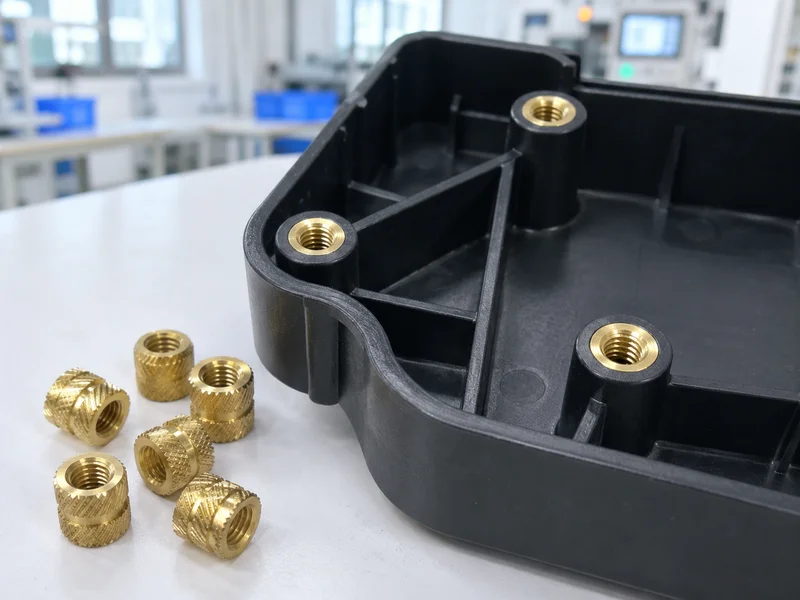
Uses:
- Metal inserts in plastic: knurls lock against pull and torque
- Pins in plastic or soft metal: straight knurls resist rotation
- Overmolded shafts: knurls retain the plastic
Design points:
- Straight knurl for torque resistance
- Groove or undercut added for pull-out resistance
- Controlled knurl diameter for consistent interference
For example, a knurled steel pin pressed into a PA66 housing resists rotation better than a plain pin. Our guide to plastic threaded inserts explains insert retention.
Key Takeaway: As a rule, combine knurls with a groove when inserts must resist both torque and pull.
How Should Knurling Be Specified on Drawings?
Knurling should be specified on drawings with pattern, pitch, standard and diameters.
Specification items:
- Pattern, such as diamond male
- Pitch, such as 0.8 mm
- Standard, such as DIN 82 RGE 0.8
- Knurl length
- Diameter before and/or after texturing
- Chamfers at knurl ends
For example, “Knurl DIN 82-RGE 0.8, length 12, Ø after knurling 15.6–15.8” is clear. Our quality control and inspection process checks knurl diameter and appearance when specified.
Key Takeaway: Finally, always state whether the diameter is before or after the knurl is rolled.
FAQ
- Q: What is knurling?
- A process that creates a ridged pattern on a round surface for grip or retention.
- Q: What is the difference between form and cut knurling?
- Form knurling displaces material and grows the diameter; cut knurling removes material.
- Q: What causes double tracking in knurling?
- A blank circumference that does not match the knurl pitch.
- Q: Which knurl pattern gives the best grip?
- Diamond patterns usually give the best finger grip.
- Q: Why are inserts knurled?
- Knurls lock inserts into plastic against torque and pull-out.
Conclusion
Knurling adds grip and retention when pattern, pitch, method and diameter are chosen together. Use cut knurling for thin walls, straight knurls for torque and diamond knurls for grip, and specify the knurl fully on the drawing. To review a turned part, send your 3D model and 2D drawing to our engineers.