
Plastic Threaded Inserts: Types, Installation and Bosses
Plastic threaded inserts are metal bushings with internal threads that are installed in molded or machined plastic parts, so screws can be assembled, removed and reassembled without stripping the plastic. Brass is the most common insert material, and inserts can be molded in, heat staked, ultrasonically installed, pressed or self-tapped. For housings, covers, enclosures and electronic assemblies, they are often the difference between a joint that survives service and one that fails at the second disassembly.
Choosing the insert and installation method together is what makes the joint reliable. For example, a heat-set brass insert in a PC/ABS boss can give strong, repeatable threads, but the same insert pressed into a glass-filled PA66 boss with too little wall may crack it. In this guide, we explain plastic threaded inserts: types, installation methods, boss design, materials, performance testing and how to specify them. For direct screwing into plastic, see our guide to the screw boss.
Plastic threaded inserts are knurled or ribbed metal bushings, usually brass, stainless steel or aluminum, with internal threads for machine screws. They are installed by molding in, heat staking (thermal insertion), ultrasonic insertion, pressing or self-tapping. Molded-in inserts give the highest retention; heat-set and ultrasonic inserts give strong retention at low tooling cost; press-in inserts are fastest but weaker. Boss design must give enough wall thickness and the correct hole size for the insert type. Performance is verified by pull-out, torque-out and jack-out tests.
In short: use inserts where screws must hold torque or be reassembled, and match the installation method to the plastic and volume.
Key points:
- Purpose: durable, reusable metal threads in plastic.
- Methods: molded-in, heat-set, ultrasonic, press-in, self-tapping.
- Boss design: wall thickness and hole size decide reliability.
Why Use Plastic Threaded Inserts?
Plastic threaded inserts are used because plastic threads wear, creep and strip under repeated assembly and torque.
Benefits:
- Reusable threads for service and maintenance
- Higher torque and clamp load
- Less creep under sustained load
- Standard machine screws instead of thread-forming screws
- Electrical grounding when metal contact is needed
For example, a battery cover removed many times over a product’s life needs inserts, while a permanently closed housing may use thread-forming screws. Our guide to creep deformation explains preload loss in plastic.
Key Takeaway: Above all, use inserts where joints are reassembled or carry high torque.
Which Types of Plastic Threaded Inserts Exist?
Types of plastic threaded inserts differ by how they are installed.
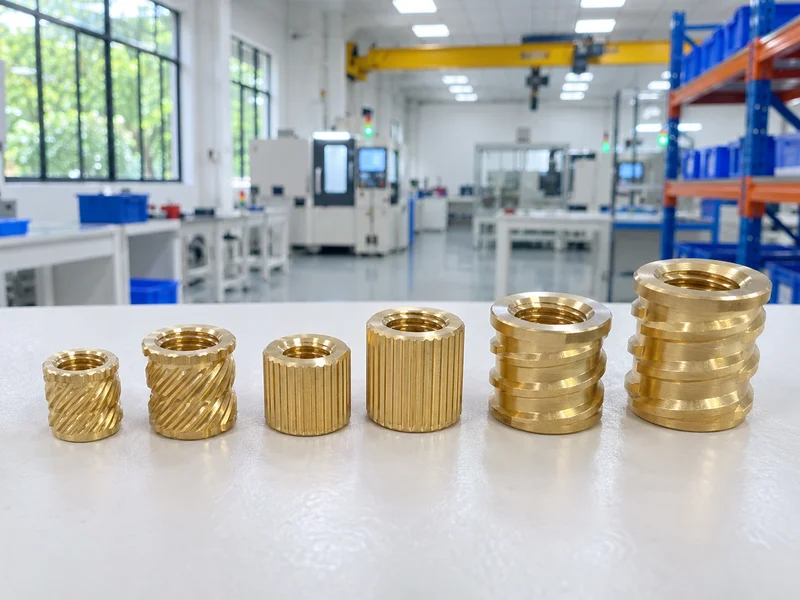
| Insert type | Installation | Retention | Typical use |
|---|---|---|---|
| Molded-in | Loaded into mold before injection | Highest | Critical joints, high volume |
| Heat-set | Heated and pressed into a hole | High | Thermoplastics, medium volume |
| Ultrasonic | Vibrated into a hole | High | Fast assembly, amorphous resins |
| Press-in | Pressed cold | Moderate | Low loads, fast assembly |
| Self-tapping | Screwed in, cuts its own thread | Moderate–high | Machined or molded holes |
For example, a molded-in brass insert suits a high-volume connector housing, while heat-set inserts suit a medium-volume enclosure. Our guide to the insert molding process covers molded-in inserts.
Key Takeaway: In other words, molded-in gives the best retention; heat-set is a strong, flexible alternative.
How Are Heat-Set and Ultrasonic Inserts Installed?
Heat-set and ultrasonic inserts are installed by softening the plastic around the insert so it flows into the knurls.
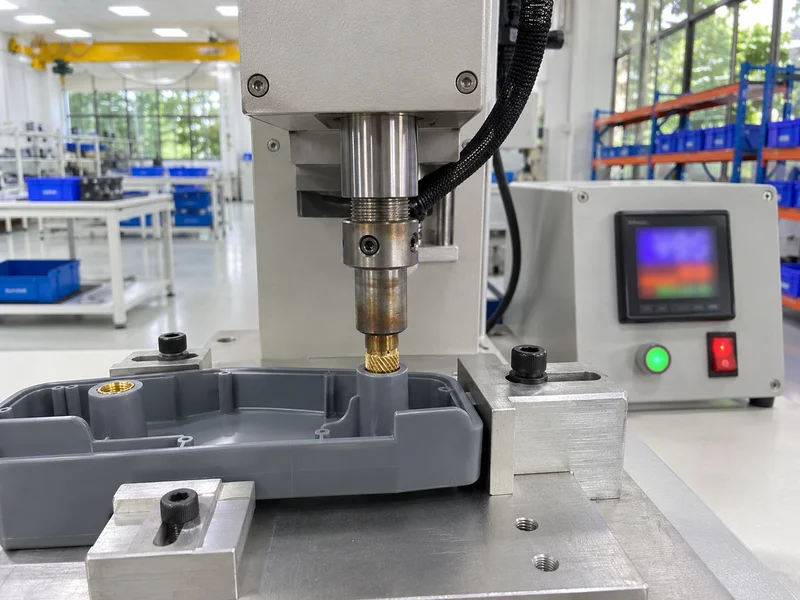
Heat-set installation:
- Heated tip brings the insert to plastic softening temperature
- Controlled press-in to depth
- Plastic flows into knurls and grooves and solidifies
Ultrasonic installation:
- Ultrasonic horn vibrates the insert
- Friction heat melts the plastic locally
- Fast cycle, best for amorphous resins
For example, heat-set inserts in PC/ABS bosses can be installed on a semi-automatic press with controlled temperature and depth. Our guide to heat staking plastic explains thermal tools, and ultrasonic welding plastic covers ultrasonic equipment.
Key Takeaway: For this reason, control temperature, force and depth for consistent heat-set inserts.
How Should Bosses Be Designed for Plastic Threaded Inserts?
Bosses for plastic threaded inserts should be designed with the right hole size, wall thickness and support.
Design rules:
- Hole size per the insert maker’s recommendation
- Wall thickness around about 0.5–1 × insert outer diameter
- Hole depth longer than the insert to collect displaced plastic
- Ribs or gussets to support tall bosses
- Avoid weld lines at boss walls
For example, a boss with a thin wall in glass-filled PA66 may crack during heat-set insertion; thickening the wall and adding gussets prevents it. Our guide to injection molding wall thickness explains wall design.
Key Takeaway: Overall, boss wall and hole size matter more than insert price.
Which Plastics Work With Threaded Inserts?
Most thermoplastics work with threaded inserts, but behavior varies.
- ABS, PC, PC/ABS: excellent for heat-set and ultrasonic
- PA6, PA66 (incl. glass-filled): good; watch cracking and moisture
- PBT: good; controlled temperature
- PP and PE: lower retention; molded-in or special inserts preferred
- POM: good machining for self-tapping inserts
- Thermosets (BMC): molded-in or adhesive-bonded inserts
For example, BMC electrical parts typically use molded-in brass inserts.
Key Takeaway: Equally, test the insert in the production resin, not a substitute.
How Are Plastic Threaded Inserts Tested?
Plastic threaded inserts are tested for pull-out, torque-out and jack-out strength.
Tests:
- Pull-out: axial force to extract the insert
- Torque-out: torque to spin the insert in the plastic
- Jack-out: force from screw tightening against the insert flange
- Thermal cycling before testing when required
- Visual checks for cracks around the boss
For example, a requirement of 2 N·m torque-out and 400 N pull-out can be verified on samples from each mold cavity. Fastener test methods are published by ASTM International.
Key Takeaway: As a rule, test inserts after the same aging the product will see.
How Should Plastic Threaded Inserts Be Specified?
Plastic threaded inserts should be specified with type, thread, material, installation and test values.
Specification items:
- Insert type and part number or dimensions
- Thread size and class, such as M4 6H
- Insert material and finish, such as brass, lead-free
- Installation method and depth
- Performance requirements: pull-out, torque-out
- Thread gauge check after installation
For example, “M3 brass heat-set insert, flush to +0.1 mm, torque-out ≥1.5 N·m, gauge M3 6H after installation” is complete. Our quality control and inspection process records insert tests when specified.
Key Takeaway: Finally, include installation depth and test values, not just the insert part number.
FAQ
- Q: What are plastic threaded inserts?
- Metal bushings with internal threads installed in plastic parts for durable screw joints.
- Q: Which insert type is strongest?
- Molded-in inserts usually give the highest retention.
- Q: How are heat-set inserts installed?
- A heated tip presses the insert into a hole so the softened plastic flows into its knurls.
- Q: What wall thickness does a boss need for inserts?
- Often about 0.5–1 times the insert outer diameter, per the insert maker.
- Q: How are inserts tested?
- With pull-out, torque-out and jack-out tests.
Conclusion
Plastic threaded inserts make screw joints in plastic durable and reusable when the insert type, installation method and boss design are chosen together and verified by testing. To review threaded joints in your part, send your 3D model and 2D drawing to our engineers.