
Chamfer vs Fillet: How to Pick the Best One
Chamfer vs fillet is one of the most common small decisions on a machined or molded part drawing. A chamfer is an angled cut across an edge, usually 45°, while a fillet is a rounded edge with a radius. Both remove sharp edges, but they behave differently for assembly, stress, cost, appearance and safety, and the wrong choice can add machining time or weaken a part.
Designers often pick one by habit. For example, specifying external fillets on every edge of a milled aluminum block may require ball or corner-rounding tools on each edge, while 0.5 × 45° chamfers can be cut quickly with one chamfer mill. In this guide, we compare chamfer vs fillet: what each is, how they affect stress, assembly, machining cost and appearance, how molded parts differ, and how to choose and specify them. For edge breaks, see our guide to deburring.
Chamfer vs fillet: a chamfer is a flat, angled edge (commonly 45°) that guides assembly, removes sharp edges and is quick to machine with a chamfer mill or turning tool. A fillet is a rounded edge or corner that spreads stress, improves fatigue life, feels smoother and flows better in molded parts. For machined external edges, chamfers are usually cheaper; for internal corners and stressed transitions, fillets are stronger. Molded parts generally favor radii for flow and strength. Specify size, angle or radius, and use general edge notes for non-functional edges.
In short: chamfer for assembly and economical edge breaks; fillet for strength, flow and feel.
Key points:
- Chamfer: flat angled edge, easy lead-in.
- Fillet: rounded edge, lower stress concentration.
- Cost: chamfers usually cheaper on machined external edges.
What Is the Difference Between Chamfer vs Fillet?
The difference between chamfer vs fillet is the edge shape: flat and angled versus rounded.
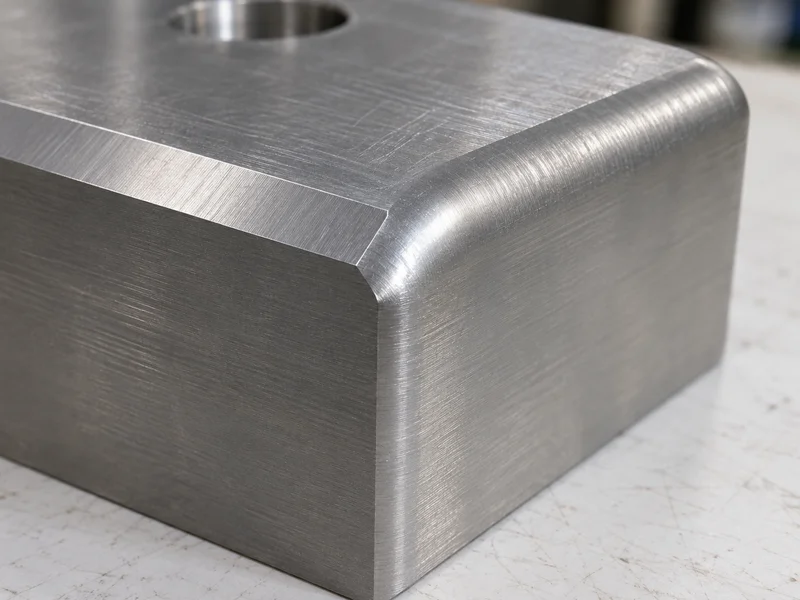
| Feature | Chamfer | Fillet |
|---|---|---|
| Shape | Flat bevel, often 45° | Circular radius |
| Callout | 1 × 45°, C1 | R1 |
| Stress concentration | Higher than fillet | Lower |
| Assembly lead-in | Excellent | Good |
| Machining (external) | Fast, one tool | Needs radius tool |
| Internal corners | Rare | Natural in milling |
For example, a bore that receives a pin usually gets a chamfer for lead-in, while a shaft shoulder under bending gets a fillet. Edge conditions can be specified with ISO 13715 symbols.
Key Takeaway: Above all, chamfers guide; fillets spread stress.
Chamfer vs Fillet: When Should You Choose a Chamfer?
You should choose a chamfer when an edge must guide assembly, break sharpness cheaply or provide a seal lead-in.
Typical uses:
- Hole entries for pins, bolts and bearings
- Shaft ends for easy insertion
- O-ring lead-ins to avoid cutting seals
- Thread starts
- Outer edges that need safe handling
- Weld preparations
For example, a 15–20° lead-in chamfer on a bore protects an O-ring during assembly. Our guide to threaded holes explains thread chamfers.
Key Takeaway: In other words, chamfers are the assembly-friendly edge.
When Should You Choose a Fillet?
You should choose a fillet when an edge or corner carries stress, needs a smooth feel or must suit a molding process.
Typical uses:
- Shaft shoulders under bending or torsion
- Internal corners of pockets (naturally from end mills)
- Rib roots and boss bases in molded parts
- Hand-held edges that need a soft feel
- Cosmetic edges on consumer parts
For example, a stepped shaft with a sharp shoulder can crack under cyclic load, while a 1 mm fillet improves fatigue life. Our guide to keyway design explains stress at shaft features.
Key Takeaway: For this reason, use fillets wherever stress concentrates.
How Do Chamfer vs Fillet Affect Machining Cost?
Chamfer vs fillet affect machining cost through tool choice and programming.
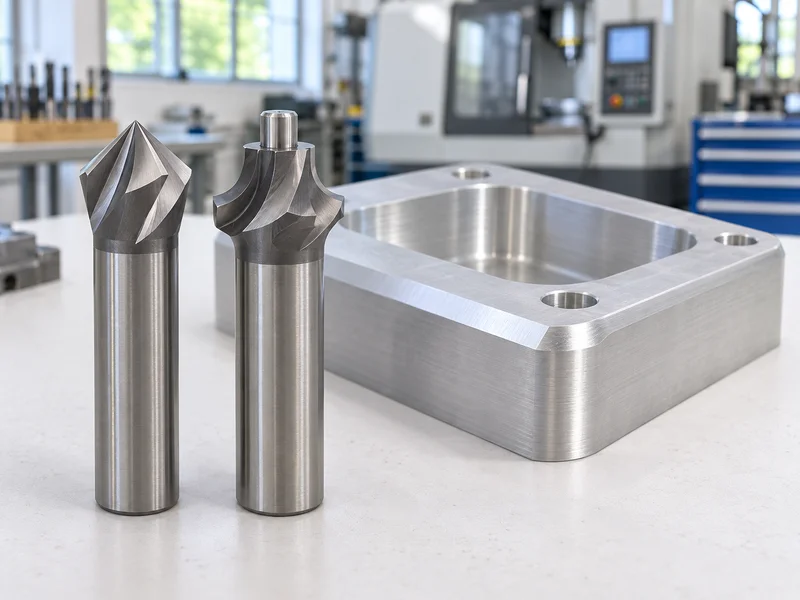
- External chamfers: one chamfer mill can do many edges quickly.
- External fillets: need corner-rounding tools or 3D toolpaths, slower.
- Internal fillets: come naturally from end mill radius; small radii slow machining.
- Turned parts: both are easy with turning inserts.
For example, a milled housing with 0.5 × 45° chamfers on all outer edges may be cheaper than one with R0.5 fillets, which need a separate corner-rounding tool per edge size. Our guide to design for CNC machining covers cost-effective features.
Key Takeaway: Overall, chamfer external machined edges unless a radius is functional or cosmetic.
How Do Molded Parts Differ?
Molded parts differ because radii help plastic flow, reduce stress and ease ejection.
Molding guidance:
- Internal corners: radius at least about 0.5 × wall thickness
- External corners: matching radius to keep walls uniform
- Chamfers: fine on edges, but radii are better at rib and boss roots
- Sharp corners: cause stress, sink and flow hesitation
For example, a sharp internal corner in a PC housing can crack under impact, while a 1 mm radius prevents it. Our guide to injection molding wall thickness explains uniform walls.
Key Takeaway: Equally, molded parts favor radii; machined parts often favor chamfers.
How Do Chamfers and Fillets Look and Feel?
Chamfers and fillets look and feel different, which matters for cosmetic parts.
- Chamfers: crisp, technical look; catch light as a line
- Fillets: soft, smooth, premium feel
- Anodizing: sharp edges may coat thinly; small chamfers or radii help coating coverage
- Handling safety: both remove sharp edges
For example, an anodized handheld cover often uses small fillets for comfort, while an instrument panel may use crisp chamfers for a technical look. Our guide to hard anodizing explains edge coverage.
Key Takeaway: As a rule, decide the look early for visible parts.
How Should Chamfers and Fillets Be Specified?
Chamfers and fillets should be specified with clear sizes and general notes.
Specification items:
- Chamfer: size × angle, such as 0.5 × 45° or C0.5
- Fillet: radius, such as R0.5
- General note: “break sharp edges 0.2–0.5 mm” for non-functional edges
- Tolerance for functional chamfers and radii
- ISO 13715 edge symbols where precise edge conditions matter
For example, “Bore Ø10 H7 with 0.5 × 30° lead-in chamfer; shoulder fillet R0.8 ±0.1; all other edges break 0.2–0.4” is complete. Our quality control and inspection process checks functional edges with profile projectors when specified.
Key Takeaway: Finally, specify functional edges individually and the rest with one note.
FAQ
- Q: What is the difference between a chamfer and a fillet?
- A chamfer is a flat angled edge; a fillet is a rounded edge.
- Q: Which is stronger, chamfer or fillet?
- Fillets usually reduce stress concentration more.
- Q: Which is cheaper to machine?
- External chamfers are usually cheaper on milled parts.
- Q: Should molded parts use chamfers or fillets?
- Mostly radii (fillets) for flow, strength and ejection.
- Q: How is a chamfer called out?
- As size × angle, such as 0.5 × 45°, or C0.5.
Conclusion
Chamfer vs fillet depends on function: chamfers for assembly and economical edge breaks, fillets for strength, molding and feel. Specify functional edges clearly and use a general note for the rest. To review edges on your part, send your 3D model and 2D drawing to our engineers.