
Hard Anodizing (Type III): Properties and Best Alloys
Hard anodizing (Type III anodizing) grows a thick, dense, very hard oxide layer on aluminum, giving machined parts excellent wear resistance, good corrosion protection and electrical insulation. It is used on sliding parts, pistons, guides, valve components, gears, fixtures, robotic parts and housings that see abrasion. Compared with decorative Type II anodizing, it is thicker, harder and darker, and it changes dimensions more.
Hard anodizing works well only when the part is designed and machined for it. For example, an H7 bore that is hard anodized without allowance will finish undersize, and a sharp edge may chip because the coating cannot grow evenly around it. In this guide, we explain hard anodizing: what it is, how it differs from Type II, properties, dimensional growth, alloy effects, design and masking rules and how to specify it. For general aluminum finishes, see our guide to anodized vs non anodized aluminum.
Hard anodizing (MIL-A-8625 Type III, ISO 10074) is an electrochemical process run at low temperature and high current density to produce aluminum oxide layers typically about 25–75 µm thick, with hardness often around 350–500 HV or higher. About half the coating grows outward and half penetrates the surface, so a 50 µm coating adds about 25 µm per surface. It provides high wear resistance, good corrosion protection and electrical insulation, and is usually grey to dark grey or black. Best results come on 6061 and 7075; high-copper and high-silicon alloys coat less well. Sharp edges, threads and fits need radii, allowances or masking.
In short: hard anodizing gives aluminum a thick, wear-resistant skin; design edges and fits for it.
Key points:
- Thickness: about 25–75 µm.
- Growth: about half outward.
- Design: radii, allowances, masking.
What Is Hard Anodizing?
Hard anodizing is an anodizing process that produces thick, dense oxide layers on aluminum for wear resistance.
Process features:
- Sulfuric acid electrolyte at low temperature (near 0 °C)
- High current density
- Thick, hard coating integral with the aluminum
- Natural color: grey to dark grey, often dyed black
For example, an aluminum guide rail that slides against steel can be hard anodized to resist wear. Specifications such as MIL-A-8625 Type III and ISO 10074 define hard anodic coatings; ISO standards are published by ISO.
Key Takeaway: Above all, the process turns the aluminum surface into a hard ceramic-like layer.
How Does Hard Anodizing Differ From Type II Anodizing?
Hard anodizing differs from Type II anodizing by thickness, hardness and appearance.
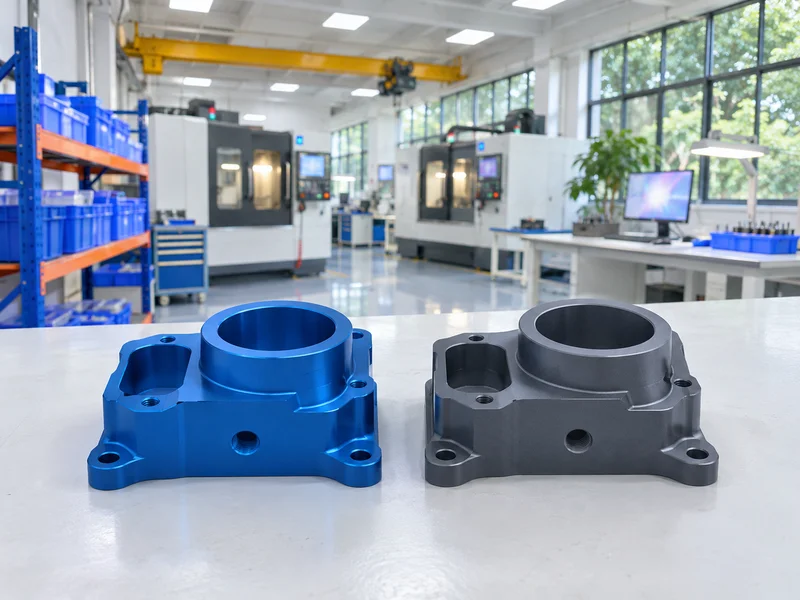
| Feature (typical) | Type II anodizing | Hard anodizing (Type III) |
|---|---|---|
| Thickness | about 5–25 µm | about 25–75 µm |
| Hardness | Moderate | High |
| Wear resistance | Medium | High |
| Color | Clear or bright dyes | Grey to dark, black dye |
| Dimensional change | Small | Significant |
| Cost | Lower | Higher |
For example, a cosmetic cover uses Type II, while a wearing slide uses hard anodizing. Our guide to aluminum powder coating vs anodizing compares finish options.
Key Takeaway: In other words, Type II is for appearance; hard anodizing is for wear.
What Properties Does a Type III Coating Provide?
Hard anodizing provides wear resistance, corrosion protection and electrical insulation.
- Wear and abrasion resistance
- Surface hardness much higher than the base aluminum
- Corrosion protection, improved with sealing
- Electrical insulation with high breakdown voltage
- Some thermal insulation
Limitations:
- Reduced fatigue strength of the base part
- Brittle coating that can crack under bending
- Limited color range
For example, a hard anodized fixture plate resists scratching from repeated part loading. Our guide to CNC machining fixtures covers fixture design.
Key Takeaway: For this reason, avoid hard anodizing on fatigue-critical flexing parts.
How Does the Coating Change Dimensions?
Hard anodizing changes dimensions because about half the coating grows outward.
Growth guidance:
- Per surface: about 50% of coating thickness
- Diameter: about 100% of coating thickness
- Example: 50 µm coating adds about 25 µm per surface, 50 µm on a diameter
- Bores: shrink by the same amount
- Threads: pitch diameter changes significantly
For example, an Ø10 H7 bore to be hard anodized 50 µm should be machined about 0.05 mm oversize. Our guide to tight tolerance machining explains allowances.
Key Takeaway: Overall, plan machining sizes for coating growth.
Which Aluminum Alloys Are Best for Hard Anodizing?
Aluminum alloys differ in how well they hard anodize.
| Alloy (typical) | Hard anodizing result |
|---|---|
| 6061 | Very good, uniform |
| 7075 | Very good, hard coatings |
| 5052 | Good |
| 6063 | Good |
| 2024 / high-copper alloys | Poorer, thinner, softer coatings |
| Cast alloys with high silicon | Poor, uneven |
For example, a 2024 part may need special processing or a different alloy for reliable hard anodizing. Our guide to 6063 vs 6061 aluminum compares alloys.
Key Takeaway: Equally, choose 6061 or 7075 for the best hard coatings.
How Should Parts Be Designed for Hard Anodizing?
Parts should be designed for hard anodizing with radii, allowances and masking.
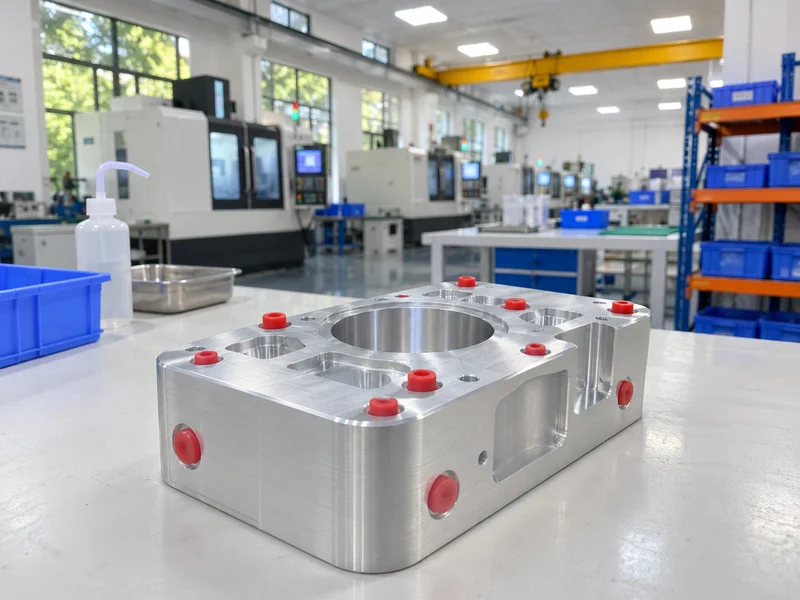
Design rules:
- Edge radii: at least about 0.5 mm to avoid chipping and thin coating
- Allowances on fits and bores
- Mask threads or machine them oversize
- Avoid deep blind holes where coating is thin
- Electrical contact points masked for grounding
- Racking points agreed on non-critical areas
For example, sharp external corners can show burnt or thin coating; a small radius gives uniform thickness. Our guide to chamfer vs fillet explains edge choices.
Key Takeaway: As a rule, round edges before coating.
How Should Hard Anodizing Be Specified?
Hard anodizing should be specified with standard, thickness, sealing, color and masking.
Specification items:
- Standard and type, such as MIL-A-8625 Type III, Class 1 or 2
- Thickness range, such as 50 ±10 µm
- Sealed or unsealed (unsealed for maximum wear)
- Color, natural or black
- Masking areas
- Dimension status: before or after coating
- Hardness or wear tests if required
For example, “Hard anodize MIL-A-8625 Type III, Class 1, 40–60 µm, unsealed, mask M6 threads, dimensions after coating” is complete. Hard anodizing is available as part of our CNC machining services, and our quality control and inspection process checks coating thickness when specified.
Key Takeaway: Finally, always state whether dimensions apply before or after coating.
FAQ
- Q: What is hard anodizing?
- A Type III anodizing process that grows a thick, hard oxide layer on aluminum.
- Q: How thick is hard anodizing?
- Typically about 25–75 µm.
- Q: How much does hard anodizing change dimensions?
- About half the coating thickness per surface.
- Q: Which alloys are best for hard anodizing?
- 6061 and 7075; high-copper and high-silicon alloys coat less well.
- Q: Is hard anodizing electrically conductive?
- No, it is an electrical insulator.
Conclusion
Hard anodizing gives aluminum parts a thick, wear-resistant and insulating surface when alloys, edges, allowances and masking are planned. Specify type, thickness, sealing and dimension status clearly. To review a hard-anodized part, send your 3D model and 2D drawing to our engineers.