
6063 vs 6061 Aluminum: How to Pick the Best One
6063 vs 6061 aluminum is a frequent question for extruded and machined parts. Both are Al-Mg-Si heat-treatable alloys, but 6063 is optimized for extrusion and surface finish, while 6061 is stronger and better for machined structural parts. 6063 is the classic “architectural” alloy for profiles, frames and heat sinks; 6061 is the default for precision machined brackets, housings and fixtures.
Choosing between them depends on how the part is made and loaded. For example, a complex heat sink profile extrudes cleanly and anodizes beautifully in 6063-T5, while a machined mounting plate that carries load is stronger and holds tolerances better in 6061-T6. In this guide, we compare 6063 vs 6061 aluminum: composition, strength, extrudability, machinability, surface finish and anodizing, thermal conductivity, cost and how to choose. For a forming alloy comparison, see our guide to 5052 vs 6061.
6063 vs 6061 aluminum: 6063 (about 0.45–0.9% Mg, 0.2–0.6% Si) extrudes easily into complex, thin-walled profiles with smooth surfaces and excellent anodizing, but it is weaker (T6 yield about 215 MPa, T5 about 145 MPa). 6061 (about 0.8–1.2% Mg, 0.4–0.8% Si plus Cu and Cr) is stronger (T6 yield about 275 MPa), machines better and suits structural parts, but extrudes less easily and gives a slightly less refined anodized finish. Choose 6063 for extruded profiles, heat sinks and decorative anodizing; 6061 for machined, load-bearing and precision parts.
In short: 6063 for extrusions and finish; 6061 for strength and machining.
Key points:
- 6063: extrudes well, best finish, lower strength.
- 6061: stronger, better machining.
- Thermal: 6063 has slightly higher conductivity.
What Is the Difference Between 6063 vs 6061 Aluminum?
The difference between 6063 vs 6061 aluminum is alloy content, which trades extrudability for strength.
| Property (typical) | 6063-T6 | 6061-T6 |
|---|---|---|
| Magnesium | ~0.45–0.9% | ~0.8–1.2% |
| Silicon | ~0.2–0.6% | ~0.4–0.8% |
| Copper | ≤0.1% | ~0.15–0.4% |
| Yield strength | ~215 MPa | ~275 MPa |
| Tensile strength | ~240 MPa | ~310 MPa |
| Extrudability | Excellent | Good |
| Machinability | Fair | Very good |
| Anodized finish | Excellent | Very good |
Aluminum alloy specifications, such as ASTM B221 for extrusions, are published by ASTM International.
Key Takeaway: Above all, 6063 trades strength for extrudability and finish.
6063 vs 6061 Aluminum: How Do Strength and Tempers Compare?
Strength and tempers compare in favor of 6061 for load-bearing parts.
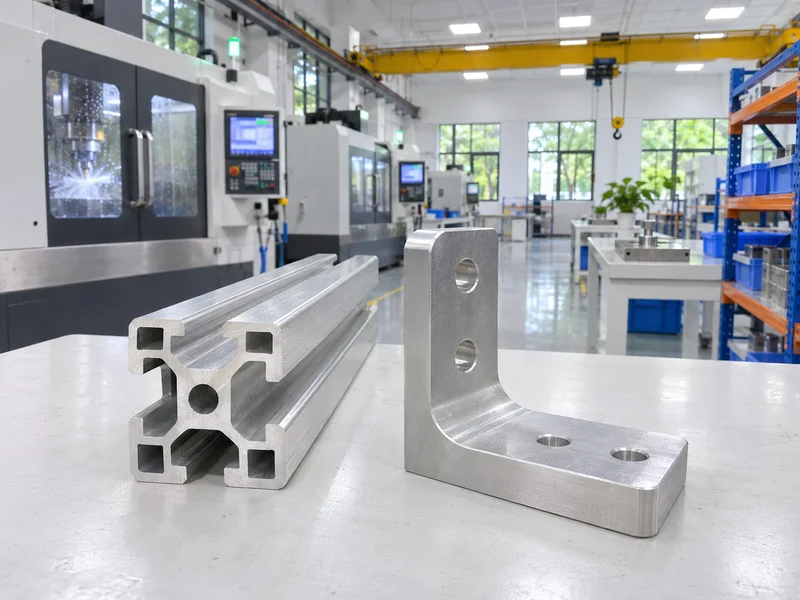
- 6063-T5: air-quenched from extrusion; common for profiles
- 6063-T6: solution heat treated and aged; higher strength
- 6061-T6: strongest common condition
- 6061-T651: stress relieved plate for machining
For example, a 6063-T5 frame profile is fine for an enclosure, but a loaded machine bracket should be 6061-T6. Our guide to aluminium alloy 6061 properties gives full 6061 data.
Key Takeaway: In other words, use 6061 when the part carries significant load.
6063 vs 6061 Aluminum: How Do Extrusion and Machining Compare?
Extrusion and machining compare differently for each alloy.
Extrusion:
- 6063: complex, thin-walled profiles at high speed with smooth surfaces
- 6061: extrudable but slower, simpler profiles, rougher surfaces
Machining:
- 6061: cleaner chips, better finish, holds tolerances
- 6063: softer, gummier, more burrs
For example, a heat sink with many thin fins is extruded in 6063 and then machined only at mounting faces. Our guide to deburring explains burr control in soft alloys.
Key Takeaway: For this reason, extrude in 6063 and machine in 6061 when you have the choice.
How Do Anodizing and Appearance Compare?
Anodizing and appearance compare in favor of 6063 for decorative parts.
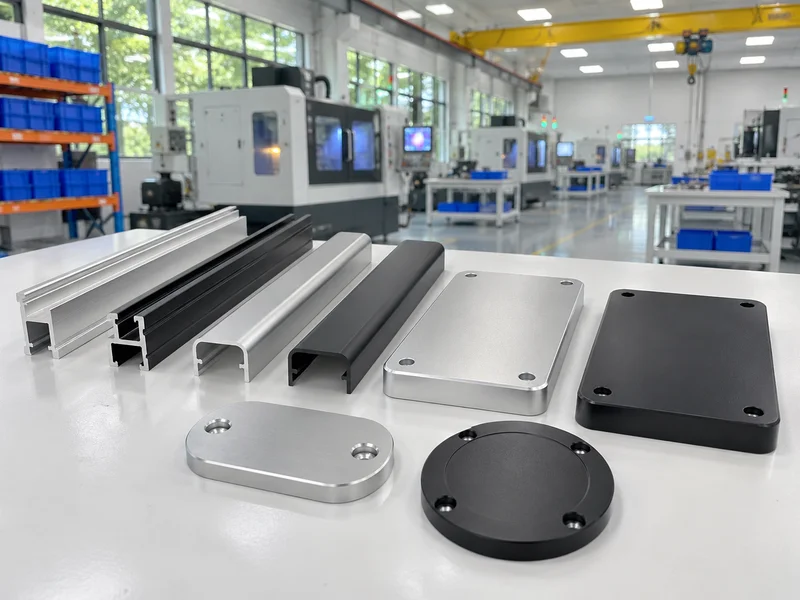
- 6063: very uniform, bright anodized finish; preferred for visible profiles
- 6061: good anodizing, slightly less uniform on some colors
- Bead blasting: improves uniformity on both
- Hard anodizing: works on both
For example, a visible enclosure frame in clear anodized 6063 looks smoother than the same frame in 6061. Our guide to hard anodizing explains thick anodic coatings.
Key Takeaway: Overall, choose 6063 for decorative extrusions.
How Do Thermal Properties Compare?
Thermal properties compare slightly in favor of 6063.
- 6063-T5/T6: thermal conductivity about 200–210 W/m·K
- 6061-T6: about 150–170 W/m·K
- Heat sinks: 6063 is common for extruded fins
- Machined heat spreaders: 6061 often used for strength and machining
For example, an LED heat sink profile in 6063 dissipates heat slightly better than in 6061. Our guide to copper and nickel plating covers finishes for thermal parts.
Key Takeaway: Equally, 6063 suits extruded thermal parts.
Which Parts Suit 6063 and Which Suit 6061?
Parts suit 6063 or 6061 according to process, load and appearance.
6063 suits:
- Extruded frames and profiles
- Heat sinks
- Decorative trims and enclosures
- Tubes and rails with light loads
6061 suits:
- Machined brackets, housings and manifolds
- Fixtures and tooling plates
- Load-bearing structural parts
- Precision components
For example, an instrument case may combine 6063 extruded side profiles with 6061 machined end plates. Our CNC machining services machine 6061 and finish-machine extruded profiles to drawing.
Key Takeaway: As a rule, match the alloy to the part’s main process.
How Should 6063 or 6061 Be Specified?
6063 or 6061 should be specified with alloy, temper, form and finish.
Specification items:
- Alloy and temper, such as 6063-T5 or 6061-T6
- Product form: extrusion, plate, bar
- Profile drawing for custom extrusions
- Anodizing type and color
- Material certificate if required
For example, “6063-T5 extrusion per drawing, clear anodize 10–15 µm” or “6061-T651 plate, black anodize Type II” are complete. Our quality control and inspection process supplies certificates on request.
Key Takeaway: Finally, always include temper and form.
FAQ
- Q: What is the difference between 6063 and 6061 aluminum?
- 6063 extrudes and anodizes better; 6061 is stronger and machines better.
- Q: Which is stronger, 6063 or 6061?
- 6061-T6 is stronger than 6063-T6.
- Q: Which is better for heat sinks?
- 6063, for extrudability and slightly higher thermal conductivity.
- Q: Which anodizes better?
- 6063 gives a more uniform decorative finish.
- Q: Which should I use for machined parts?
- 6061, especially T6 or T651.
Conclusion
6063 vs 6061 aluminum depends on process and load: 6063 for extruded profiles, heat sinks and decorative finishes, 6061 for machined, stronger and precision parts. Specify alloy, temper and form clearly. To review aluminum selection, send your 3D model and 2D drawing to our engineers.