
Sprue Bushing: Key Dimensions, Materials and Sprue Design
A sprue bushing is the hardened steel component in an injection mold that receives molten plastic from the machine nozzle and guides it into the runner system or directly into the part. It sits at the center of the stationary mold half and must seal against the nozzle, survive repeated contact and heat, and release the sprue cleanly every cycle. Though small, it causes many startup problems when its size or seating is wrong.
Sprue bushing problems are easy to prevent. For example, a nozzle radius larger than the sprue bushing seat radius leaks plastic around the nozzle and builds up a ring of material, while a sprue orifice smaller than the nozzle orifice makes the sprue stick. In this guide, we explain the sprue bushing: function, key dimensions, matching to the nozzle, materials, sprue sticking and leaks, hot sprue options and how to specify sprue bushings. For runner and gate systems, see our guide to injection molding gate types.
A sprue bushing is a hardened steel bushing in the stationary mold half with a spherical seat that matches the machine nozzle and a tapered channel (often about 1–3° included angle) that carries melt to the runner or part. Its seat radius must be slightly larger than the nozzle radius (for example 0.5–1 mm larger), and its orifice slightly larger than the nozzle orifice (about 0.5–1 mm), so the nozzle seals and the sprue releases. It is located by a locating ring and is often a standard component from HASCO, DME or MISUMI. Hot sprue bushings keep the sprue molten to eliminate sprue waste.
In short: match the sprue bushing seat and orifice to the nozzle, and choose a hot sprue when sprue waste or cycle time matters.
Key points:
- Seat radius: larger than the nozzle radius.
- Orifice: larger than the nozzle orifice.
- Taper: helps sprue release.
What Is a Sprue Bushing?
A sprue bushing is the inlet component of an injection mold that connects the machine nozzle to the mold’s flow path.
Functions:
- Receives melt from the nozzle
- Seals against the nozzle under injection pressure
- Guides melt to the runner or gate
- Releases the sprue on mold opening
- Withstands heat, pressure and nozzle contact
For example, in a cold runner mold, the sprue bushing feeds a runner that distributes melt to several small cavities. Our guide to injection mold components explains the mold layout.
Key Takeaway: Above all, the sprue bushing is where the machine and mold meet.
What Are the Key Dimensions of a Sprue Bushing?
The key dimensions of a sprue bushing control sealing, flow and release.
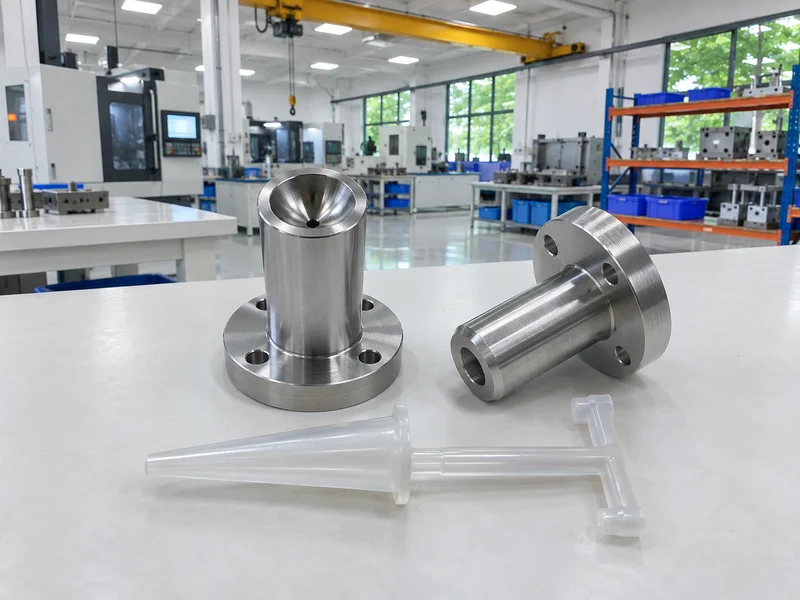
| Dimension | Typical guidance |
|---|---|
| Seat radius (SR) | Larger than nozzle radius, e.g. nozzle SR15 → bushing SR15.5–16 |
| Orifice diameter | About 0.5–1 mm larger than nozzle orifice |
| Taper | About 1–3° included angle for release |
| Length | As short as the mold allows |
| Head diameter | Fits locating ring and clamp plate |
For example, a press with an SR20 nozzle and Ø4 mm orifice would use a sprue bushing with about SR20.5–21 seat and Ø4.5–5 mm orifice. Our guide to estimating molding cycle time explains how sprue thickness affects cooling.
Key Takeaway: In other words, the bushing must be slightly larger than the nozzle in both radius and orifice.
How Should the Sprue Bushing Match the Machine Nozzle?
The sprue bushing should match the machine nozzle so the nozzle seals and the sprue releases.
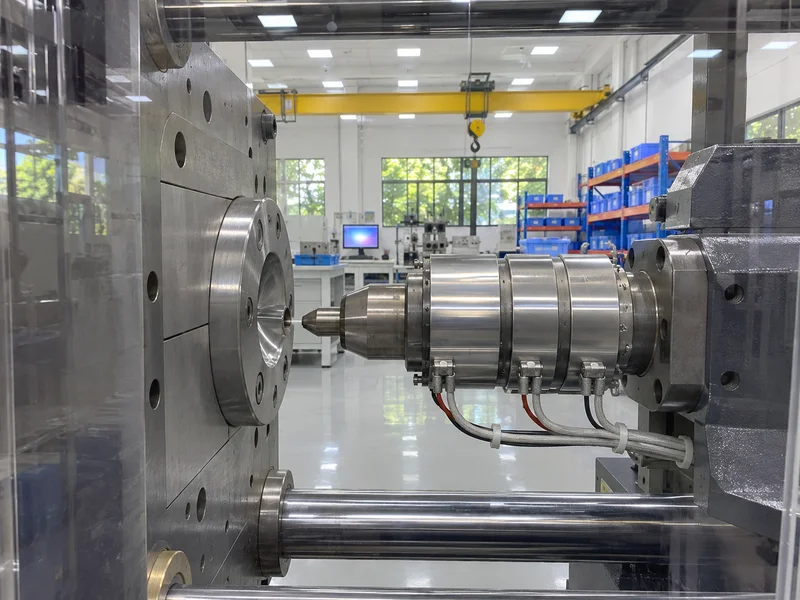
Matching rules:
- Bushing seat radius > nozzle radius: nozzle touches at the center, sealing properly
- Bushing orifice > nozzle orifice: no undercut that grips the sprue
- Alignment through the locating ring
- Nozzle contact force set correctly on the machine
For example, if a mold built for an SR20 nozzle runs on a machine with an SR40 nozzle, the nozzle seals only at the outer edge and leaks. A nozzle tip change fixes it. Our guide to mold temperature controller covers other machine-mold interfaces.
Key Takeaway: For this reason, record nozzle radius and orifice in the mold documentation.
Which Materials Are Used for Sprue Bushings?
Sprue bushings are made from hardened, wear-resistant steels.
- Hardened tool steels such as 1.2343 or 1.2344
- Through-hardened to resist nozzle contact and wear
- Polished channel for easy sprue release
- Coatings for abrasive or corrosive resins
For example, a mold running glass-filled PA66 benefits from a hardened, polished sprue bushing to limit wear. Our guide to how to choose mold steel explains steel selection.
Key Takeaway: Overall, use hardened standard bushings for durability.
Sprue Injection Molding: How Is the Sprue Designed?
In sprue injection molding, the sprue is the tapered channel of plastic that forms inside the bushing and carries melt from the nozzle to the runner or directly to the part.
| Sprue design point | Typical practice |
|---|---|
| Taper | About 1–3° included angle so the sprue pulls out cleanly |
| Orifice | About 0.5–1 mm larger than the nozzle orifice |
| Length | As short as the mold allows, to cut cooling time and waste |
| Sprue puller | Z-pin or undercut puller on the moving half to pull the sprue out |
| Cold slug well | Opposite the sprue to catch the cold front of the melt |
| Direct sprue gate | Sprue feeds a single large part at its center |
For example, a single-cavity bucket or deep housing can be filled by a direct sprue gate, while small multi-cavity parts are fed through a sprue, runner and side gates. The sprue is usually the thickest section of the shot, so a long sprue can set the cycle time. Our guides to cold runner design and injection molding gate types explain what follows the sprue.
Key Takeaway: Similarly, keep the sprue short, tapered and pulled by a puller, so it never limits the cycle.
Why Do Sprues Stick or Leak?
Sprues stick or leak because of dimensional mismatch, damage or process settings.
| Problem | Typical cause | Fix |
|---|---|---|
| Sprue sticks | Bushing orifice smaller than nozzle, scratches, low taper | Larger orifice, polish, check taper |
| Plastic leaks at nozzle | Seat radius mismatch, damaged seat, low contact force | Match radii, repair seat, adjust force |
| Stringing | Nozzle too hot | Adjust nozzle temperature, decompression |
| Sprue breaks | Long thin sprue, cold slug | Shorter sprue, cold slug well |
For example, a damaged sprue bushing seat from a misaligned nozzle may leak until re-machined or replaced. Our guide to maintenance of molds covers inspection.
Key Takeaway: Equally, most sprue problems are dimensional, not process-related.
When Should You Use a Heated Sprue?
You should use a hot sprue bushing when sprue waste, cycle time or sprue cooling limits production.
Benefits:
- No sprue waste to regrind or discard
- Shorter cycle when the sprue is the thickest section
- Lower injection pressure
- Direct gating into single-cavity parts
Considerations:
- Higher cost and controller needed
- Resin suitability and temperature control
- Maintenance of heaters and thermocouples
For example, a single-cavity part with a long sprue may cut several seconds per cycle with a hot sprue. Our guide to the hot runner system explains hot runner options.
Key Takeaway: As a rule, consider a hot sprue when the sprue cools slower than the part.
How Should Sprue Bushings Be Specified?
Sprue bushings should be specified with standard, dimensions and machine data.
Specification items:
- Component standard: HASCO, DME, MISUMI or equivalent
- Seat radius and orifice matched to the customer’s machine nozzle
- Locating ring diameter for the press
- Hot or cold sprue
- Spare bushing if required
For example, a mold specification may state “nozzle SR15, Ø3.5 orifice, locating ring Ø100, standard HASCO sprue bushing”. Our injection mold manufacturing service builds molds to HASCO, Meusburger, DME or MISUMI standards. Machine-mold interface dimensions are standardized by EUROMAP.
Key Takeaway: Finally, give the supplier your machine’s nozzle data before the mold is designed.
FAQ
- Q: What is a sprue bushing?
- The hardened mold component that receives melt from the nozzle and guides it into the mold.
- Q: Why must the sprue bushing radius be larger than the nozzle radius?
- So the nozzle seals at the center instead of leaking at the edge.
- Q: Why does the sprue stick?
- Usually the bushing orifice is smaller than the nozzle orifice or the channel is scratched.
- Q: What is a hot sprue bushing?
- A heated sprue bushing that keeps melt molten and eliminates sprue waste.
- Q: Are sprue bushings standard parts?
- Yes, from suppliers such as HASCO, DME and MISUMI.
Conclusion
A sprue bushing works when its seat and orifice match the machine nozzle, its channel releases the sprue and it is hardened for long life. Consider hot sprues where sprue waste or cooling limits the cycle. To review a mold design, send your 3D model and 2D drawing to our engineers.