
Collapsible Core: When to Use It and Design Rules
A collapsible core is a mold component made of segments that collapse inward after molding, releasing internal undercuts such as internal threads, grooves or snap rings without rotating the part or the core. It lets small precision parts like closures, caps, fittings and medical-style components with internal features be molded in one shot and ejected straight off, often with shorter cycles and simpler molds than unscrewing systems.
Collapsible cores have limits, though. For example, a cap with a continuous internal thread can be released by a collapsible core, but the thread may show small witness lines where the segments meet, and very deep undercuts may exceed the core’s collapse. In this guide, we explain the collapsible core: how it works, when to use it, how it compares with unscrewing and stripping, design rules, materials and maintenance, and how to specify it. For rotating cores, see our guide to unscrewing injection mold design.
A collapsible core consists of a center pin and segmented sleeves that form an internal undercut during molding; when the center pin retracts, the segments collapse inward so the part can be ejected axially. Standard collapsible cores are available in size ranges for internal diameters from small sizes upward, with defined maximum undercut depths. They suit internal threads, grooves and undercuts on round parts, especially in multi-cavity molds, and avoid the gears and motors of unscrewing molds. Design must respect the core’s collapse limits, segment witness lines and required draft.
In short: collapsible cores release internal undercuts without rotation; check collapse limits and witness lines.
Key points:
- Function: segments collapse to release internal undercuts.
- Benefit: no rotation, simpler than unscrewing.
- Limits: maximum undercut depth and witness lines.
What Is a Collapsible Core?
A collapsible core is a segmented mold core that shrinks in diameter after molding so internal undercuts can be released.
Main components:
- Center pin: supports the segments during molding
- Collapsing sleeve: segments forming the undercut
- Positive collapse sleeve: helps segments retract reliably
- Mold plate actuation: retracts the center pin before ejection
For example, a closure with an internal thread is molded around the expanded core, the center pin withdraws, the segments collapse and the closure is stripped off. Our guide to 8 ways to achieve undercut success explains other undercut methods.
Key Takeaway: Above all, the collapsible core removes the undercut, not the part.
When Should You Use a Collapsible Core?
You should use a collapsible core when a round part has internal undercuts that cannot be stripped or unscrewed easily.
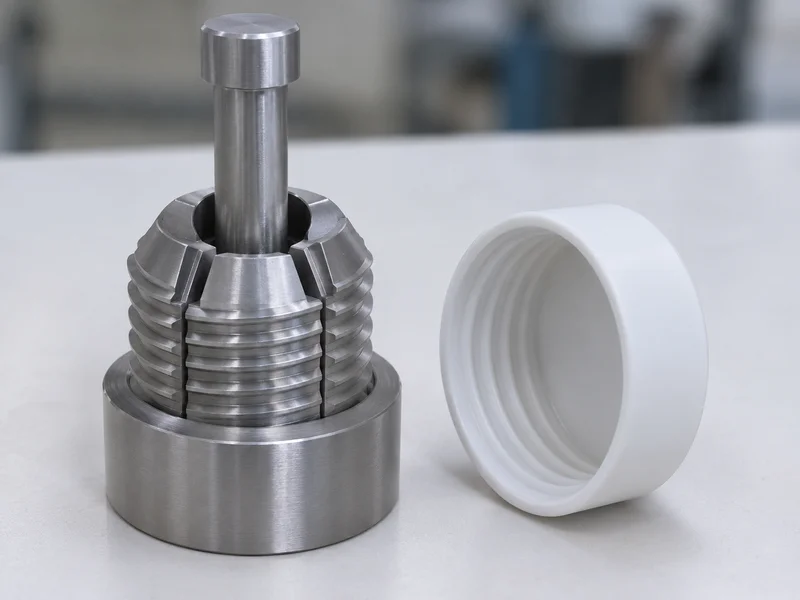
Good uses:
- Internal threads on caps and fittings
- Internal grooves for O-rings or snap rings
- Internal undercuts on round parts
- Multi-cavity molds where unscrewing drives are complex
- Rigid materials that cannot be stripped
For example, a glass-filled nylon fitting with an internal groove cannot be stripped without damage, so a collapsible core is used. Our guide to molded threads and how to design them explains thread options.
Key Takeaway: In other words, collapsible cores suit rigid round parts with internal features.
How Does a Collapsible Core Compare With Unscrewing and Stripping?
A collapsible core compares with unscrewing and stripping by cycle time, mold complexity and part features.
| Method | Mechanism | Pros | Cons |
|---|---|---|---|
| Collapsible core | Segments collapse | No rotation, compact, fast | Witness lines, size limits |
| Unscrewing core | Core rotates out | Full threads, no witness lines | Gears/motors, longer cycle |
| Stripping | Part flexes off | Simple, cheap | Only for flexible resins and shallow undercuts |
For example, a PP cap with shallow threads may be stripped, while a PC cap with full threads may use a collapsible core or unscrewing. Our unscrewing injection molds page explains rotating systems.
Key Takeaway: For this reason, compare all three before choosing.
How Should Parts Be Designed for a Collapsible Core?
Parts should be designed for a collapsible core within its collapse limits.
Design rules:
- Undercut depth within the core’s maximum collapse
- Interrupted threads or features where segments meet, if acceptable
- Draft on non-undercut surfaces
- Uniform wall thickness around the core
- Clearance for the core’s center pin and sleeve
For example, a thread profile slightly shallower than standard may fit a standard collapsible core size and avoid a custom core. Our guide to injection molding wall thickness explains wall design.
Key Takeaway: Overall, design features to fit standard core sizes when possible.
What Are Segment Witness Lines?
Witness lines on collapsible core parts are faint marks where the core segments meet.
Facts:
- Small lines along the internal surface
- Usually acceptable on internal threads and grooves
- Can affect sealing if on a sealing surface
- Controlled by core precision and maintenance
For example, an internal thread may show small segment lines that do not affect function, while an internal sealing groove may need a different solution. Our guide to parting line injection molding explains similar witness marks.
Key Takeaway: Equally, check whether witness lines fall on functional surfaces.
How Are Segmented Cores Maintained?
Collapsible cores are maintained by cleaning, lubrication and inspection of segments.
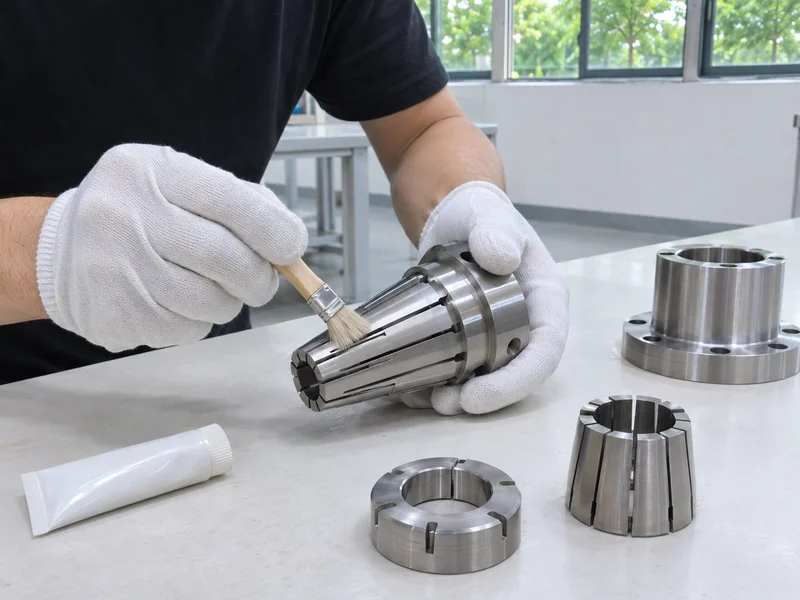
Maintenance:
- Clean segments to remove residue
- Lubricate sliding surfaces as specified
- Inspect wear on segment edges
- Check collapse stroke and timing
- Keep spares for high-volume molds
For example, residue buildup between segments can stop full collapse and damage parts on ejection. Our guide to maintenance of molds covers maintenance plans.
Key Takeaway: As a rule, clean collapsible cores more often than simple cores.
How Should Collapsible Cores Be Specified?
Collapsible cores should be specified with type, size, actuation and spares.
Specification items:
- Core type and size from a standard supplier
- Undercut geometry and acceptable witness lines
- Actuation method and sequence
- Steel and treatment
- Spare cores or segments
For example, a mold specification may state “standard collapsible core for internal thread M24×2, witness lines acceptable, two spare segment sets”. Our injection mold manufacturing service designs molds for internal undercuts, including CUMSA-standard components. Standard component dimensions are also covered by ISO mold component standards.
Key Takeaway: Finally, agree witness line acceptance before building the mold.
FAQ
- Q: What is a collapsible core?
- A segmented mold core that collapses after molding to release internal undercuts.
- Q: When is a collapsible core used?
- For internal threads, grooves and undercuts on round, rigid parts.
- Q: How does it differ from an unscrewing core?
- It collapses instead of rotating, so no gears or motors are needed.
- Q: Do collapsible cores leave marks?
- Yes, small witness lines where segments meet.
- Q: Are there size limits?
- Yes, each core has a maximum diameter range and collapse depth.
Conclusion
A collapsible core releases internal undercuts without rotation, simplifying molds for threaded and grooved round parts. Design within collapse limits, accept or avoid witness lines and maintain the core well. To review an undercut part, send your 3D model and 2D drawing to our engineers.