
Countersink vs Counterbore: How to Pick the Best One
Countersink vs counterbore is a basic but important choice whenever screws must sit flush with or below a machined surface. A countersink is a conical recess for flat-head screws, so the screw head sits flush with the surface. A counterbore is a flat-bottomed cylindrical recess for socket head cap screws and similar fasteners, so the head sits below the surface. The wrong choice, or the wrong dimensions, leaves heads proud, loose or cracking the part.
The two features are not interchangeable. For example, a socket head cap screw placed in a countersink will not seat properly, while a flat-head screw in a counterbore leaves a gap under the head and loses clamping. In this guide, we compare countersink vs counterbore: what each is, when to use each, standard dimensions, machining methods, use in plastics and thin parts, and how to call them out on drawings. For thread design, see our guide to threaded holes.
Countersink vs counterbore: a countersink is a cone-shaped recess, typically 90° for metric flat-head screws (ISO 10642, DIN 7991) and 82° for US inch screws, that lets the screw head sit flush. A counterbore is a flat-bottomed, stepped cylindrical recess sized for socket head cap screws (ISO 4762) or washers, so the head sits at or below the surface with full bearing area. Countersinks center the screw and look flush; counterbores give stronger clamping and allow taller heads. Use the standard angle and diameters for the fastener, and call them out with ⌵ or ⌴ symbols.
In short: countersink for flat-head screws flush with the surface; counterbore for cap screws below the surface.
Key points:
- Countersink: conical, 90° metric or 82° inch.
- Counterbore: flat-bottomed step for cap screws.
- Callouts: use standard symbols and fastener sizes.
What Is the Difference Between Countersink vs Counterbore?
The difference between countersink vs counterbore is the recess shape and the screw it suits.
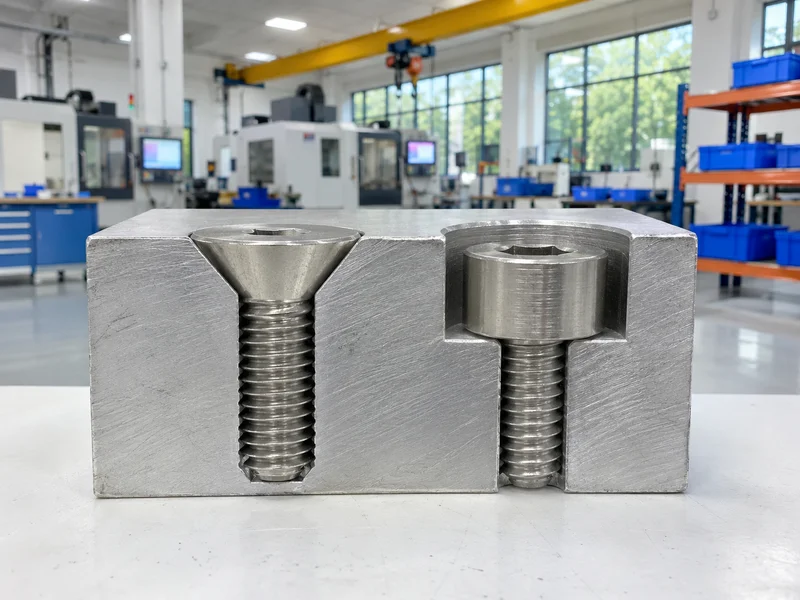
| Feature | Countersink | Counterbore |
|---|---|---|
| Shape | Conical | Cylindrical, flat bottom |
| Screw type | Flat-head (countersunk) | Socket head cap, washers |
| Head position | Flush | At or below surface |
| Bearing area | Cone surface | Flat shoulder |
| Centering | Self-centering | Needs hole clearance |
| Drawing symbol | ⌵ | ⌴ |
For example, a cover plate that must be flat for a sliding part uses countersunk screws, while a fixture plate uses counterbored cap screws for higher clamp force. Screw standards such as ISO 4762 and ISO 10642 are published by ISO.
Key Takeaway: Above all, match the recess to the screw head.
Countersink vs Counterbore: When Should You Use a Countersink?
You should use a countersink when the screw head must sit flush and look clean.
Typical uses:
- Cover plates and panels with flat surfaces
- Sliding or mating surfaces where heads must not protrude
- Cosmetic parts
- Thin parts where a counterbore would remove too much material
Also used:
- Chamfered hole entries for deburring and lead-in
For example, a guide rail mounted under a moving carriage uses countersunk screws so nothing catches. Our guide to chamfer vs fillet covers chamfered entries.
Key Takeaway: In other words, countersinks give a flush, self-centered head.
Countersink vs Counterbore: When Is a Counterbore Better?
You should use a counterbore when the screw needs full clamping, a recessed head or a washer.
Typical uses:
- Fixture and tooling plates
- Mold plates with socket head cap screws
- Assemblies needing high clamp force
- Parts where heads must sit below surface
- Bolted joints with washers
For example, a mold clamp plate uses counterbored M10 cap screws so the heads sit below the plate face. Our guide to CNC machining fixtures shows typical uses.
Key Takeaway: For this reason, counterbores suit structural and tooling joints.
What Dimensions Are Standard?
Standard dimensions depend on the screw size and standard.
Example (metric, typical):
| Screw | Counterbore Ø × depth (ISO 4762) | Countersink Ø at 90° (ISO 10642) |
|---|---|---|
| M3 | Ø6.5 × 3.3 | about Ø6.7 |
| M4 | Ø8 × 4.4 | about Ø9.0 |
| M5 | Ø10 × 5.4 | about Ø11.2 |
| M6 | Ø11 × 6.4 | about Ø13.4 |
| M8 | Ø15 × 8.6 | about Ø17.9 |
Values vary slightly by reference; confirm with your standard or fastener catalog. For example, using a 82° countersink for an M5 metric screw leaves the head sitting on an edge rather than the full cone.
Key Takeaway: Overall, use the fastener standard’s angle and diameters.
How Are Countersinks and Counterbores Machined?
Countersinks and counterbores are machined with dedicated tools or milling.
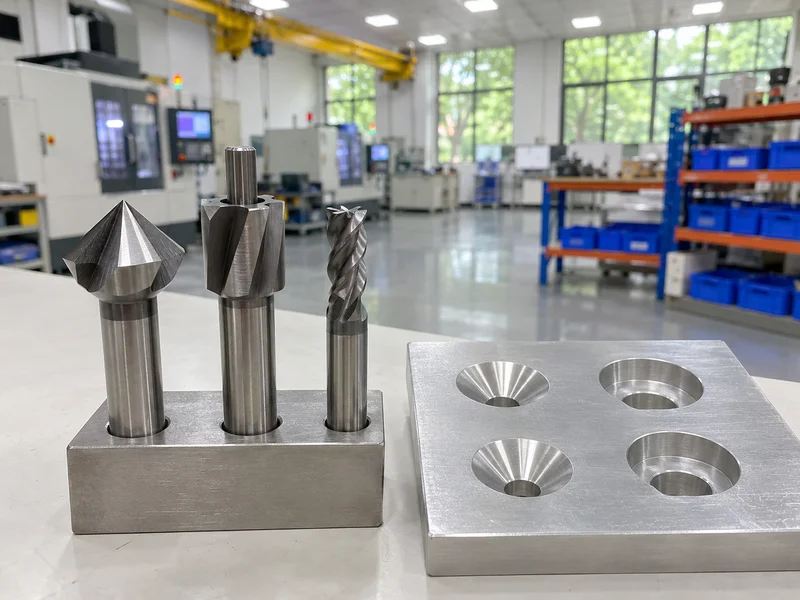
- Countersinks: countersink cutters or spot drills with the right angle; chamfer mills
- Counterbores: counterbore tools with pilots, or end mills with circular interpolation
- Combination tools: drill and counterbore in one pass for production
- Back counterbores: special tools for the reverse side
For example, a CNC program may drill, then circular-mill counterbores to exact diameter and depth with one end mill. Our CNC milling service machines both features.
Key Takeaway: Equally, depth control matters as much as diameter.
How Do Plastics and Thin Parts Change the Choice?
Plastics and thin parts change the choice because of material strength and available thickness.
- Thin metal parts: countersinks may leave a knife edge; counterbores may cut through
- Plastics: countersunk screws can split plastic by wedging; counterbores with washers spread load
- Molded parts: counterbores are molded as stepped holes; avoid sharp cones
- Inserts: use counterbores above threaded inserts for flush heads
For example, a countersunk screw in a thin PC cover may crack it when tightened; a counterbore with a flat-head washer reduces stress. Our guide to plastic threaded inserts explains inserts.
Key Takeaway: As a rule, avoid wedge loads from countersinks in brittle plastics.
How Should Countersinks and Counterbores Be Called Out?
Countersinks and counterbores should be called out with symbols, diameters, angles and depths.
Callouts:
- Countersink: ⌵ Ø11.2 × 90°
- Counterbore: ⌴ Ø10 ↧ 5.4
- Through hole: Ø5.5 THRU
- Fastener reference: “for M5 ISO 4762”
- Tolerances: on diameter and depth if functional
For example, “Ø5.5 THRU, ⌴ Ø10 ↧ 5.4, for M5 ISO 4762” is complete. Our quality control and inspection process checks recess depth and diameter when specified.
Key Takeaway: Finally, reference the fastener so the machinist and inspector use the same standard.
FAQ
- Q: What is the difference between a countersink and a counterbore?
- A countersink is conical for flat-head screws; a counterbore is a flat-bottomed step for cap screws.
- Q: What angle is a metric countersink?
- Usually 90° for metric flat-head screws; 82° for US inch screws.
- Q: When should I use a counterbore?
- When screws need full clamping or must sit below the surface.
- Q: Can countersinks crack plastic parts?
- Yes, the cone can wedge and split brittle plastics.
- Q: How is a counterbore called out?
- With the ⌴ symbol, diameter and depth, plus the through-hole size.
Conclusion
Countersink vs counterbore depends on the screw and the joint: countersinks for flush flat-head screws, counterbores for recessed cap screws and strong clamping. Use standard dimensions and clear callouts. To review fastener features on your part, send your 3D model and 2D drawing to our engineers.