
Tool Steel Grades: How to Pick the Best One
Tool steel grades are families of high-carbon alloy steels designed for cutting, forming and molding other materials. The main groups are water-hardening (W), oil-hardening (O), air-hardening (A), high-carbon high-chromium (D), shock-resisting (S), hot-work (H), high-speed (M and T) and plastic mold steels (P). Each group trades hardness, toughness, wear resistance, heat resistance and machinability differently.
Choosing the wrong group shows up quickly. For example, a D2 punch may chip under impact where an S7 or A2 punch survives, and a P20 mold cavity may wear at the gate where an H13 insert lasts. In this guide, we explain tool steel grades: the groups, key properties, common grades for molds, dies and machined parts, how to choose and how to specify them. For mold-specific choices, see our guide on how to choose mold steel.
Tool steel grades are classified by AISI/ASTM letter groups: W (water-hardening), O (oil-hardening), A (air-hardening cold-work), D (high-carbon high-chromium cold-work), S (shock-resisting), H (hot-work), M and T (high-speed) and P (plastic mold steels). Common examples are A2, D2, S7, H13, M2 and P20, with European equivalents such as 1.2363, 1.2379, 1.2344, 1.3343 and 1.2311. Selection depends on the dominant failure mode — wear, chipping, heat checking or deformation — plus machinability, heat treatment and cost.
In short: identify how the tool will fail, then pick the tool steel group that resists that failure.
Key points:
- Groups: W, O, A, D, S, H, M/T, P.
- Trade-off: wear resistance vs toughness.
- Choice: by failure mode and process.
What Are the Main Tool Steel Grades?
The main tool steel grades are grouped by hardening method and application.
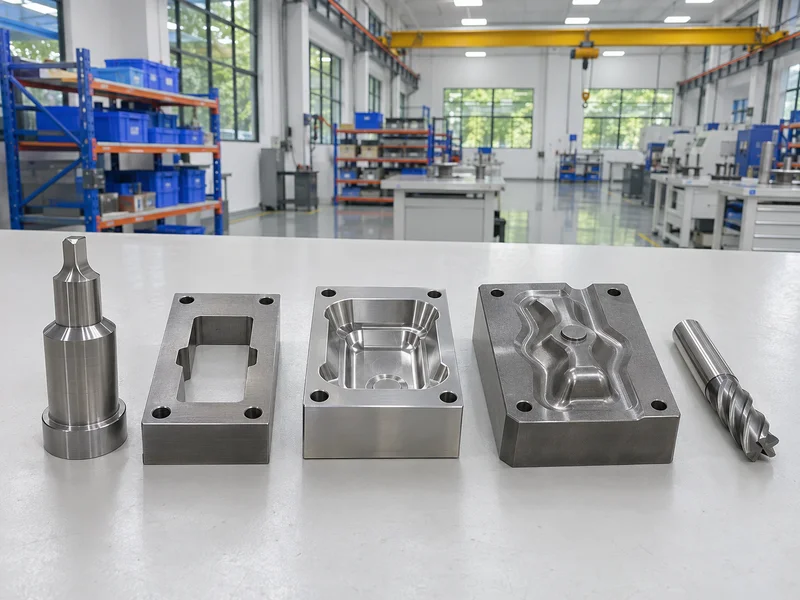
| Group | Example grades | Typical use |
|---|---|---|
| W – water-hardening | W1 | Simple low-cost tools |
| O – oil-hardening | O1 / 1.2510 | Gauges, small dies |
| A – air-hardening | A2 / 1.2363 | Punches, forming dies, fixtures |
| D – high-carbon high-chromium | D2 / 1.2379 | Blanking dies, wear parts |
| S – shock-resisting | S7 | Chisels, punches under impact |
| H – hot-work | H13 / 1.2344 | Die casting dies, hardened mold inserts |
| M / T – high-speed | M2 / 1.3343 | Cutting tools, small punches |
| P – plastic mold | P20 / 1.2311, 718H | Injection mold cavities and bases |
Tool steels are specified in ASTM A681 and ASTM A600 from ASTM International.
Key Takeaway: Above all, the letter tells you the family’s main strength.
Which Properties Separate the Groups?
Tool steel grades are separated by five main properties.
- Hardness: resistance to indentation and deformation
- Wear resistance: from carbides such as chromium and vanadium carbides
- Toughness: resistance to chipping and cracking
- Hot hardness: strength at elevated temperature
- Dimensional stability: size change during hardening
For example, D2 has high wear resistance from chromium carbides but lower toughness, while S7 is very tough but wears faster. Our guide to A2 vs D2 tool steel compares two cold-work grades in detail.
Key Takeaway: In other words, no tool steel grade is best at everything.
Which Tool Steel Grades Are Used for Injection Molds?
Injection molds mainly use P, H and stainless mold grades.
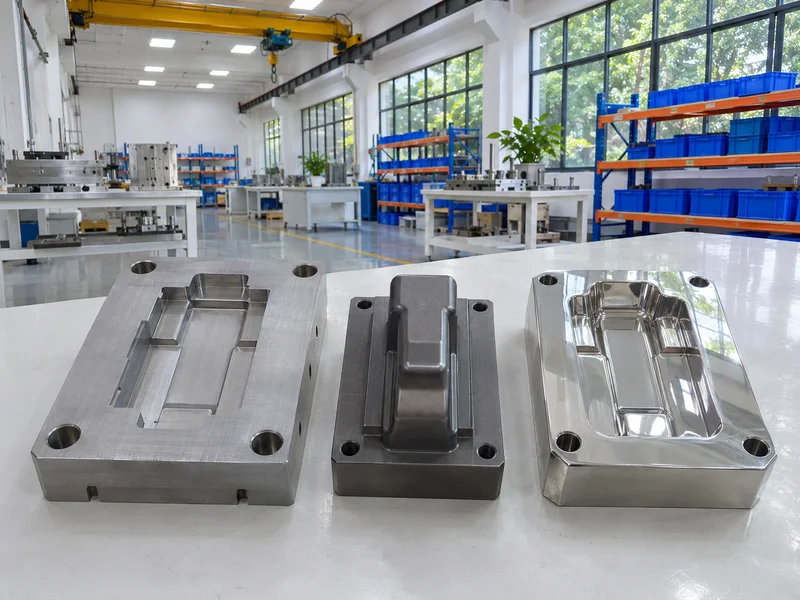
| Need | Typical grade | Hardness |
|---|---|---|
| General cavities, bases | P20 / 718H | about 28–37 HRC |
| Filled resins, high volume | H13 / 1.2344 | about 48–52 HRC |
| Mirror polish, corrosion | 420 / S136 / 1.2083 | about 48–52 HRC |
| Wear inserts, small cores | D2 or similar | about 58–60 HRC |
For example, a small precision connector mold may use a 718H base, H13 cavity inserts and nitrided ejector pins. Our guides to P20 steel, H13 tool steel and 420 stainless steel cover each one.
Key Takeaway: For this reason, molds usually combine several grades rather than one.
Which Tool Steel Grades Suit Dies and Machined Tools?
Dies and machined tools use cold-work, shock-resisting and high-speed grades.
- A2: forming punches, fixtures, gauges
- D2: blanking and trimming dies, wear plates
- S7: punches and tools under heavy impact
- O1: small gauges and low-volume dies
- M2: cutting tools and small high-wear punches
For example, a CNC-machined fixture locator may be A2 for stability, while a trimming blade is D2 for edge life. Our CNC machining services machine tool steel parts to drawing, with heat treatment arranged per project and precision grinding in-house.
Key Takeaway: Overall, cold-work grades suit cutting and forming at room temperature.
How Do You Choose Between Tool Steel Grades?
You choose between tool steel grades by the dominant failure mode and the process.
| Main failure | Better grade direction |
|---|---|
| Abrasive wear | D2, higher-alloy grades, coatings |
| Chipping or cracking | S7, A2, H13 |
| Heat checking | H13 and other hot-work grades |
| Deformation | Higher hardness |
| Corrosion | Stainless mold grades |
For example, if a punch chips, moving from D2 to A2 or S7 often solves it; if it wears, moving the other way helps. Our guide to heat treatment of steel explains how tempering changes this balance.
Key Takeaway: Equally, change one variable at a time: grade, hardness or coating.
How Should Tool Steel Be Specified?
Tool steel should be specified with grade, standard, hardness and finishing.
- Grade and standard, such as “1.2344 per ASTM A681 H13”
- Hardness range, such as 48–52 HRC
- Heat treatment and tempering
- Surface treatment, such as nitriding or PVD
- Material certificate and hardness report
For example, “D2 / 1.2379, 58–60 HRC, grind cutting edges, hardness report” is complete. Our injection mold manufacturing team selects tool steel per insert and records hardness for critical parts.
Key Takeaway: Finally, write the hardness range next to every tool steel grade.
FAQ
- Q: What are the main tool steel grades?
- W, O, A, D, S, H, M/T and P groups, such as A2, D2, S7, H13, M2 and P20.
- Q: Which tool steel is hardest?
- High-speed and high-carbon high-chromium grades reach the highest hardness.
- Q: Which tool steel is toughest?
- Shock-resisting S grades and hot-work H grades are among the toughest.
- Q: Which tool steel is used for injection molds?
- Mainly P20/718H, H13 and stainless grades such as S136.
- Q: What is the difference between A2 and D2?
- A2 is tougher; D2 is more wear resistant.
Conclusion
Tool steel grades differ in hardness, wear resistance, toughness and heat resistance. Identify the main failure mode, choose the group that resists it and specify hardness and treatment clearly. To review tool steel choices for a mold or part, send your 3D model and 2D drawing to our engineers.