
H13 Tool Steel: Properties, Heat Treatment and Uses
H13 tool steel is a chromium–molybdenum–vanadium hot-work steel known for toughness, hardness at elevated temperature and resistance to thermal fatigue. It is widely used for die casting dies, extrusion and forging tools, and for hardened injection mold inserts that run filled or high-temperature plastics. In mold shops it is often ordered as 1.2344 or SKD61.
It is not the best choice for every mold. For example, a cavity for a glass-filled PA66 connector benefits from H13 hardened to about 50 HRC, while a cosmetic ABS cover with a mirror finish may be better in a stainless or polishing grade. In this guide, we explain H13 tool steel: composition, properties, heat treatment, uses in molds and dies, machining, comparisons with other steels and how to specify it. For general choices, see our guide on how to choose mold steel.
H13 tool steel (AISI H13, EN 1.2344, JIS SKD61) contains about 0.32–0.45% carbon, 4.75–5.5% chromium, 1.1–1.75% molybdenum and 0.8–1.2% vanadium. It is usually hardened and tempered to about 44–52 HRC, keeps strength at high temperature and resists heat checking. It is used for die casting dies, hot-work tools, hardened injection mold cavities and cores, slides, gate inserts and nitrided ejector pins. It machines well annealed, is finished by EDM and grinding after hardening, and can be nitrided for extra wear resistance.
In short: H13 gives toughness and heat resistance in a hardened mold or die steel.
Key points:
- Type: hot-work, air-hardening tool steel.
- Hardness: about 44–52 HRC in service.
- Uses: die casting dies, hardened mold inserts, ejector pins.
What Is H13 Tool Steel?
H13 tool steel is a 5% chromium hot-work steel in the H group of tool steels.
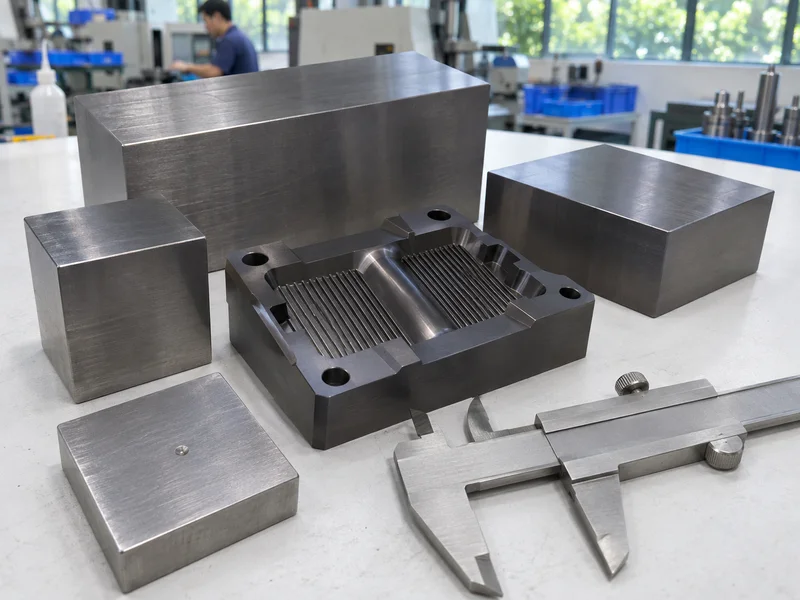
| Element (typical) | H13 / 1.2344 |
|---|---|
| Carbon | 0.32–0.45% |
| Chromium | 4.75–5.50% |
| Molybdenum | 1.10–1.75% |
| Vanadium | 0.80–1.20% |
| Silicon | 0.80–1.20% |
Common equivalents include AISI H13, EN 1.2344, JIS SKD61 and Chinese 4Cr5MoSiV1. Tool steel grades are specified in ASTM A681 from ASTM International. Our guide to A2 vs D2 tool steel covers cold-work grades.
Key Takeaway: Above all, H13 is a hot-work steel, so it keeps hardness where cold-work steels soften.
What Properties Make H13 Tool Steel Useful?
H13 tool steel is useful because it combines toughness, hot hardness and resistance to thermal cracking.
- High toughness for an air-hardening tool steel
- Hot hardness that holds at elevated temperature
- Thermal fatigue resistance against heat checking
- Good through-hardening in thick sections
- Nitriding response for a hard, wear-resistant surface
- Moderate corrosion resistance only, lower than stainless grades
For example, an aluminum die casting die in H13 cycles between molten metal and spray cooling thousands of times before heat checking appears. Our guide to heat treatment of steel explains hardening and tempering.
Key Takeaway: In other words, H13 resists the cracks caused by repeated heating and cooling.
How Is H13 Tool Steel Heat Treated?
H13 tool steel is hardened in vacuum or controlled atmosphere and tempered at least twice.
Typical route:
- Rough machine in the annealed state
- Stress relieve before finish machining
- Preheat, then austenitize at about 1,010–1,030 °C
- Gas quench in a vacuum furnace
- Double or triple temper to the target hardness
- Nitride where extra surface wear resistance is needed
For example, a mold insert for PA66 GF30 may be hardened to 48–50 HRC and then nitrided at the gate area. Pre-hardened H13 blocks of about 40–44 HRC are also available for simpler tools.
Key Takeaway: For this reason, specify the final hardness and any nitriding on the drawing.
Where Is H13 Used in Molds and Dies?
H13 is used where molds or dies need hardness, toughness and heat resistance together.
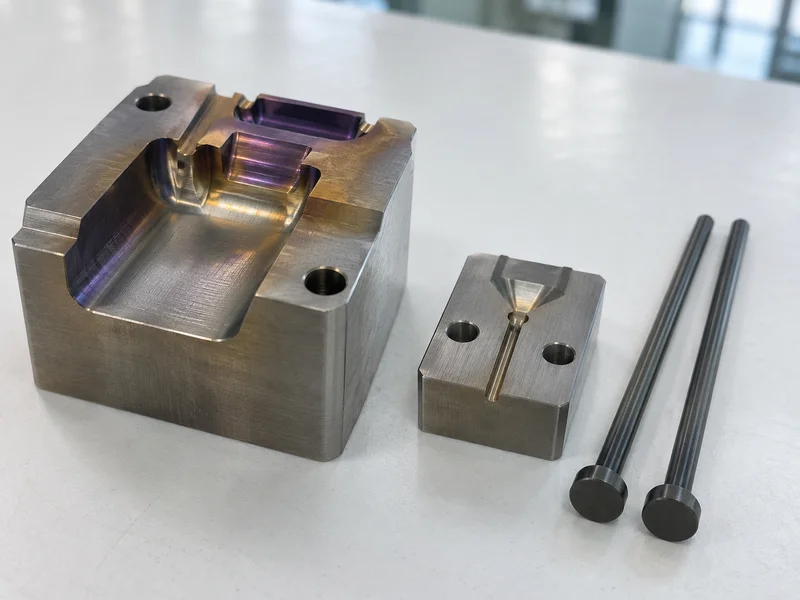
| Application | Why H13 |
|---|---|
| Die casting dies (aluminum, zinc) | Hot hardness, heat checking resistance |
| Hot forging and extrusion tools | Toughness at temperature |
| Injection mold inserts for filled resins | Wear resistance at 48–52 HRC |
| Slides, lifters and gate inserts | Toughness and hardness |
| Ejector pins and sleeves (nitrided) | Hard surface, tough core |
For example, many small precision molds use H13 inserts in a P20 mold base, so only the cavity steel carries the cost of hardening. Our guides to mold inserts and ejector pins give examples.
Key Takeaway: Overall, use H13 for hardened inserts and leave the mold base in pre-hardened steel.
How Is H13 Tool Steel Machined?
H13 tool steel is machined annealed and finished after hardening with hard milling, EDM and grinding.
- Annealed H13 at about 200–230 HB machines like other alloy steels
- Hard milling with coated carbide is possible after hardening
- Sinker and wire EDM form ribs, sharp corners and through profiles
- Grinding finishes fits and parting surfaces
- Polishing reaches SPI B to A grades with care
For example, a hardened H13 core is wire-cut for its profile, sinker-EDM’d for fine ribs and then polished. Our guides to wire EDM and surface grinding explain these steps.
Key Takeaway: Equally, leave stock for heat treatment and finish critical features after hardening.
How Does H13 Compare With Other Mold Steels?
H13 compares with other mold steels on hardness, toughness, polish and corrosion resistance.
| Steel | Typical hardness | Strength | Limitation |
|---|---|---|---|
| P20 / 718H | about 30–36 HRC | Pre-hardened, easy to machine | Lower wear resistance |
| H13 / 1.2344 | about 48–52 HRC | Tough, heat resistant | Needs heat treatment |
| 420 / S136 | about 48–52 HRC | Polish, corrosion resistance | Lower conductivity |
| D2 / 1.2379 | about 58–62 HRC | High wear resistance | Lower toughness |
For example, a high-volume clip mold in POM uses H13 inserts, while a clear lens mold uses 420 stainless steel. Our guide to injection mold steel material compares more grades.
Key Takeaway: As a rule, choose H13 for wear and toughness, stainless for polish and corrosion.
How Should H13 Tool Steel Be Specified?
H13 tool steel should be specified with grade, condition, hardness and surface treatment.
- Grade, such as “1.2344 ESR” or “AISI H13”
- Condition: annealed, pre-hardened or hardened
- Hardness range, such as 48–52 HRC
- Surface treatment, such as gas nitriding
- Material certificate where required
For example, “Core insert 1.2344 ESR, harden and temper 48–52 HRC, nitride gate area, material certificate” is complete. Our injection mold manufacturing team selects H13 inserts for filled and high-volume resins.
Key Takeaway: Finally, always state hardness with the grade; H13 without hardness is incomplete.
FAQ
- Q: What is H13 tool steel used for?
- Die casting dies, hot-work tools, hardened mold inserts and nitrided ejector pins.
- Q: How hard is H13 tool steel?
- Usually 44–52 HRC after hardening and tempering.
- Q: Is H13 the same as 1.2344 and SKD61?
- They are close equivalents with small composition differences.
- Q: Is H13 stainless?
- No, it has about 5% chromium and can rust.
- Q: Can H13 be nitrided?
- Yes, nitriding adds a hard surface for wear resistance.
Conclusion
H13 tool steel offers toughness, hot hardness and heat-checking resistance, which makes it a standard choice for die casting dies and hardened injection mold inserts. Specify grade, hardness and treatment clearly. To review a mold that needs hardened steel, send your 3D model and 2D drawing to our engineers.