
P20 Steel for Molds: Uses, Machining and Limits
P20 steel is a pre-hardened mold steel supplied at about 28–36 HRC, so cavities and cores can be machined directly without a heat treatment step. It machines easily, polishes and textures well, and is the most common steel for medium-volume injection molds, mold base plates and large cavity blocks. Its nickel-alloyed version, 718H or 1.2738, gives more even hardness in thicker blocks.
P20 has limits. For example, a P20 cavity running ABS can last hundreds of thousands of shots, but the same cavity running PA66 with 30% glass fiber may wear at the gate within a much shorter run, so hardened inserts are used there. In this guide, we explain P20 steel: grades, properties, uses, machining and polishing, limits, upgrades and how to specify it. For general steel choices, see our guide on how to choose mold steel.
P20 steel (AISI P20, EN 1.2311; nickel version 1.2738 / 718H) is a low-carbon chromium–molybdenum mold steel supplied pre-hardened to about 28–36 HRC. It machines well, accepts texture and polishing to good grades, and can be nitrided for better surface wear. It is used for cavities and cores in medium-volume molds, mold base plates, holders and large blocks. It is less suitable for abrasive glass-filled resins, corrosive resins such as PVC, very high volumes and mirror finishes, where hardened or stainless steels are preferred.
In short: P20 is the workhorse pre-hardened mold steel; upgrade it when wear, corrosion or polish demands more.
Key points:
- Supplied: pre-hardened, about 28–36 HRC.
- Strengths: machinability, texture, cost.
- Limits: wear and corrosion.
What Is P20 Steel?
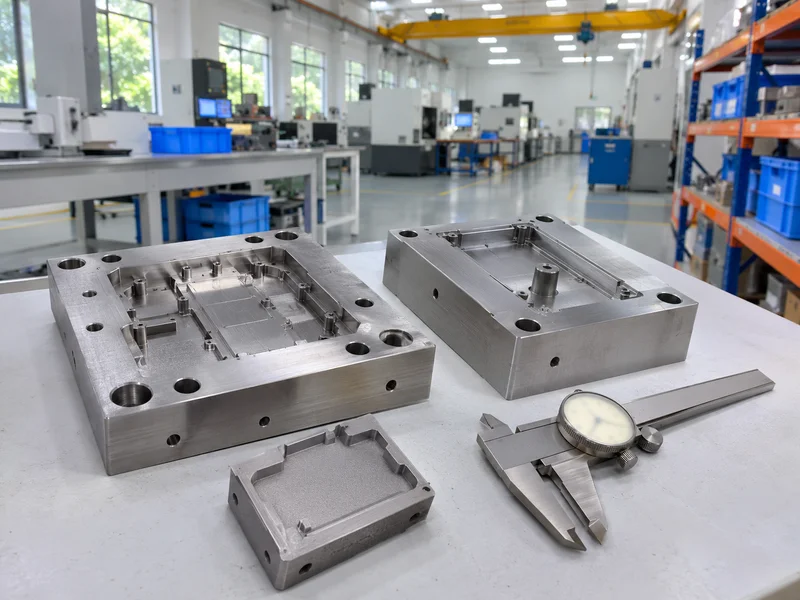
P20 steel is a plastic mold steel in the P group of tool steels.
| Grade | Typical hardness | Note |
|---|---|---|
| P20 / 1.2311 | about 28–34 HRC | Standard pre-hardened |
| P20+Ni / 1.2738 / 718H | about 33–37 HRC | More uniform in thick blocks |
| P20+S / 1.2312 | about 28–34 HRC | Free-machining, not for polishing |
Typical composition is about 0.35–0.45% carbon, 1.4–2.0% chromium and 0.2% molybdenum, plus about 1% nickel in 1.2738. Tool steels are specified in ASTM A681 from ASTM International. Our guide to injection mold steel material compares mold steels.
Key Takeaway: Above all, P20 is pre-hardened, which saves heat treatment time and distortion.
Why Is This Pre-Hardened Steel So Widely Used?
P20 steel is widely used because it balances machinability, toughness and cost.
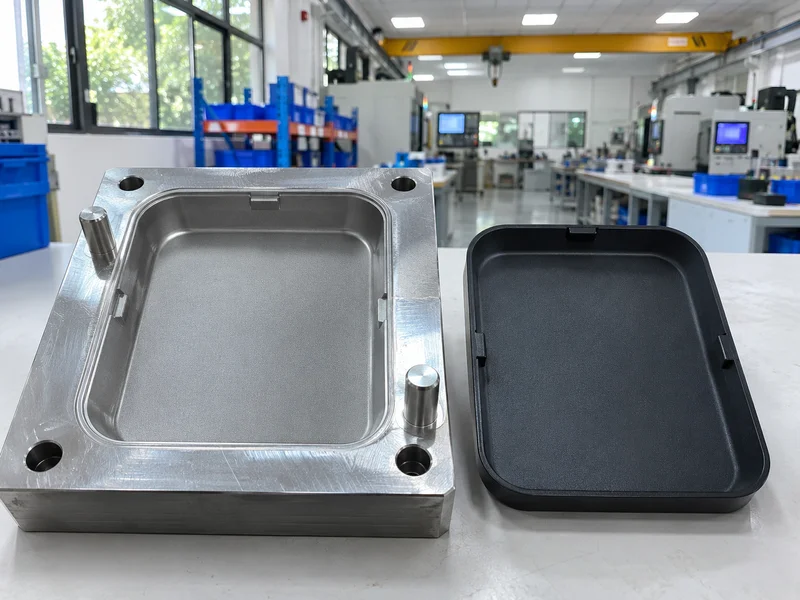
- No heat treatment before use, so less distortion and shorter lead time
- Good machinability for milling, drilling and EDM
- Texture response for VDI and chemical textures
- Reasonable polish to about SPI B-1 or A-3 with care
- Weldable for repairs and changes
- Nitridable for better surface hardness
For example, a mold for a textured appliance cover in ABS is often built entirely in 718H. Our guide to mold texture explains textures that suit P20.
Key Takeaway: In other words, choose P20 when speed, texture and cost matter more than maximum life.
Where Is This Mold Steel Used?
P20 steel is used across molds and tooling components.
| Use | Why P20 |
|---|---|
| Cavities and cores, medium volume | Machinable, adequate life |
| Mold base A and B plates | Strength and stability |
| Slides and holders | Toughness |
| Large cavity blocks | Uniform pre-hardened condition (718H) |
| Prototype and bridge molds | Fast build |
For example, a small precision mold may use a P20 base with hardened inserts at the gate and fine features. Our guides to mold inserts and mold bases for short production runs explain these layouts.
Key Takeaway: For this reason, P20 often carries the mold while harder steels carry the wear.
How Is It Machined and Polished?
P20 steel is machined in its supplied hardness and finished by EDM, polishing or texture.
- Milling and drilling with carbide tools at moderate speeds
- Sinker EDM for ribs and fine details
- Polishing in stages; avoid over-polishing soft spots
- Texturing after polishing to a suitable base finish
- Nitriding after machining to raise surface hardness
For example, a 718H cavity may be milled, EDM’d for logos, polished to SPI B-1 and then textured. Our guide to mold polishing explains finish grades.
Key Takeaway: Overall, P20 is fast to machine, so it shortens mold lead time.
What Are the Limits of P20 Steel?
The limits of P20 steel come from its moderate hardness and corrosion resistance.
- Abrasive resins such as glass-filled PA wear gates and shutoffs
- Corrosive resins such as PVC attack the steel
- Very high volumes need hardened steel
- Mirror finishes need cleaner, harder grades
- Rust in humid storage without protection
For example, a PVC fitting mold usually uses stainless steel cavities instead of P20. Our guides to H13 tool steel and 420 stainless steel describe common upgrades.
Key Takeaway: Equally, match the resin to the steel; P20 is not for every resin.
How Does P20 Steel Compare With 718H and H13?
P20 steel compares with 718H and H13 on hardness, uniformity and life.
| Steel | Hardness | Best for |
|---|---|---|
| P20 / 1.2311 | about 28–34 HRC | Small and medium blocks, general resins |
| 718H / 1.2738 | about 33–37 HRC | Larger blocks, better polish and texture |
| H13 / 1.2344 | about 48–52 HRC | Filled resins, high volume, hardened inserts |
For example, a 300,000-shot ABS mold may be fully 718H, while a 1,000,000-shot PA66 GF mold uses H13 inserts. Our guide to injection molding tool design explains how steel fits into mold design.
Key Takeaway: As a rule, upgrade from P20 to 718H for size and to H13 for wear.
How Should P20 Steel Be Specified?
P20 steel should be specified with grade, hardness and any surface treatment.
- Grade, such as “1.2311” or “718H / 1.2738”
- Hardness range, such as 30–36 HRC
- Surface treatment, such as nitriding
- Finish, such as SPI B-1 or VDI 27
- Material certificate where required
For example, “Cavity and core 718H, 33–37 HRC, texture VDI 27, material certificate” is complete. Our injection mold manufacturing team selects steel per insert using LKM, ASSAB or Gröditz sources as available.
Key Takeaway: Finally, specify the exact grade, because P20 variants behave differently.
FAQ
- Q: What is P20 steel?
- A pre-hardened mold steel supplied at about 28–36 HRC.
- Q: Is 718H the same as P20?
- 718H is a nickel-alloyed P20 with more uniform hardness in thick blocks.
- Q: Can P20 be hardened further?
- It is used pre-hardened; surface nitriding is the usual upgrade.
- Q: How many shots can a P20 mold make?
- Often hundreds of thousands with unfilled resins, depending on design and care.
- Q: Can P20 be polished to a mirror?
- Good polish is possible, but mirror finishes are better in stainless or ESR grades.
Conclusion
P20 steel is the standard pre-hardened mold steel for medium-volume molds, bases and large blocks. Use it for speed, texture and cost, and upgrade to 718H, H13 or stainless when size, wear, corrosion or polish demand it. To review steel for your mold, send your 3D model and 2D drawing to our engineers.