
Mold Base: Parts, Types, Standards and Sizing
A mold base is the steel frame of an injection mold: the plates, guide pins, bushings, ejector system housing and clamping plates that hold the cavity and core inserts in place and mount the mold in the press. Most mold bases are bought as standard units from suppliers such as LKM, HASCO, Meusburger or DME and then machined for the specific part.
The mold base decides alignment, stiffness and how easily the mold is maintained. For example, a small precision mold with a thin B-plate can bend under injection pressure and flash at the parting line, even when the cavity inserts are perfect; a thicker support plate or support pillars fixes it. In this guide, we explain the mold base: its parts, the main types, standards, plate steels, sizing and how to specify one. For a short-run angle, see our guide to mold bases for short production runs.
A mold base consists of a top clamping plate, A (cavity) plate, B (core) plate, support plate, spacer blocks or rails, ejector retainer and ejector plates, bottom clamping plate, guide pins and bushings, return pins, locating ring and sprue bushing. Common types are two-plate, three-plate and hot runner bases. Standard bases from LKM, HASCO, Meusburger, DME or Futaba come in fixed sizes with interchangeable components. Plates are usually medium-carbon steel such as 1050/S50C or pre-hardened P20, with inserts in harder steels.
In short: the mold base holds and aligns the inserts; size and stiffness matter as much as the cavity.
Key points:
- Function: hold, align and mount the inserts.
- Types: two-plate, three-plate, hot runner.
- Standards: LKM, HASCO, Meusburger, DME.
What Are the Parts of a Mold Base?
A mold base has plates for the cavity side, the core side and the ejector system.
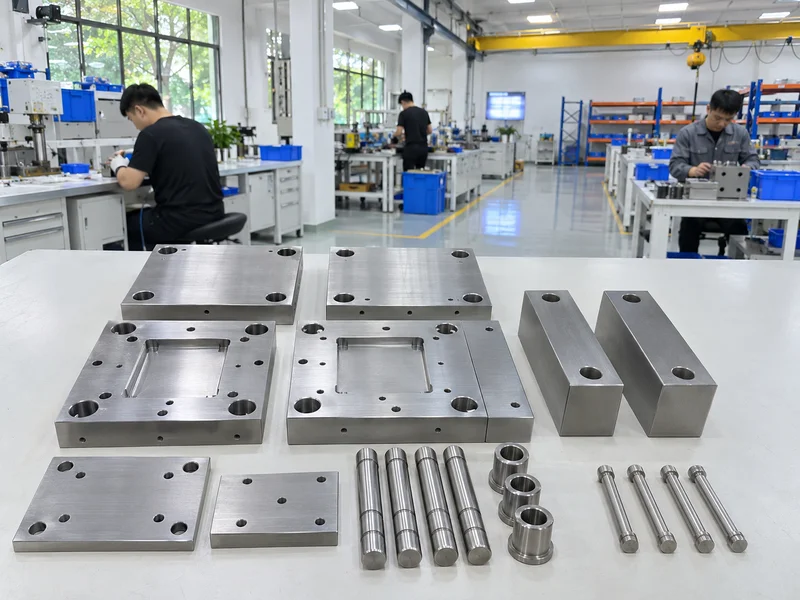
| Part | Function |
|---|---|
| Top clamping plate | Mounts the fixed half to the press |
| A plate | Holds cavity inserts |
| B plate | Holds core inserts |
| Support plate | Stiffens the B plate |
| Spacer blocks / rails | Create space for ejector travel |
| Ejector retainer and ejector plates | Carry ejector pins |
| Bottom clamping plate | Mounts the moving half |
| Guide pins and bushings | Align the two halves |
| Locating ring, sprue bushing | Center the mold on the nozzle |
For example, the locating ring diameter must match the press platen, or the mold cannot be mounted. Our guides to injection mold components and sprue bushing give details.
Key Takeaway: Above all, every plate has a structural job.
What Types of Mold Base Are Used?
The main types of mold base are two-plate, three-plate and hot runner.
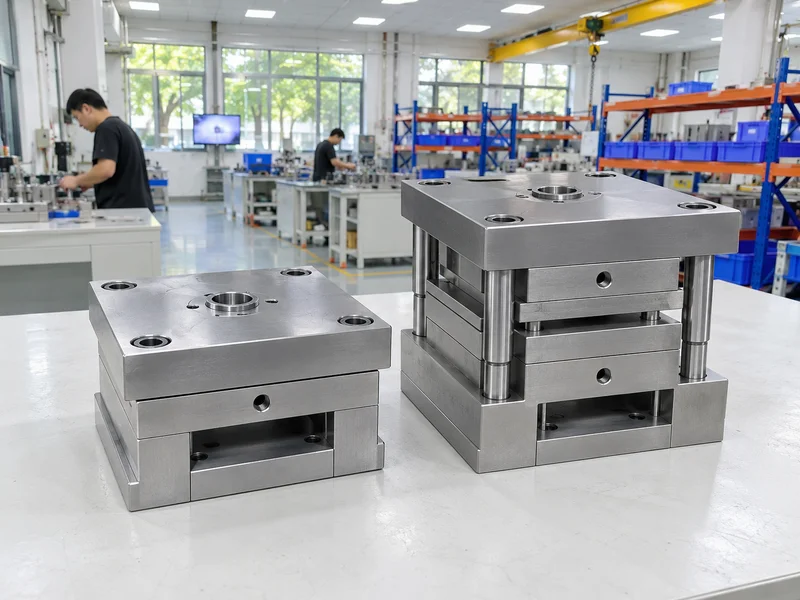
- Two-plate: one parting line; runner and part eject together
- Three-plate: extra runner plate; pin-point gates and automatic degating
- Hot runner: manifold plate holds the hot runner system
- Stack: two parting faces for double output
For example, a small cosmetic cap with a center pin-point gate often uses a three-plate base so the runner separates automatically. Our guides to hot runner systems and stack molds explain the other types.
Key Takeaway: In other words, the gating method usually decides the base type.
Which Standards Are Common?
Common mold base standards come from a few large component suppliers.
| Standard | Region | Note |
|---|---|---|
| LKM | China / Asia | Wide size range, common in Asian molds |
| HASCO | Europe | Metric, modular components |
| Meusburger | Europe | Metric, large catalog |
| DME | North America | Inch and metric series |
| Futaba | Japan | Metric |
For export molds, the base and components are often chosen to match the customer’s plant so spare parts are local. Component dimensions for molds are also covered by ISO standards.
Key Takeaway: For this reason, agree the mold base standard with the plant that will maintain the mold.
Which Steels Are Used for the Plates?
Base plates use medium-carbon or pre-hardened steels; cavity steel goes in the inserts.
- 1050 / S50C / 1.1730: standard plates, good machinability
- P20 / 1.2311 / 718H: plates that also form cavities, or need more strength
- Stainless plates: for corrosive or clean environments
- Hardened inserts: H13, S136 or similar in pockets
For example, a precision mold may use an S50C base with 718H A and B plates and H13 inserts. Our guides to P20 steel and mold inserts explain these combinations.
Key Takeaway: Overall, spend on insert steel and keep the plates in economical steel.
How Is a Mold Base Sized?
The base is sized by the inserts, cooling, side actions and the target press.
Sizing checks:
- Insert size plus wall around pockets for strength
- Space for cooling channels and water connectors
- Room for slides, lifters and their locks
- Ejector stroke set by spacer block height
- Press fit: tie-bar spacing, minimum and maximum mold height, platen size
- Plate thickness to limit B-plate deflection
For example, a mold with two side slides needs a wider base than the same cavity without slides. Our guide to injection molding tool design covers layout decisions.
Key Takeaway: Equally, check the press data before you order the base.
How Should a Mold Base Be Specified?
A mold base should be specified with standard, size, type, steel and components.
- Standard and series, such as LKM or HASCO
- Size and plate thicknesses
- Type: two-plate, three-plate or hot runner
- Plate steel and any pre-hardened plates
- Components: guide system, locks, ejector guides, support pillars
- Press interface: locating ring, nozzle radius, clamping slots
For example, “HASCO standard base, 296 × 346, two-plate, 1.2312 A/B plates, interlocks, ejector guided, locating ring Ø100” is complete. Our injection mold manufacturing team builds molds to HASCO, Meusburger, STRACK, DME, CUMSA or MISUMI standards.
Key Takeaway: Finally, write the press interface into the specification.
FAQ
- Q: What is a mold base?
- The steel frame that holds the cavity and core inserts and mounts the mold in the press.
- Q: What are the main types of mold base?
- Two-plate, three-plate and hot runner bases.
- Q: What is the difference between LKM, HASCO and DME?
- They are different suppliers’ standard systems with different sizes and components.
- Q: What steel is a mold base made of?
- Usually 1050/S50C or pre-hardened P20 plates.
- Q: Why does the mold base matter for precision?
- It controls alignment and stiffness, which affect flash and dimensions.
Conclusion
The mold base holds, aligns and mounts the mold. Choose the type by gating, the standard by the receiving plant, plate steel by function and size by inserts, actions and press. To review a mold base for your project, send your 3D model and 2D drawing to our engineers.