
Plastic Mold Making Process: From Design to Trials
Plastic mold making is the process of designing and building the steel tool that shapes molten plastic into a part. It runs from DFM and mold design through steel cutting, heat treatment, CNC machining, EDM, grinding, polishing, fitting and assembly to mold trials, corrections and final approval. For a typical small or medium precision injection mold, the build takes about 4–8 weeks.
Knowing the steps helps buyers plan and avoid delays. For example, a late change to a snap-fit after the cavity is hardened can mean welding and re-cutting steel, while the same change at DFM costs only a model update. In this guide, we explain plastic mold making step by step: quotation and DFM, design, steel and machining, finishing and fitting, trials and approval, timing and how to follow a project. For design detail, see our guide to injection molding tool design.
Plastic mold making follows a set sequence: RFQ review, kickoff and DFM, 3D mold design and approval, ordering steel and the mold base, rough machining, heat treatment of hardened inserts, finish CNC machining, sinker and wire EDM, grinding, polishing or texture, fitting and assembly, T0/T1 trials, corrections, sample approval and packing. Each step has an output that the next step depends on, so changes are cheapest early. Typical lead time is 4–8 weeks, depending on complexity, steel, hot runner, texture and validation.
In short: plastic mold making is a chain; decisions made at DFM save the most time and steel.
Key points:
- Front end: DFM and design approval.
- Build: machining, EDM, grinding, polishing, fitting.
- Close: trials, corrections, approval.
How Does Plastic Mold Making Start?
Plastic mold making starts with the part files, the RFQ and a DFM review.
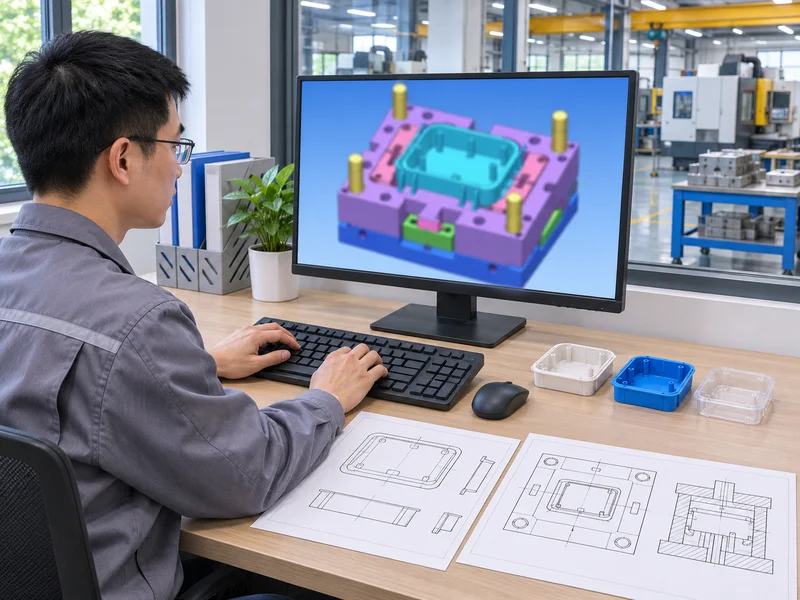
- RFQ: 3D model, 2D drawing, resin, volume, press, finish
- Quotation: tool concept, cavities, steel, lead time
- Kickoff: order and schedule confirmed
- DFM: draft, walls, gates, parting line, undercuts, ejection
For example, DFM may show that a 0° draft wall on a textured face will drag, so the customer approves 3° draft before design starts. Our injection molding quote RFQ checklist lists the inputs.
Key Takeaway: Above all, finish the part decisions before the mold design starts.
How Is the Mold Designed and Approved?
The mold is designed in 3D CAD and approved before steel is cut.
- Layout: cavities, runner, gates, mold base size
- Inserts: cavity, core and replaceable details
- Systems: cooling, venting, ejection, slides and lifters
- Simulation: Moldflow when complexity requires it
- Approval: customer signs off the 3D design and steel list
For example, a design review may move an ejector pin off a cosmetic face before the design is released. Our guide to mold flow analysis explains simulation.
Key Takeaway: In other words, an approved design freezes the scope and protects the schedule.
How Are Mold Steel and Inserts Machined?
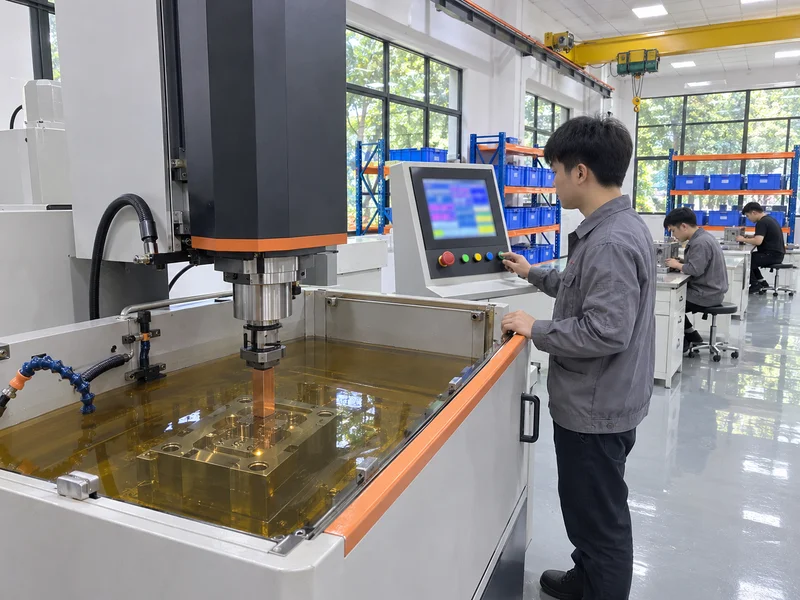
Mold steel and inserts are machined in stages around heat treatment.
| Stage | Process |
|---|---|
| Rough machining | CNC milling, drilling of cooling and ejector holes |
| Heat treatment | Hardening and tempering of hardened inserts |
| Finish machining | High-speed and 5-axis milling |
| Electrode work | Graphite or copper electrodes for EDM |
| Sinker EDM | Ribs, sharp corners, fine details |
| Wire EDM | Through profiles, slide and insert pockets |
| Grinding | Datum faces, fits and parting surfaces |
For example, a hardened core with deep thin ribs is milled where tools reach and sinker-EDM’d for the rib slots. Our guides to sinker EDM and wire EDM explain these steps.
Key Takeaway: For this reason, the machining route follows the feature, not one machine.
How Are Molds Finished, Fitted and Assembled?
Molds are finished, fitted by hand and assembled before the first trial.
- Polishing to the agreed SPI grade
- Texture applied by the texture supplier when specified
- Fitting of shutoffs, slides and parting surfaces with blue
- Assembly of inserts, ejector system, cooling and hot runner
- Checks: water circuits, movement, ejector travel, venting
For example, a slide shutoff is spotted with blue until the contact is even, which prevents flash at the side hole. Our guides to mold polishing and mold texture explain finishing.
Key Takeaway: Overall, fitting is where precision becomes a working mold.
How Are Trials Handled in Plastic Mold Making?
Mold trials and approval confirm that the mold makes good parts.
- T0 / T1 trial on a suitable press with the production resin
- Sample inspection of dimensions, appearance and function
- Correction list agreed with the customer
- Steel changes and re-trial
- Approval of samples and the trial record
A standard quotation often includes up to three trials and short sample runs. For example, T1 samples may show a dimension slightly off; the steel is adjusted and T2 confirms it. Our guide to mold inspection standards covers checks, and measurement standards are published by ISO.
Key Takeaway: Equally, agree the acceptance criteria before the first trial.
How Long Does Plastic Mold Making Take?
Plastic mold making usually takes about 4–8 weeks from design approval to first samples.
| Factor | Effect on time |
|---|---|
| Part complexity and slides | Longer |
| Hardened steel inserts | Adds heat treatment time |
| Hot runner | Adds lead time for the system |
| Texture | Adds supplier time |
| Late design changes | Adds rework and trials |
For example, a simple two-cavity mold may reach T1 in about four weeks, while a complex mold with lifters and texture takes longer. Our injection mold manufacturing projects include weekly photo updates during the build.
Key Takeaway: As a rule, fast approvals shorten mold lead time more than faster machining.
How Do Molds Leave the Plant?
Molds leave the plant after approval, inspection and export packing.
- Final inspection and spare parts list
- Anti-rust protection of cavities and plates
- Vacuum packing and fumigated wooden case
- Documents such as trial report and steel list as agreed
For example, an export mold ships with its trial samples, water layout drawing and quoted spare ejector pins. Our precision mold making page explains how we verify critical features before handover.
Key Takeaway: Finally, agree packing and documents when you order the mold, not when it ships.
FAQ
- Q: What are the steps of plastic mold making?
- DFM, design, steel, machining, EDM, grinding, polishing, fitting, trials, approval and packing.
- Q: How long does it take to make an injection mold?
- Usually about 4–8 weeks for small and medium molds.
- Q: What is a T1 sample?
- A sample part from an early mold trial used to check dimensions and function.
- Q: Why is DFM important?
- It fixes part issues before steel is cut, when changes are cheap.
- Q: Which machines are used in mold making?
- CNC machining centers, sinker and wire EDM, grinders and trial presses.
Conclusion
Plastic mold making runs from DFM and design through machining, finishing and fitting to trials and approval. Freeze decisions early, agree acceptance criteria and follow the build with clear updates. To start a mold project, send your 3D model and 2D drawing to our engineers.