
Contract Injection Molding: How to Pick the Best Partner
Contract injection molding is a manufacturing service in which an outside molder produces plastic parts to the customer’s design, using molds that the customer usually owns, while the molder supplies the presses, process engineering, labor and quality control. It lets product companies get molded parts without buying machines, hiring molding staff or running a plant.
Choosing the right contract molder matters more than the hourly machine rate. For example, two suppliers may quote the same part price, but one includes DFM review, mold trials and dimensional reports, while the other quotes only molding and charges every change later. In this guide, we explain how contract injection molding works, what it includes, when to use it, how to compare suppliers, what to agree in the contract and how a project runs. For supplier questions, see our list of questions to ask an injection molding company.
Contract injection molding covers some or all of these services: DFM review, mold design and building, mold trials, material sourcing, production molding, secondary operations, assembly, inspection, packaging and logistics. The customer supplies the part design and usually owns the mold after paying for it. Key terms to agree are mold ownership, part price basis, minimum order, lead times, quality documents, change control, spare parts and maintenance responsibility. It suits companies that want flexible capacity and engineering support without capital in presses.
In short: contract injection molding buys capacity and expertise, so define responsibilities clearly.
Key points:
- Customer: design, approval, ownership of the mold.
- Molder: tooling, process, production, quality.
- Contract: ownership, price basis, quality and changes.
How Does Contract Injection Molding Work?
Contract injection molding works by splitting responsibilities between the customer and the molder.
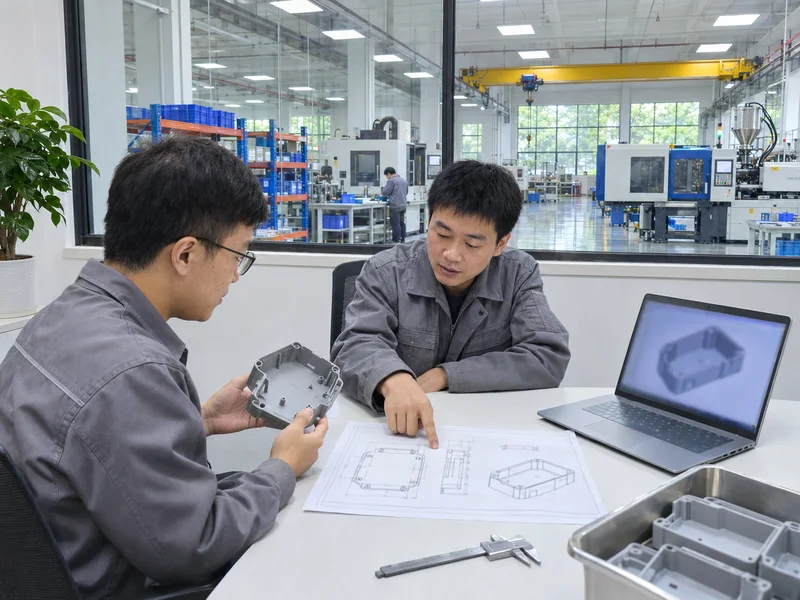
| Responsibility | Usually customer | Usually molder |
|---|---|---|
| Part design | ✓ | DFM feedback |
| Mold | Pays for and owns | Designs, builds, maintains |
| Material | Approves grade | Buys and controls lots |
| Process | Approves samples | Develops and documents |
| Quality | Sets acceptance criteria | Inspects and reports |
| Logistics | Chooses Incoterms | Packs and ships |
For example, a European buyer may own a 2-cavity mold kept at the molder’s site, approve T1 samples and then place monthly orders. Our plastic injection molding page explains our production route.
Key Takeaway: Above all, write down who owns each decision before the mold is built.
What Services Does a Contract Molder Provide?
A contract molder provides a range of services beyond molding.
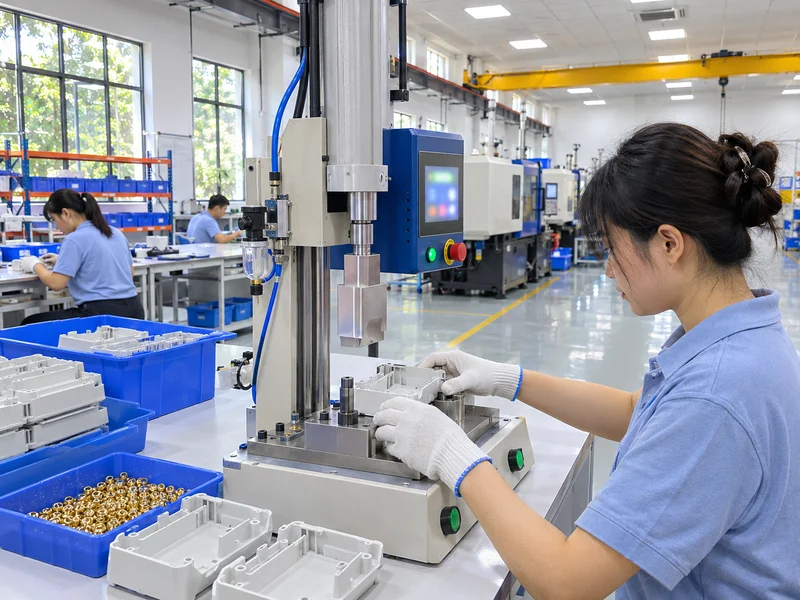
- Engineering: DFM, mold flow analysis, tolerance review
- Tooling: mold design, building, trials and repairs
- Molding: production on suitable presses
- Secondary operations: inserts, ultrasonic welding, printing, laser marking, assembly
- Quality: FAI, CMM reports, in-process checks
- Logistics: packing, labeling, export documents
For example, a molder can insert brass nuts, ultrasonically weld two halves and pack finished assemblies, so the customer receives a ready component. Our Engineering & DFM page and our guide to ultrasonic welding plastic explain some of these steps.
Key Takeaway: In other words, compare service scope, not just the molding price.
When Is Outsourced Molding the Right Choice?
Contract injection molding is the right choice when in-house molding would cost more or add risk.
- No presses or molding staff in house
- Variable demand that does not justify fixed capacity
- Specialized processes such as two-shot or insert molding
- Cost targets that need a lower-cost region
- Fast launch without building a plant
It is less suitable when the part is core intellectual property that must never leave the company, or when volumes are so high and stable that a dedicated in-house cell is cheaper. For example, a company with a single high-volume product may later bring molding in-house. Our two-shot injection molding page covers a common specialized process.
Key Takeaway: For this reason, consider capacity, skills and IP together when deciding.
How Do You Compare Contract Injection Molding Suppliers?
You compare contract injection molding suppliers on capability, communication and quality evidence.
| Factor | What to check |
|---|---|
| Press range | Tonnage and shot size for your parts |
| Tooling | In-house or partner tool shop, mold standards |
| Engineering | DFM quality, simulation where needed |
| Materials | Experience with your resin grades |
| Quality | Inspection equipment, sample reports |
| Communication | Language, response time, progress reports |
| Logistics | Export experience, Incoterms |
For example, a sample DFM report and a sample CMM report often tell more than a capability brochure. Our guide to supplier audit checklists lists what to inspect on site.
Key Takeaway: Overall, ask for real reports and talk to the engineers who will run your project.
What Should a Contract Molding Agreement Cover?
A contract molding agreement should cover ownership, price, quality and change rules.
- Mold ownership and the right to move it
- Part price basis: resin price, cycle time, cavities, volume
- Resin price adjustment rules
- Minimum order and lead times
- Quality documents and acceptance criteria
- Engineering changes and how they are priced
- Mold maintenance and repair responsibility
- Confidentiality and IP protection
For example, a resin clause that adjusts price when the published resin index moves by more than 5% avoids disputes. Our guide to engineering change orders explains change control. General contract and trade terms follow ICC Incoterms definitions.
Key Takeaway: Equally, clear ownership and change rules prevent most later disputes.
How Does a Contract Molding Project Run?
A contract injection molding project runs from RFQ to repeat production in clear steps.
- RFQ: 3D model, 2D drawing, volume and material
- Quote and DFM: price, tool concept and risks
- Mold build: typically 4–8 weeks for small and medium molds
- T1 samples and corrections
- Approval: FAI or dimensional report
- Pilot lot and production release
- Repeat orders under agreed terms
For example, a medium housing mold usually reaches T1 in 5–6 weeks, then one or two correction loops before approval. Our injection molding quote checklist lists the data to send.
Key Takeaway: As a rule, plan time for at least one correction loop after T1.
How Do We Handle Contract Injection Molding?
We handle contract injection molding as one project with one point of contact.
- Molds built in our 1,800 m² factory in Dongguan
- Production molding in our Shenzhen molding plant, 41 presses from 30 to 380 T including two-shot machines
- Engineering in English, with weekly photo progress reports
- Quality documents such as FAI, CMM reports and 8D supplied per project
- Terms project-based, with no fixed minimum order
For example, a small connector housing can be designed, molded and inspected with its mold trial report and dimensional report in one project file. Our injection mold manufacturing page explains the tooling side.
Key Takeaway: Finally, one team that owns both mold and production shortens problem solving.
FAQ
- Q: What is contract injection molding?
- An outside molder producing plastic parts to your design using your mold.
- Q: Who owns the mold?
- Usually the customer, once the mold is paid for; confirm it in the contract.
- Q: What is the minimum order?
- It varies; many molders set it by press time, and some work project by project.
- Q: What should I send for a quote?
- A 3D model, a 2D drawing, annual volume and material.
- Q: How long until first parts?
- About 4–8 weeks to T1 for small and medium molds.
Conclusion
Contract injection molding gives access to tooling, presses and engineering without the cost of a plant. Choose a supplier on real capability and clear terms, not price alone. To start a contract molding project, send your 3D model and 2D drawing to our engineers.