
Injection Molding in China: How to Pick the Best Supplier
Injection molding in China means sourcing molds, molded plastic parts or both from Chinese tool shops and molders, most of which are clustered in Guangdong, Zhejiang and Jiangsu. Buyers choose China mainly for lower tooling cost, fast mold building and a deep supply chain of steel, mold components, hot runners and secondary processes, but they must manage communication, quality approval, IP and logistics carefully.
The biggest risks are usually unclear specifications, not distance. For example, a buyer who sends only a 3D model may receive parts that match the model but miss an unmarked cosmetic surface, while a buyer who sends a 2D drawing with critical dimensions and cosmetic zones gets parts checked against the right standard. In this guide, we explain why buyers choose injection molding in China, the regions, costs, how to choose a supplier, how to protect IP, quality approval, shipping and a step-by-step sourcing process. For an RFQ template, see our injection molding quote checklist.
Injection molding in China typically offers mold prices well below Western levels and mold lead times of about 4–8 weeks for small and medium molds. Guangdong (Dongguan, Shenzhen) is the largest hub for precision molds and molded parts. Success depends on a complete RFQ (3D model, 2D drawing, material, volume), engineering contact in English, written approval of samples, agreed mold standards and steel, an NDA or NNN agreement, inspection before shipment and clear Incoterms such as EXW, FOB or DDP.
In short: China offers cost and speed, and clear specifications turn that into reliable parts.
Key points:
- Hub: Guangdong for precision molds and parts.
- Lead time: about 4–8 weeks to T1 for many molds.
- Key to success: clear drawings, approvals and inspection.
Why Do Buyers Choose Injection Molding in China?
Buyers choose injection molding in China for cost, speed and supply chain depth.
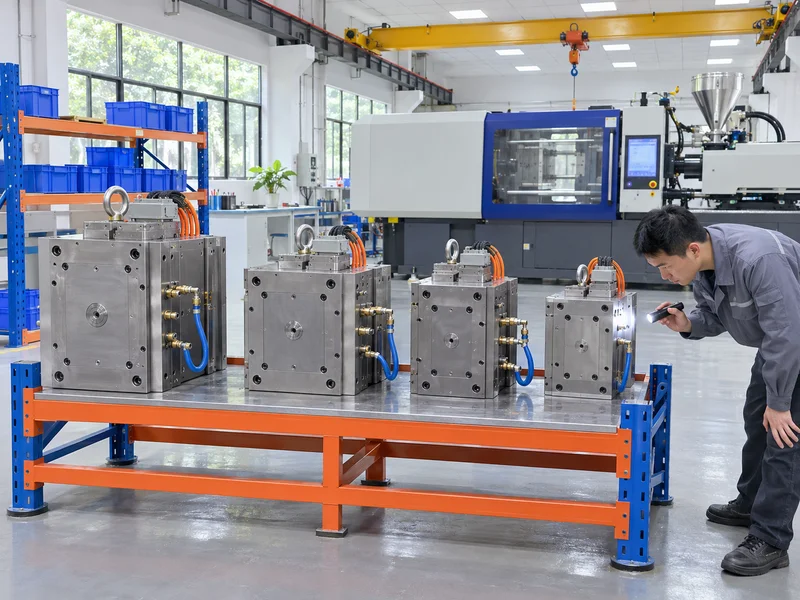
- Tooling cost: lower labor and machining cost in mold building
- Speed: many shops run machines in two shifts
- Supply chain: steel, mold bases, hot runners and standard parts nearby
- Process range: two-shot, insert molding, micro molding and secondary operations
- Scale: capacity for both pilot lots and mass production
For example, a mold that needs graphite electrodes, wire EDM and a hot runner can source all three within a short drive in Dongguan. Our injection mold manufacturing page explains the tooling steps.
Key Takeaway: Above all, the savings come from an integrated supply chain, not only from labor cost.
Which Regions Lead Injection Molding in China?
Several regions lead injection molding in China, each with its own strengths.
| Region | Main cities | Strengths |
|---|---|---|
| Pearl River Delta (Guangdong) | Dongguan, Shenzhen, Guangzhou | Precision molds, electronics, consumer products |
| Yangtze River Delta | Ningbo, Taizhou, Suzhou, Shanghai | Automotive, appliances, large molds |
| Other regions | Xiamen, Qingdao, Tianjin | Regional industries |
For example, Ningbo and Taizhou are known for large automotive and appliance molds, while Dongguan has many small and medium precision mold shops. Our precision mold making page explains the small and medium precision molds we focus on.
Key Takeaway: In other words, match the region to the size and type of your parts.
How Much Does Injection Molding in China Cost?
Injection molding in China costs less for tooling, while part prices depend mostly on resin and cycle time.
| Cost item | What drives it |
|---|---|
| Mold | Size, cavities, steel, hot runner, slides |
| Part price | Resin, cycle time, cavities, labor |
| Samples | Trials and sample freight |
| Inspection | FAI, CMM reports, third-party checks |
| Freight and duty | Mode, Incoterms, import tariffs |
For example, a large resin share of a part’s cost means part prices from China may be close to local prices, while the mold saving remains large. Duties and tariffs vary by country and product code, so check them before comparing quotes. Our guides to injection mold cost and how much injection molding costs explain the cost drivers.
Key Takeaway: For this reason, compare landed cost per part, including freight and duty.
How Do You Choose a China Injection Molding Supplier?
You choose a China injection molding supplier by checking engineering, tooling, molding and communication.
- Engineering: quality of the DFM report and questions asked
- Tooling: own tool shop or partner shop, mold standards (HASCO, DME, LKM)
- Molding: press range, two-shot or insert capability
- Quality: CMM, inspection reports, sample approval process
- Communication: English-speaking engineers, progress reports
- References: examples of similar parts
For example, a supplier that returns a DFM report with draft, wall and gate comments before quoting is usually easier to work with. Our guide to questions to ask an injection molding company lists the details to check.
Key Takeaway: Overall, judge suppliers by the engineering questions they ask.
How Can You Protect IP When Molding in China?
You can protect IP when molding in China with contracts, data control and supplier choice.
- NNN agreement (non-disclosure, non-use, non-circumvention) under Chinese law
- Share only needed data, such as part files without full assemblies
- Mold ownership stated in the purchase order
- Trademark registration in China for branded products
- Supplier vetting before sharing designs
For example, a buyer can send a single part file and drawing instead of the full product assembly. Guidance on IP in China is available from the EU China IP SME Helpdesk.
Key Takeaway: Equally, register trademarks and sign an NNN before sharing designs.
How Is Quality Approved for Parts From China?
Quality for parts from China is approved through samples, reports and pre-shipment checks.
| Step | What to agree |
|---|---|
| T1 samples | Number of shots, dimensional report |
| Approval | Signed golden samples, FAI |
| Production | Critical features, check frequency |
| Pre-shipment | AQL sampling, packing check |
| Problems | Containment, root cause, 8D report |
For example, keeping signed golden samples at both sites lets both sides check color and cosmetic disputes against the same parts. Our guides to first article inspection reports and 8D reports explain the documents, and our quality control & inspection page shows our inspection process.
Key Takeaway: As a rule, approve samples in writing and keep a golden sample on both sides.
How Does Sourcing Injection Molding in China Work?
Sourcing injection molding in China works best as a defined sequence of steps.
- Send RFQ: 3D model, 2D drawing, material, volume
- Review quotes and DFM from two or three suppliers
- Sign NNN and place the mold order, often 50% / 40% / 10% payment
- Follow mold building through weekly photo reports
- Approve T1 samples, then corrections
- Release production after the pilot lot
- Ship under EXW, FOB or DDP
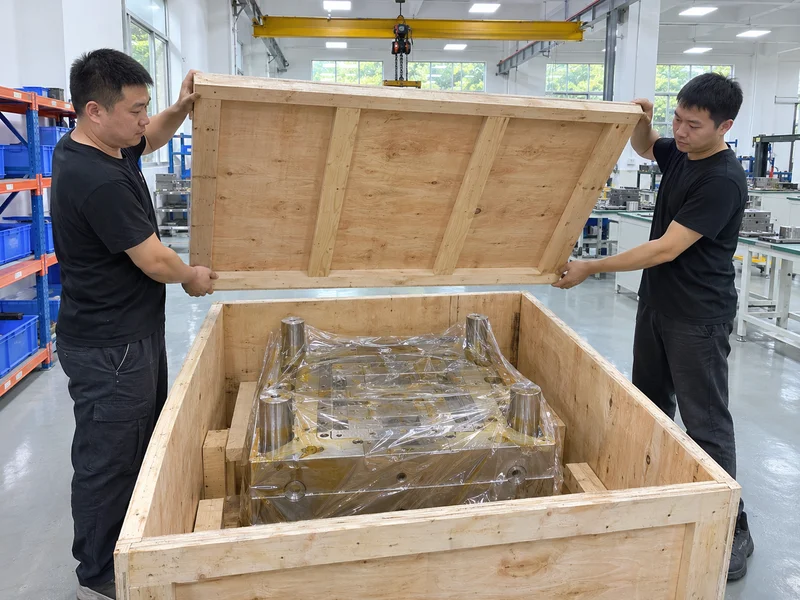
For example, molds bought for production elsewhere are packed with anti-rust oil, vacuum bagging and a fumigated wooden case. Our plastic injection molding page explains how our team builds molds in our Dongguan factory and runs production in our Shenzhen plant.
Key Takeaway: Finally, a clear process with written approvals removes most sourcing risk.
FAQ
- Q: Is injection molding in China cheaper?
- Tooling usually is; part prices depend on resin share, freight and duty.
- Q: How long does a mold take in China?
- About 4–8 weeks to T1 for many small and medium molds.
- Q: Where are most Chinese mold makers?
- In Guangdong and the Yangtze River Delta.
- Q: How do I protect my design?
- Use an NNN agreement, share only needed data and register trademarks.
- Q: Which Incoterms are common?
- EXW and FOB, with DDP available from some suppliers.
Conclusion
Injection molding in China offers lower tooling cost, speed and a full supply chain when specifications, approvals and IP are handled clearly. Choose suppliers on engineering and quality evidence. To get a quote and DFM review, send your 3D model and 2D drawing to our engineers.