
Metal to Plastic Conversion: Benefits, Materials, Limits
Metal to plastic conversion is the redesign of a machined, cast or stamped metal part as an injection molded plastic part, usually in a glass-filled engineering resin, to cut weight, cost and assembly steps. It works well for brackets, housings, covers, clips, fluid fittings and gear parts when loads, temperatures and tolerances fit what plastics can do, and fails when a design is simply copied from metal to plastic.
A good conversion is a redesign, not a material swap. For example, a zinc die-cast bracket with 4 mm solid walls copied in PA66 GF30 would sink and warp, while the same bracket redesigned with 2.5 mm walls, ribs and molded-in clips can be lighter, cheaper and just as stiff for its load. In this guide, we explain metal to plastic conversion: benefits, suitable parts, materials, design changes, limits, validation and the conversion process. For resin choices, see our guide to engineering plastics.
Metal to plastic conversion replaces metal parts with molded engineering plastics such as PA66 GF, PPA, PBT GF, PPS, PEEK or POM. Benefits include 30–60% lower weight, part consolidation, corrosion resistance and lower cost per part at volume. Limits include lower stiffness, creep under long-term load, heat and moisture effects, and wider tolerances. Successful conversion starts from the function, redesigns walls with ribs and uniform thickness, selects a grade for the real environment, adds metal inserts where needed and validates with tests under real load and temperature.
In short: convert when the function fits plastic, and redesign the part for molding.
Key points:
- Benefits: weight, consolidation, corrosion, cost.
- Limits: stiffness, creep, heat, tolerance.
- Method: redesign, test, then tool.
What Are the Benefits of Metal to Plastic Conversion?
The benefits of metal to plastic conversion come from weight, consolidation and lower processing cost.
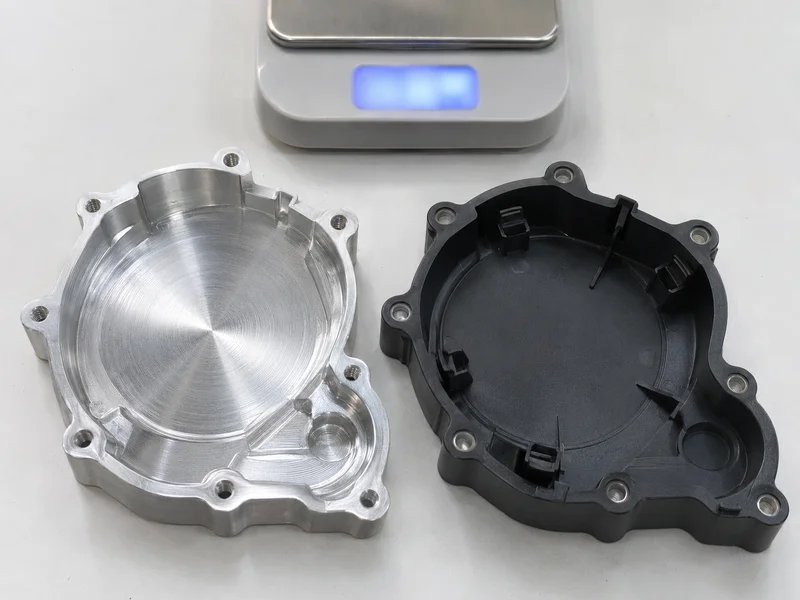
- Weight: plastics are about one-fifth to one-seventh the density of steel
- Part consolidation: clips, bosses and hinges molded in one part
- No finishing: color and texture molded in, no painting or plating
- Corrosion resistance: no rust or galvanic issues
- Cost per part: short cycles at volume
- Noise and vibration: better damping
For example, a three-piece steel bracket with screws can become one molded part with snap fits, removing two assembly steps. Our guides to snap fit design and living hinge design show integrated features.
Key Takeaway: Above all, the largest savings usually come from removing parts and operations.
Which Parts Suit Metal to Plastic Conversion?
Parts suit metal to plastic conversion when loads, temperatures and tolerances are within plastic limits.
| Good candidates | Poor candidates |
|---|---|
| Brackets and supports under moderate load | Highly stressed structural parts |
| Housings and covers | Parts above about 150–200 °C continuous |
| Pump and valve bodies at moderate pressure | High-pressure hydraulic parts |
| Gears and cams at light load | Precision bearing seats with tight fits |
| Clips, levers and handles | Very low volume parts |
For example, a die-cast aluminum motor cover often converts well, while an engine mount does not. Our guide to plastic gears explains gear conversions.
Key Takeaway: In other words, screen by load, temperature, tolerance and volume first.
Which Materials Replace Metal?
Glass-filled and high-performance plastics replace metal in most conversions.
| Material | Typical use | Notes |
|---|---|---|
| PA66 GF30–50 | Brackets, housings | Strong, absorbs moisture |
| PPA GF | Higher heat, automotive | Less moisture effect than PA66 |
| PBT GF | Electrical housings | Stable, good in humidity |
| PPS GF | High heat, chemicals | Brittle, high stiffness |
| PEEK / PEEK CF | Extreme conditions | High cost |
| POM | Gears, moving parts | Low friction |
For example, a PA66 GF30 bracket may lose a large share of its stiffness when wet and hot, so PPA GF may be chosen for under-hood parts. Our guides to glass filled nylon, PPS injection molding and PEEK injection molding explain these grades.
Key Takeaway: For this reason, use property data at the real temperature and moisture, not dry room-temperature values.
How Should a Part Be Redesigned for Plastic?
A part should be redesigned for plastic with uniform walls, ribs and features suited to molding.
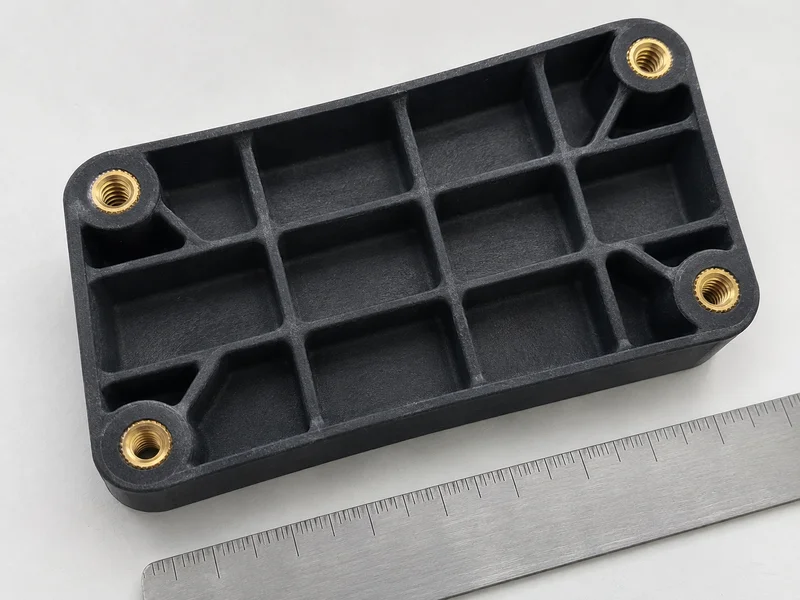
- Uniform walls, often 2–4 mm, instead of thick metal sections
- Ribs for stiffness, about 50–60% of wall thickness
- Generous radii to reduce stress concentration
- Draft on all walls
- Metal inserts for threads and high-load points
- Fiber orientation considered with gate position
For example, replacing a 6 mm solid wall with a 2.5 mm wall and a grid of ribs keeps stiffness while avoiding sink. Our guides to injection molding wall thickness, draft angle guidelines and plastic threaded inserts give the rules.
Key Takeaway: Overall, redesign around stiffness from geometry, not from thickness.
What Are the Limits of Metal to Plastic Conversion?
The limits of metal to plastic conversion come from stiffness, creep, temperature and tolerance.
| Limit | Effect | Mitigation |
|---|---|---|
| Lower stiffness | More deflection | Ribs, higher glass content |
| Creep | Deformation under long load | Lower stress, creep data |
| Temperature | Strength loss when hot | High-heat grades |
| Moisture | Size and stiffness change | PPA, PBT or conditioning |
| Tolerance | Wider than machining | Machining critical features |
| Anisotropy | Weaker across fiber flow | Gate position, flow simulation |
For example, a bolted plastic flange can relax over time, so compression limiters are molded in. Our guides to creep deformation and injection molding tolerances explain these effects.
Key Takeaway: Equally, plan for creep and tolerance from the start, not after testing fails.
How Is a Converted Part Validated?
A converted part is validated with simulation, prototypes and tests under real conditions.
- FEA with temperature- and moisture-adjusted properties
- Mold flow analysis for fiber orientation and weld lines
- Prototypes: machined plastic or bridge-tool parts
- Tests: load, fatigue, creep, thermal cycling, chemical exposure
- Field trial before full release
For example, a machined PA66 GF prototype gives a first load test, but only molded parts show the real weld lines and fiber orientation. Test methods are published by ASTM and ISO. Our guide to mold flow analysis explains simulation.
Key Takeaway: As a rule, validate with molded parts before releasing the production tool.
How Does a Metal to Plastic Conversion Project Run?
A metal to plastic conversion project runs from screening to production in stages.
- Screen the part: load, temperature, tolerance, volume
- Select materials and compare costs
- Redesign with DFM review
- Simulate structure and filling
- Prototype and test
- Build the production mold
- Validate molded parts and release
For example, a buyer converting a machined aluminum cover can compare the current machined part cost with the molded part cost plus tooling over the life volume. We support both routes: our CNC machining services page covers metal parts and prototypes, and our plastic injection molding page covers the molded result.
Key Takeaway: Finally, compare total cost over life volume, including tooling and removed operations.
FAQ
- Q: What is metal to plastic conversion?
- Redesigning a metal part as an injection molded plastic part.
- Q: How much weight can be saved?
- Often 30–60%, depending on the design and material.
- Q: Which plastics replace metal?
- Mainly glass-filled PA66, PPA, PBT, PPS and PEEK.
- Q: Is plastic as strong as metal?
- Not per volume, but redesign with ribs can meet the part’s real load.
- Q: When is conversion not worth it?
- For highly stressed, very hot, very tight tolerance or very low volume parts.
Conclusion
Metal to plastic conversion can cut weight and cost when the part is redesigned for molding and validated under real conditions. Screen candidates carefully and test molded parts. To review a conversion, send your 3D model and 2D drawing to our engineers.