
Plastic Gears: Materials, Gear Types and Molded Design
Plastic gears are toothed wheels made from engineering plastics such as POM, PA66 and PEEK, usually by injection molding, that transmit motion quietly and without lubrication in small and medium-load drives. They are used in printers, appliances, power tools, automotive actuators, medical devices and office equipment, where low weight, low noise and low cost per part matter more than very high torque.
Molding gears accurately takes more care than molding most parts. For example, a POM spur gear with a gate on one side of the rim can shrink unevenly and go out of round, while the same gear with a center or three-point gate stays round enough to mesh quietly. In this guide, we explain plastic gear materials, gear types, design rules, molding, accuracy, testing and when to choose plastic over metal. For general molding design, see our guide to injection molding wall thickness.
Plastic gears are mainly molded from POM (acetal), PA6 and PA66 (nylon), PBT, PPS and PEEK, sometimes with glass, PTFE or carbon fill. They run quiet and self-lubricating, resist corrosion and cost little in volume, but carry less load, are sensitive to heat and moisture, and are less accurate than ground metal gears. Accuracy depends on uniform walls, gate position, cooling, shrinkage compensation in the mold and a stable process. Typical molded gear quality is about AGMA 6–10 or ISO 8–10, with higher grades possible with precise tooling.
In short: plastic gears work best for light to moderate loads where quiet running and low cost matter.
Key points:
- Materials: POM and nylon cover most uses.
- Accuracy driver: gate, walls and shrinkage control.
- Limits: load, temperature and moisture.
What Are Plastic Gears Used For?
Plastic gears are used in drives that need low noise, low weight and no lubrication.
- Office and consumer products: printers, shredders, kitchen appliances
- Power tools and garden tools: small reduction stages
- Automotive: window lifts, seat adjusters, mirror and HVAC actuators
- Medical and lab devices: pumps and dispensers
- Toys and small motors: low-cost gear trains
For example, an HVAC flap actuator often uses a POM gear train driven by a small DC motor. Our guide to automotive injection molding covers related parts.
Key Takeaway: Above all, plastic gears fit drives where noise and cost matter more than peak torque.
Which Materials Are Best for Plastic Gears?
The best materials for plastic gears depend on load, speed, temperature and moisture.
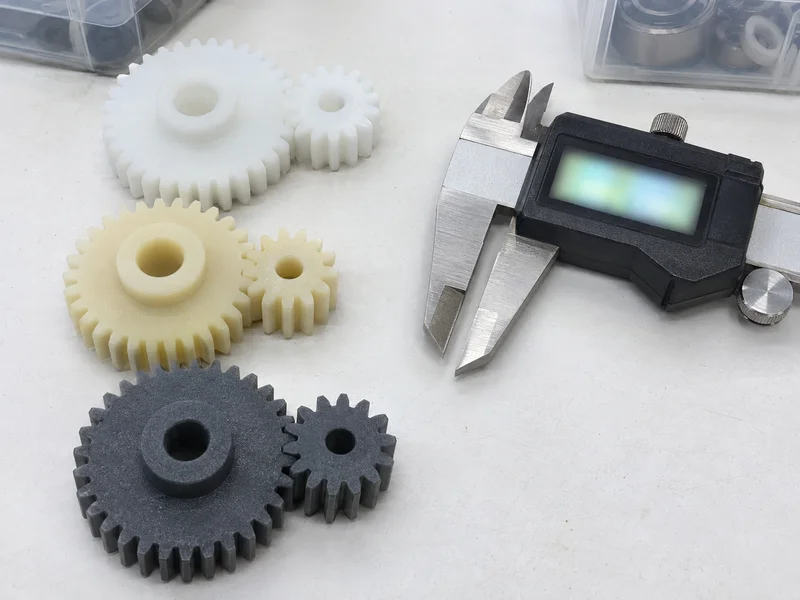
| Material | Strengths | Watch out for |
|---|---|---|
| POM (acetal) | Low friction, dimensional stability, fatigue strength | Weak against strong acids |
| PA66 / PA6 (nylon) | Toughness, impact, wear | Absorbs moisture, size changes |
| PA66 GF | Higher stiffness and load | More wear on mating gear |
| PBT | Stable, good in humid conditions | Lower fatigue than POM |
| PPS / PEEK | High temperature, chemicals | High cost |
| PTFE-filled grades | Lower friction and wear | Lower strength |
Nylon gears are popular for impact loads, but a gear pair of POM driving PA66 often wears less than two gears of the same material. Our guides to POM injection molding, nylon 6 vs nylon 66 and Delrin vs nylon compare these resins.
Key Takeaway: In other words, pair materials and check moisture before choosing a gear grade.
Which Gear Types Can Be Molded?
Most common gear types can be molded, but some need more complex tools.
- Spur gears: simplest, straight pull from the mold
- Helical gears: need a rotating core or unscrewing action to release
- Worm and worm wheels: worms often need side actions or unscrewing
- Internal gears: molded inside housings
- Cluster gears: two gears molded as one part
- Bevel gears: possible with careful parting design
For example, a helical gear is released by letting the core rotate as the part ejects, much like an unscrewing mold. Our unscrewing injection molds page explains rotating cores.
Key Takeaway: For this reason, confirm the gear type with the mold maker before freezing the design.
How Should a Molded Gear Be Designed?
A molded gear should be designed with uniform walls and features that limit uneven shrinkage.
- Uniform rim and web thickness to avoid sink and out-of-roundness
- Web instead of solid body for larger gears, symmetric if possible
- No ribs or holes in the web that cause local shrinkage near teeth
- Generous root fillets to reduce tooth stress
- Hub thickness close to rim thickness
- Shaft fit with knurls, flats or inserts instead of press fits alone
For example, a 40 mm POM gear with a 2 mm rim, a 2 mm symmetric web and a 2.5 mm hub runs truer than a solid 8 mm thick gear. Our guides to plastic shrinkage and metal insert molding explain shrinkage and steel hubs.
Key Takeaway: Overall, design the gear body for even cooling, then design the teeth.
How Are Plastic Gears Injection Molded?
Plastic gears are injection molded in precise tools that compensate for shrinkage.
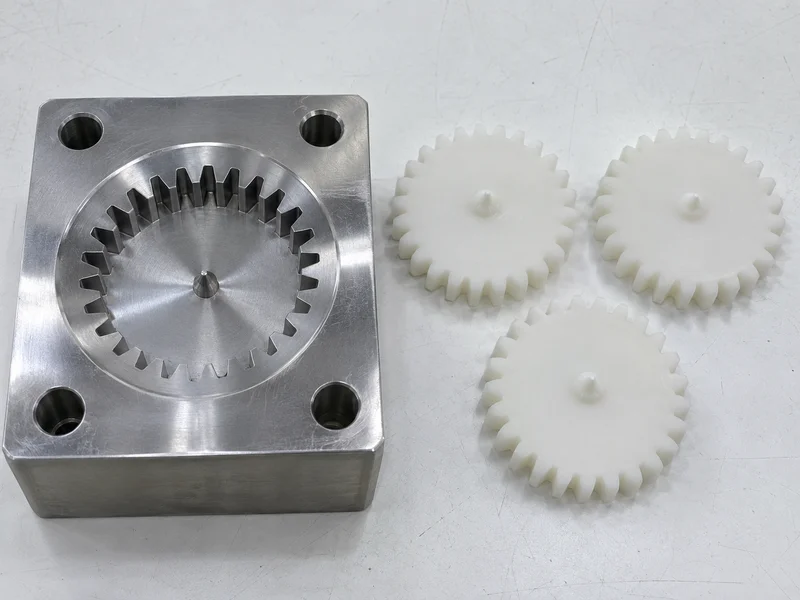
| Factor | Good practice |
|---|---|
| Gate | Center diaphragm or three or more balanced pin gates |
| Cavity | Wire EDM tooth profile, corrected for shrinkage |
| Cooling | Balanced cooling on both halves |
| Venting | At the tooth tips and weld areas |
| Process | Stable packing, controlled mold temperature |
| Cavities | Fewer cavities for high-accuracy gears |
For example, a single side gate leaves a weld line opposite the gate and an oval gear, while three balanced gates on the web give more even filling. Our guides to wire EDM, injection molding gate types and scientific molding explain these steps.
Key Takeaway: Equally, expect a tooth profile correction loop after the first trial.
How Accurate Are Molded Plastic Gears?
Molded plastic gears are less accurate than ground steel gears but accurate enough for many drives.
- Typical quality: about AGMA 6–10 or ISO 8–10 for good molded gears
- Main errors: runout, tooth profile and total composite error
- Measurement: double-flank roll test, gear measuring machines, CMM
- Conditioning: nylon gears measured after a defined moisture condition
For example, a nylon gear measured straight from the mold can grow measurably after it absorbs moisture, so the drawing should say when it is measured. Gear standards are published by AGMA and ISO. Our guide to CMM measurement explains inspection.
Key Takeaway: As a rule, specify gear quality, measurement method and conditioning on the drawing.
When Should You Choose Plastic Over Metal Gears?
You should choose plastic gears over metal when load is moderate and noise, weight or cost matter.
| Choose plastic when | Choose metal when |
|---|---|
| Light to moderate torque | High torque or shock loads |
| Quiet running needed | Temperatures above the resin limit |
| No lubrication allowed | Tight accuracy over long life |
| High volume, low cost | Very low volume |
| Corrosive or wet service | Large size or thin teeth under load |
For example, a printer drive uses molded POM gears, while the final stage of a power tool gearbox often stays steel. Our guide to CNC machining vs injection molding compares the routes, and our CNC turning page covers machined metal gears and shafts.
Key Takeaway: Finally, many gear trains mix molded plastic gears with a metal output stage.
FAQ
- Q: What plastic is best for gears?
- POM for most gears; PA66 for impact; PEEK or PPS for high temperature.
- Q: Are nylon gears strong?
- They are tough and wear well, but absorb moisture and change size.
- Q: Do plastic gears need grease?
- Many run dry, but light lubrication extends life under higher load.
- Q: How accurate are molded gears?
- Typically about AGMA 6–10 or ISO 8–10, depending on tooling and process.
- Q: Can helical gears be molded?
- Yes, using a rotating core or unscrewing mechanism in the mold.
Conclusion
Plastic gears give quiet, light and low-cost motion when the material, gear body design and mold are planned together. Define load, temperature, accuracy and measurement before tooling. To review a gear design for molding, send your 3D model and 2D drawing to our engineers.