
Masterbatch in Injection Molding: Let-Down and Color Match
Masterbatch is a concentrated blend of pigments or additives in a carrier resin that molders mix with natural plastic pellets to color parts or change their properties during injection molding. A color masterbatch typically goes in at 1–5% of the resin weight, which makes it the most common way to color medium and high volume molded parts without buying fully pre-colored compound.
The let-down ratio decides whether the color stays stable from lot to lot. For example, a black ABS housing run at a 2% color ratio can drift to a grey, streaky surface if the doser feeds 1.5% on one shift and 2.5% on the next, even though the resin is the same. In this guide, we explain masterbatch types, how it compares with other coloring methods, let-down ratios, carrier compatibility, color matching, defects and how to specify it. For resin choice, see our injection molding material selection guide.
Masterbatch is a pelletized concentrate of pigment or additive dispersed in a carrier resin. Color masterbatch is mixed with natural resin at a let-down ratio (LDR), usually 1–5%, by a gravimetric or volumetric doser at the machine throat. It costs less than pre-colored compound for most volumes and allows fast color changes, but needs a compatible carrier, good dispersion, accurate dosing and approval of color on molded parts under a defined light source. Additive masterbatches add UV stability, flame retardancy, antistatic or slip properties.
In short: the right concentrate, at a tested and controlled ratio, gives repeatable color at low cost.
Key points:
- Typical LDR: 1–5% by weight.
- Main risk: dosing and dispersion variation.
- Approval: color checked on molded parts, not on pellets.
What Is Masterbatch in Injection Molding?
Masterbatch in injection molding is a concentrate that delivers color or additives into the natural resin at the press.
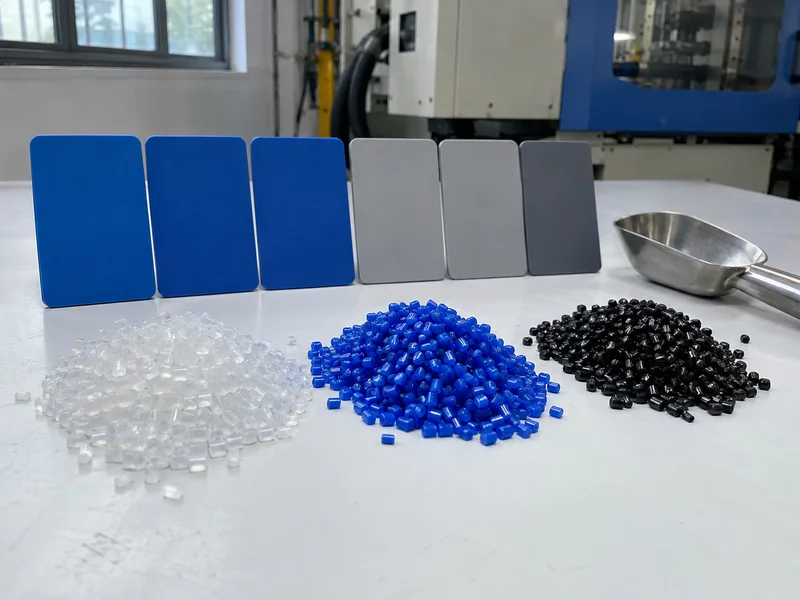
- Pigment or additive: the active part, often 20–70% of the pellet
- Carrier resin: PE, PP, PS, ABS or a universal carrier
- Dispersing agents: help pigment spread evenly in the melt
- Form: pellets similar in size to the base resin
For example, a white PP masterbatch may contain about 60% titanium dioxide in a PP carrier. Our guide to polypropylene injection molding explains the base resin.
Key Takeaway: Above all, treat masterbatch as part of the material specification, not as a shop-floor detail.
How Does Color Masterbatch Compare With Other Coloring Methods?
Color masterbatch compares with other methods by cost, color accuracy and flexibility.
| Method | How it works | Strength | Limit |
|---|---|---|---|
| Color masterbatch | Concentrate mixed at the press | Low cost, fast color change | Needs accurate dosing |
| Pre-colored compound | Resin fully colored by the supplier | Best color consistency | Higher cost, minimum order |
| Liquid color | Liquid pigment pumped into the throat | Very low LDR | Messy, needs pump control |
| Dry pigment | Powder blended with pellets | Lowest material cost | Dust, poor dispersion |
For example, a high-volume grey PP cover often uses a color concentrate, while a cosmetic PC/ABS part with a tight color tolerance may use pre-colored compound. Our guide to ABS injection molding covers ABS color behavior.
Key Takeaway: In other words, choose the method from volume, color tolerance and the number of colors.
What Let-Down Ratio Should Masterbatch Use?
The let-down ratio is the percentage of concentrate in the total blend, and it should come from the supplier’s data and a molded trial.
| Application | Typical LDR |
|---|---|
| Strong colors, opaque parts | 2–4% |
| Black | 1–2% |
| White, high hiding power | 2–5% |
| Transparent tints | 0.5–2% |
| Additive concentrate (UV, antistatic) | 1–3% |
A ratio that is too low can show streaks and poor hiding; a ratio that is too high wastes money and can change shrinkage, impact strength and flame rating. For example, a 4% white masterbatch in thin PC can reduce impact strength compared with 2%. The ISO and ASTM test methods for impact and color are useful references when properties must be checked.
Key Takeaway: For this reason, fix the ratio after testing parts, and record it in the process sheet.
Why Must the Carrier Match the Resin?
The carrier must match the resin because an incompatible carrier separates, weakens the part or causes surface defects.
- Same family: PP carrier for PP, ABS or SAN carrier for ABS
- Universal carriers: convenient but not ideal for engineering resins
- Melt flow: close to the base resin for even mixing
- Temperature: carrier and pigment must survive the processing temperature
For example, a PE-based concentrate in a PA66 GF30 part can cause delamination near the gate. High-temperature resins need heat-stable pigments, as explained in our guide to high temperature injection molding.
Key Takeaway: Overall, ask for the carrier and heat limit on every concentrate datasheet.
How Is Color Matched and Approved?
Color is matched against a master sample and approved on molded parts under defined conditions.
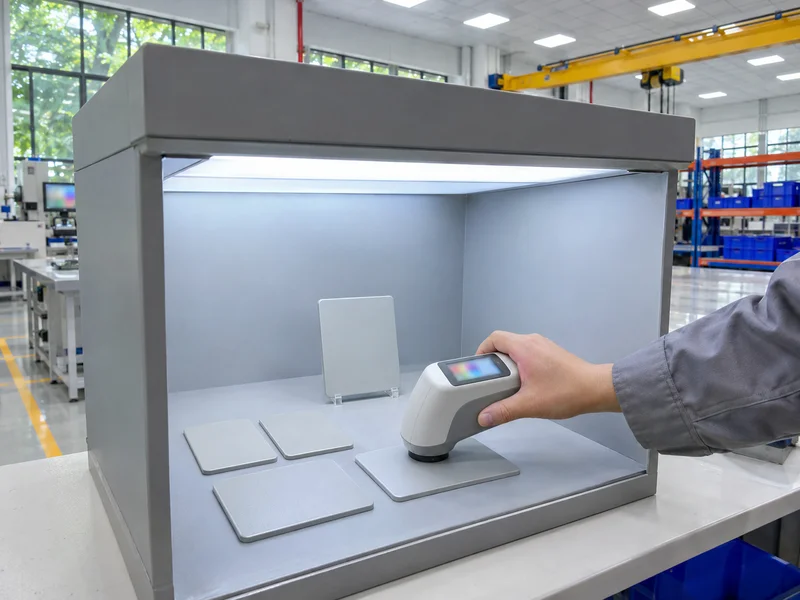
- Reference: Pantone, RAL or a physical master plaque
- Lab match: the supplier adjusts pigments in the same resin grade
- Measurement: spectrophotometer readings with a Delta E limit, such as ΔE ≤ 1.0
- Visual check: a light booth with D65 and a second light source for metamerism
- Approval: signed color samples kept as limit samples
For example, a light grey housing that matches under D65 may look green under shop LED lights if the pigments are not checked under two light sources. Our guide to injection molding surface finishes explains how texture also changes perceived color.
Key Takeaway: Equally, approve color on the real texture and resin, not on a flat lab chip.
Which Color Problems Appear in Production?
Color problems in production usually come from dosing, dispersion, moisture or heat.
| Problem | Likely cause | Check |
|---|---|---|
| Color streaks | Low LDR, poor mixing, low back pressure | Doser calibration, screw mixing |
| Color shift between lots | Dosing variation, new concentrate lot | Lot record, ΔE check |
| Specks or dots | Undispersed pigment, contamination | Concentrate quality, purging |
| Splay or bubbles | Moist carrier | Dry the concentrate with the resin |
| Brittle parts | Too high LDR, wrong carrier | Impact test, carrier datasheet |
For example, streaks on a black PP part often disappear when back pressure is raised slightly and the doser is recalibrated. Our guides to black specks, purging compound and plastic resin drying cover related issues.
Key Takeaway: As a rule, log the concentrate lot, ratio and doser setting for every production lot.
How Should Color Concentrate Be Specified?
Color concentrate should be specified with the resin, color target, ratio and approval method.
- Base resin grade, such as a named PC/ABS grade
- Color target, with Pantone, RAL or master sample and ΔE limit
- Concentrate type and carrier, or “supplier to propose”
- Let-down ratio and its tolerance
- Additives, such as UV or flame retardant, and any rating to keep
- Approval samples and the light source used
For example, “PC/ABS, RAL 7035, ΔE ≤ 1.0 under D65, concentrate 2% ±0.2%, approved on textured T1 parts” leaves little room for doubt. In our plastic injection molding projects, the color concentrate, its ratio and lot are recorded in the process sheet so repeat orders match the approved samples.
Key Takeaway: Finally, put the color target and ratio in writing before the first production lot.
FAQ
- Q: What is masterbatch?
- A concentrate of pigment or additive in a carrier resin, mixed with natural resin during molding.
- Q: What is a normal let-down ratio?
- Usually 1–5% by weight, depending on color and pigment strength.
- Q: Is masterbatch cheaper than pre-colored resin?
- Usually yes for medium and high volumes, but pre-colored compound gives tighter color control.
- Q: Can a color concentrate change part properties?
- Yes, a high ratio or wrong carrier can reduce impact strength or change shrinkage.
- Q: How is color approved?
- By measuring ΔE against a master sample and checking parts in a light booth.
Conclusion
Masterbatch is the most flexible way to color molded parts, as long as the carrier, ratio and dosing are controlled and color is approved on real parts. Specify the target, ratio and approval method up front. To review color and material for your part, send your 3D model and 2D drawing to our engineers.