
Black Specks Injection Molding: Causes and Prevention
Black specks injection molding defects are small dark spots or particles embedded in or on molded parts. They are especially visible on white, light-colored and clear parts, and they are a common reason for cosmetic rejection. Most black specks are degraded plastic or carbonized residue that has broken loose from the screw, barrel, check ring, nozzle or hot runner, though contamination in the resin can also be the source.
Finding the source is faster than fighting the symptom. For example, specks that appear at the start of each shift after an overnight stop usually come from material degraded in the hot barrel, while specks that appear randomly in one cavity may come from a hot runner dead spot. In this guide, we explain black specks injection molding: what they are, common sources, how to diagnose them, process and maintenance fixes, material handling and how to specify cosmetic limits. For other surface defects, see our guide to injection molding defects and solutions.
Black specks injection molding defects are usually carbonized or degraded resin released from barrel walls, screw flights, check rings, nozzles or hot runner dead spots, or contamination introduced with the resin, regrind, dryers or conveyors. Causes include excessive melt temperature or residence time, poor purging during color or material changes, worn screws and check rings, degraded or dirty regrind, and heat-sensitive resins. Fixes combine proper purging, residence-time control, maintenance of the screw and hot runner, clean material handling and appropriate cosmetic acceptance criteria.
In short: black specks come mainly from degraded material or contamination; find the source and fix it there.
Key points:
- Main source: degraded resin inside the machine or hot runner.
- Other source: contaminated resin or regrind.
- Fixes: purging, residence time, maintenance, clean handling.
What Are Black Specks in Injection Molding?
Black specks in injection molding are dark particles visible in or on molded parts.
Typical forms:
- Small black dots on the surface
- Embedded dark particles in clear parts
- Brown streaks or flakes from partially degraded material
- Clusters after startup or color changes
For example, a white PP cap may show tiny black dots after a long stop. Clear parts show even sub-millimeter specks. Our guide to clear plastic injection molding covers clear part criteria.
Key Takeaway: Above all, specks are most visible on light and clear parts.
What Causes Black Specks Injection Molding Defects?
Black specks injection molding defects are caused by degraded resin or contamination.
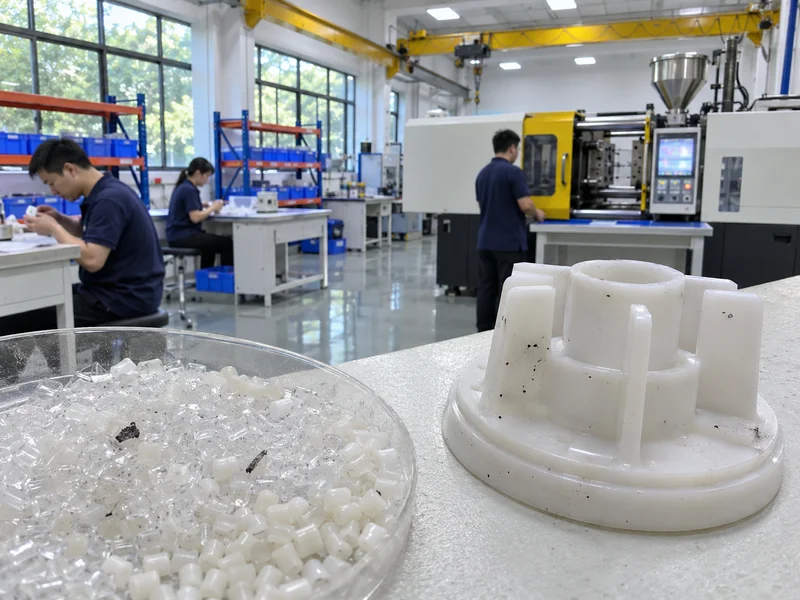
Common causes:
- Long residence time in a large barrel for a small shot
- Excessive melt temperature
- Worn screw, check ring or barrel creating hang-up areas
- Hot runner dead spots and damaged tips
- Poor purging during changes
- Contaminated resin, regrind, dryers or conveyors
- Heat-sensitive resins such as POM, PVC or FR grades
For example, running a 20 g part on a machine with a 300 g barrel gives long residence time and degrades resin. Our guide to purging compound explains cleaning.
Key Takeaway: In other words, look first at residence time and machine condition.
Black Specks Injection Molding: How Do You Diagnose the Source?
You diagnose the source of black specks by checking when and where they appear.
Diagnosis steps:
- Check the resin: inspect pellets and regrind under light.
- Purge into air: look for specks in the purge.
- Compare cavities: specks in one cavity suggest the hot runner drop.
- Track timing: after startups, changes or randomly.
- Check the screw and check ring for buildup and wear.
- Inspect the hot runner for dead spots and degraded material.
For example, specks present in an air shot but not in the pellets point to the barrel or screw. Our guide to the hot runner system explains hot runner maintenance.
Key Takeaway: For this reason, test pellets, purge and parts separately to isolate the source.
Black Specks Injection Molding: Which Process Changes Help?
Process changes reduce black specks by limiting degradation.
Process fixes:
- Lower melt temperature within the resin range
- Reduce residence time: use a smaller machine or barrel
- Avoid long idle times at temperature
- Lower back pressure and screw speed if shear heating is high
- Purge before shutdowns and use stable materials when idle
For example, moving a small POM part to a press with a smaller barrel can reduce residence time from minutes to seconds. Our guide to POM injection molding explains POM’s sensitivity.
Key Takeaway: Overall, less heat history means fewer specks.
How Does Maintenance Prevent Black Specks?
Maintenance prevents black specks by removing places where material hangs up and degrades.
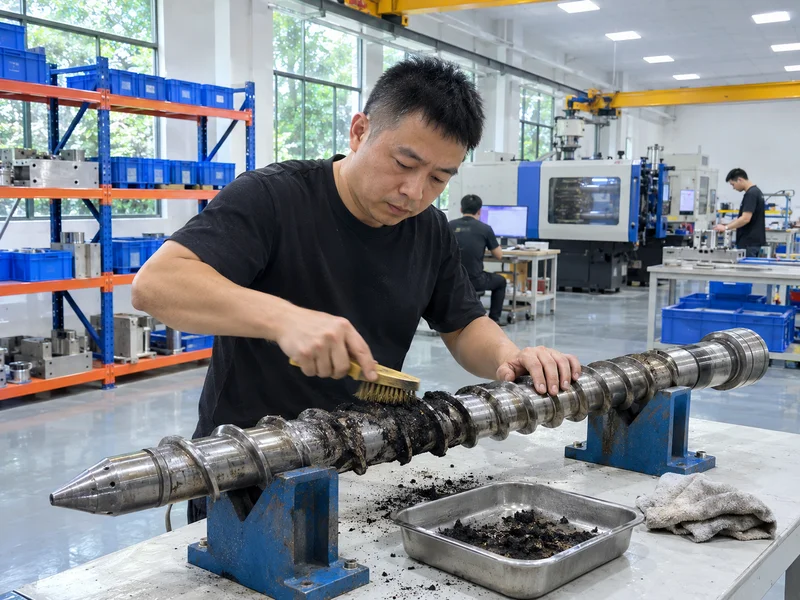
Maintenance actions:
- Pull and clean the screw periodically
- Replace worn check rings and screw tips
- Inspect barrels for wear
- Clean nozzles and hot runner tips
- Fix leaks in hot runner manifolds
- Clean dryers and conveying lines
For example, a worn check ring that lets material flow back can trap degraded resin; replacing it often removes recurring specks. Our guide to maintenance of molds covers mold-side care.
Key Takeaway: Equally, recurring specks usually point to worn components.
How Should Material Handling Control Contamination?
Material handling should control contamination from bags to hopper.
Controls:
- Closed containers and clean bag handling
- Clean dryers and hoppers between materials
- Dedicated conveying lines for light colors
- Regrind control: clean, same material, fines removed
- Magnets and filters where suitable
For example, regrind collected from a dirty floor can introduce dark particles into white parts. Our guide to recycled plastic injection molding explains regrind control.
Key Takeaway: As a rule, light-colored parts need cleaner material handling.
How Should Black Speck Limits Be Specified?
Black speck limits should be specified as measurable cosmetic criteria.
Specification items:
- Maximum speck size (for example ≤0.2 mm)
- Maximum number per surface area
- Surface class where limits apply
- Viewing distance and lighting
- Boundary samples
For example, “A surfaces: no specks visible at 500 mm; B surfaces: max two specks ≤0.3 mm” is testable. Our quality control and inspection process uses such criteria when specified. Visual inspection practices are also published by ASTM International.
Key Takeaway: Finally, define speck size and count by surface class.
FAQ
- Q: What causes black specks in injection molding?
- Degraded resin from the screw, barrel or hot runner, or contamination in the material.
- Q: How do you find the source of black specks?
- Check pellets, purge into air, compare cavities and track when specks appear.
- Q: Can purging remove black specks?
- It removes residue; maintenance and residence time control stop recurrence.
- Q: Why do specks appear after startups?
- Material degraded in the hot barrel during idle time.
- Q: How are black specks specified?
- By maximum size and count per surface class under defined viewing conditions.
Conclusion
Black specks injection molding defects come mainly from degraded material and contamination. Diagnose the source, control residence time and temperature, maintain the screw and hot runner, keep material clean and specify cosmetic limits. To review a cosmetic molding problem, send your 3D model and 2D drawing to our engineers.