
Cylindrical Grinding: Tolerances, Planning and Problems
Cylindrical grinding finishes round parts, such as shafts, pins, bearing journals, spindles, bushings and core pins, to very tight diameter tolerances, roundness and surface finish. A rotating abrasive wheel grinds the outside diameter (OD) or inside diameter (ID) of a part that also rotates, which lets cylindrical grinding reach accuracies that turning cannot, especially on hardened steel.
Grinding is usually the last step after turning and heat treatment, so planning matters. For example, a hardened shaft turned to final size before hardening may warp out of tolerance, while one turned with grinding stock and ground after hardening ends up straight and round. In this guide, we explain cylindrical grinding: OD, ID and centerless grinding, what it achieves, when to use it, process planning, common problems and how to specify ground diameters. For flat surfaces, see our guide to surface grinding.
Cylindrical grinding uses a rotating abrasive wheel against a rotating workpiece to finish external (OD) or internal (ID) cylindrical surfaces, shoulders and tapers. Variants include between-centers OD grinding, chucked OD/ID grinding and centerless grinding for high-volume pins. Typical results on small precision parts are diameter tolerances of a few microns, roundness in the micron range and finishes around Ra 0.1–0.4 µm. It is used after hardening, for bearing seats, precision fits and core pins. Parts are turned with grinding stock, heat treated, then ground, with care to avoid burn and taper.
In short: turn with stock, harden, then cylindrically grind critical diameters to final size.
Key points:
- Types: OD, ID, centerless.
- Accuracy: micron-level diameters and roundness.
- Sequence: turn, harden, grind.
What Is Cylindrical Grinding?
Cylindrical grinding is an abrasive process that finishes round surfaces on a rotating workpiece.
Main types:
- OD grinding between centers: shafts and pins with center holes
- Chucked OD/ID grinding: bushings, sleeves, bores
- Centerless grinding: high-volume pins and rods without centers
- Plunge and traverse grinding: short features or long diameters
For example, a hardened mold core pin is ground between centers to its final diameter and finish. Our Dongguan factory uses an Okamoto internal/external grinder for precision round parts. Machine capability is not finished-part tolerance; finished values are confirmed per drawing.
Key Takeaway: Above all, cylindrical grinding finishes round features after hardening.
What Can Cylindrical Grinding Achieve?
Cylindrical grinding can achieve tight diameter, form and finish on suitable parts.
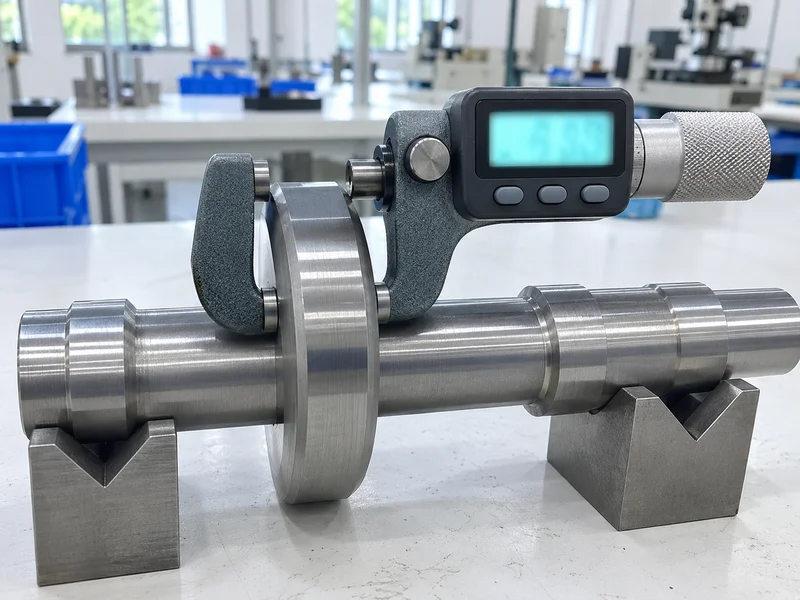
Typical capabilities (process-dependent):
- Diameter tolerance: a few microns
- Roundness and cylindricity: micron range
- Runout: very low between ground diameters in one setup
- Surface finish: about Ra 0.1–0.4 µm
For example, bearing seats on a hardened shaft may be ground to k5 with Ra 0.4 µm and runout within a few microns. Our guide to the bearing press fit tolerance chart explains bearing fits.
Key Takeaway: In other words, grinding reaches IT5–IT6 where turning reaches IT7–IT8.
When Should You Use Cylindrical Grinding?
You should use cylindrical grinding when diameters, roundness or finish exceed turning capability, or when parts are hardened.
Typical cases:
- Hardened shafts and pins
- Bearing seats and precision fits
- Mold core pins and ejector components
- Gauge pins and plug gauges
- Sealing diameters needing fine finish
For example, an ejector sleeve’s outer and inner diameters are ground for a precise sliding fit. Our guide to ejector sleeve design explains why.
Key Takeaway: For this reason, grind only the diameters that need it.
How Should Cylindrical Grinding Be Planned?
Cylindrical grinding should be planned with grinding stock, center holes and heat treatment in mind.
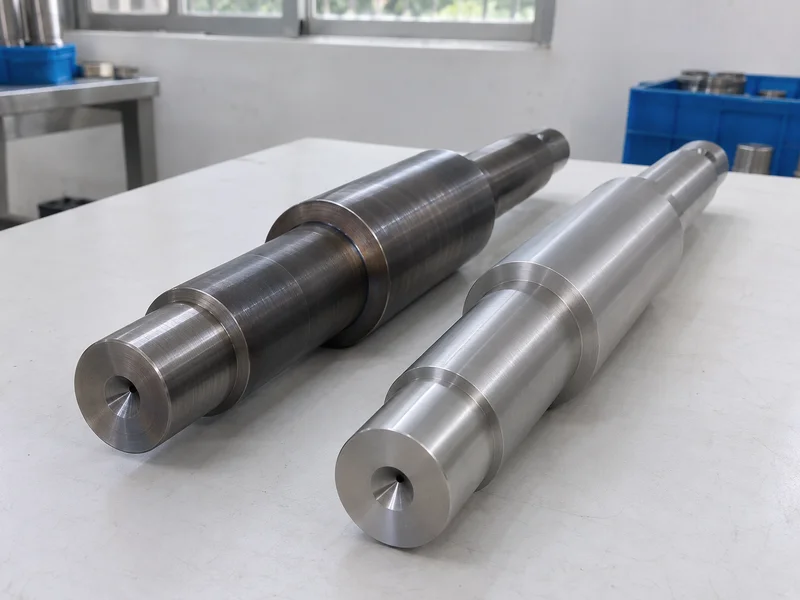
Planning steps:
- Turn with grinding stock (often about 0.1–0.3 mm on diameter).
- Add center holes for between-centers grinding.
- Heat treat to required hardness.
- Straighten if needed.
- Grind critical diameters and shoulders.
- Inspect diameters, roundness and runout.
For example, a shaft with four bearing and seal diameters is ground in one setup between centers so all diameters share one axis. Our guide to heat treatment of steel explains sequencing.
Key Takeaway: Overall, leave stock and center holes for grinding.
What Problems Occur When Grinding Diameters?
Problems in cylindrical grinding come from heat, setup and wheel condition.
| Problem | Typical cause | Fix |
|---|---|---|
| Grinding burn | Excess heat, dull wheel | Dress, reduce feed, more coolant |
| Taper | Misalignment, wheel wear | Align, dress |
| Out of round | Poor centers, vibration | Good center holes, rigid setup |
| Chatter | Unbalanced wheel | Balance, check bearings |
| Lobing | Centerless setup | Adjust geometry |
For example, damaged center holes can make a shaft out of round even with a perfect wheel. Our guide to high precision CNC turning explains center hole quality.
Key Takeaway: Equally, good center holes are the foundation of round grinding.
How Does Cylindrical Grinding Compare With Hard Turning?
Cylindrical grinding compares with hard turning by accuracy, finish and cost.
| Factor | Cylindrical grinding | Hard turning |
|---|---|---|
| Tolerance | Very tight | Tight |
| Finish | Finer | Good |
| Flexibility | Less | More (complex profiles) |
| Speed | Slower setup | Faster for short runs |
| Typical use | Bearing seats, pins | Hardened gears, profiles |
For example, a hardened shaft with complex profiles may be hard turned, with only bearing seats ground. Grinding terms are defined in standards from ISO.
Key Takeaway: As a rule, combine hard turning and grinding where it saves time.
How Should Ground Diameters Be Specified?
Ground diameters should be specified with tolerance, form, runout and finish.
Specification items:
- Diameter tolerance or fit code, such as Ø20 h6
- Roundness or cylindricity
- Runout to datum axis
- Surface finish, such as Ra 0.4
- Hardness of the ground area
- “Ground” note for clarity
For example, “Ø25 k5, cylindricity 0.003, runout 0.005 to A-B, Ra 0.4, 58–62 HRC, ground” is complete. Our quality control and inspection process measures ground features with suitable gauges.
Key Takeaway: Finally, include form and runout, not just diameter.
FAQ
- Q: What is cylindrical grinding?
- An abrasive process that finishes round outside or inside diameters on rotating parts.
- Q: What tolerance can cylindrical grinding hold?
- A few microns on diameter, with micron-level roundness on suitable parts.
- Q: What is centerless grinding?
- A cylindrical grinding method without centers, used for high-volume pins and rods.
- Q: Why grind after heat treatment?
- To remove distortion and reach final size on hardened parts.
- Q: How much stock is left for grinding?
- Often about 0.1–0.3 mm on diameter, depending on size and distortion.
Conclusion
Cylindrical grinding finishes round parts to tolerances and finishes turning cannot reach, especially after hardening. Plan stock, center holes and sequence, and specify form, runout and finish. To review a precision round part, send your 3D model and 2D drawing to our engineers.