
Ejector Sleeve: When to Use It and Design Rules
An ejector sleeve is a hollow ejector that pushes a molded part off a core pin by contacting the full ring around it. Sleeves are used where an ordinary ejector pin would leave a mark in the wrong place, push unevenly or damage the part, typically around bosses, screw holes, round posts and cylindrical features. For small precision molds with many bosses, ejector sleeves improve ejection quality and part appearance.
Sleeves need precise fits and good alignment, or they wear, gall and flash. For example, a sleeve with too much clearance on its core pin can let plastic flash into the gap and jam, while one with too little clearance seizes when the mold heats up. In this guide, we explain the ejector sleeve: how it works, when to use one, design and fit rules, materials and hardening, common problems and maintenance, and how to specify sleeves. For ejection marks, see our guide to ejector pin marks.
An ejector sleeve is a hardened tubular ejector that slides over a stationary core pin and pushes on the full annular face around a boss or hole. It gives even ejection force, avoids pin marks on cosmetic faces and prevents bosses from cracking or sticking. Key design factors are wall thickness (often at least about 0.75–1 mm), precise sliding fits on the core pin and in the plate (typically a few microns of clearance per side, depending on resin flash tendency), adequate guided length, hardness and surface treatment, and secure fixing of the core pin. Sleeves are standard components from suppliers such as HASCO, DME and MISUMI.
In short: use ejector sleeves to push bosses and round features evenly; fit and harden them carefully.
Key points:
- Function: push around cores, not on cosmetic faces.
- Fit: tight enough to prevent flash, free enough to slide.
- Standard parts: easier replacement.
What Is an Ejector Sleeve?
An ejector sleeve is a hollow ejector component that surrounds a core pin and pushes the part off it.
Components:
- Sleeve: hardened tube attached to the ejector plate
- Core pin: stationary pin fixed to the clamp plate, passing through the sleeve
- Guided length: where the sleeve slides in the core plate
For example, a screw boss in a housing is formed by a core pin, and an ejector sleeve around it pushes the boss off evenly. Our guide to the screw boss explains boss design.
Key Takeaway: Above all, the sleeve moves while the core pin stays fixed.
When Should You Use an Ejector Sleeve?
You should use an ejector sleeve when a boss, post or round feature needs even ejection.
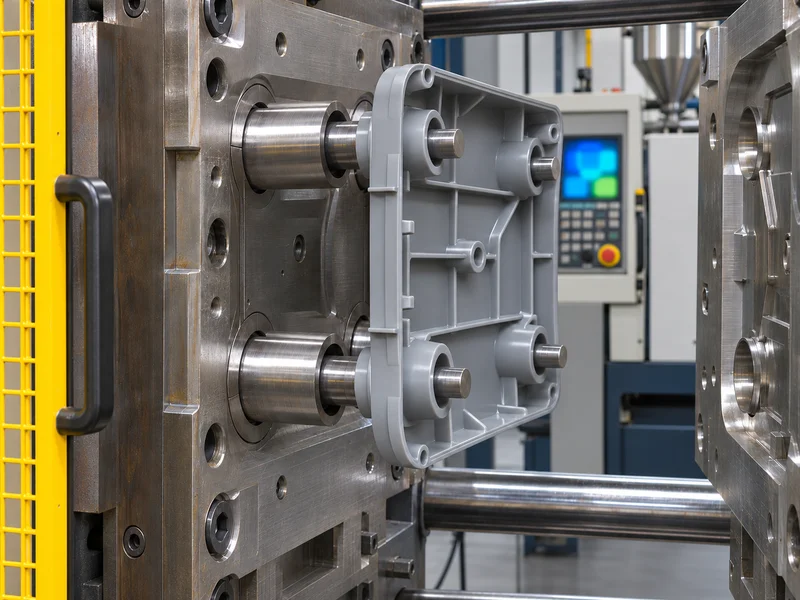
Typical cases:
- Screw bosses that stick on core pins
- Round posts and tubes
- Thin-walled cylindrical features
- Cosmetic parts where pin marks are not allowed nearby
- Deep cores that grip the part
For example, a tall boss ejected only by nearby pins may crack or deform; a sleeve pushes on the boss itself. Our guide to injection mold components explains ejector systems.
Key Takeaway: In other words, sleeves eject round features where they stick.
How Should an Ejector Sleeve Be Designed?
An ejector sleeve should be designed with adequate wall, guided length and core pin support.
Design rules:
- Wall thickness: at least about 0.75–1 mm for strength
- Guided length: enough to prevent tilting
- Relief: behind the guided length to reduce friction
- Core pin fixed securely in the clamp plate
- Venting at the end of fill around bosses
- Standard sizes where possible
For example, a boss with a 2 mm wall allows a sleeve wall of about 1 mm, leaving clearance to the boss edge. Our guide to injection molding wall thickness covers boss walls.
Key Takeaway: For this reason, design bosses with room for a sturdy sleeve wall.
What Fits and Materials Do Ejector Sleeves Need?
Ejector sleeves need precise sliding fits and hard, wear-resistant materials.
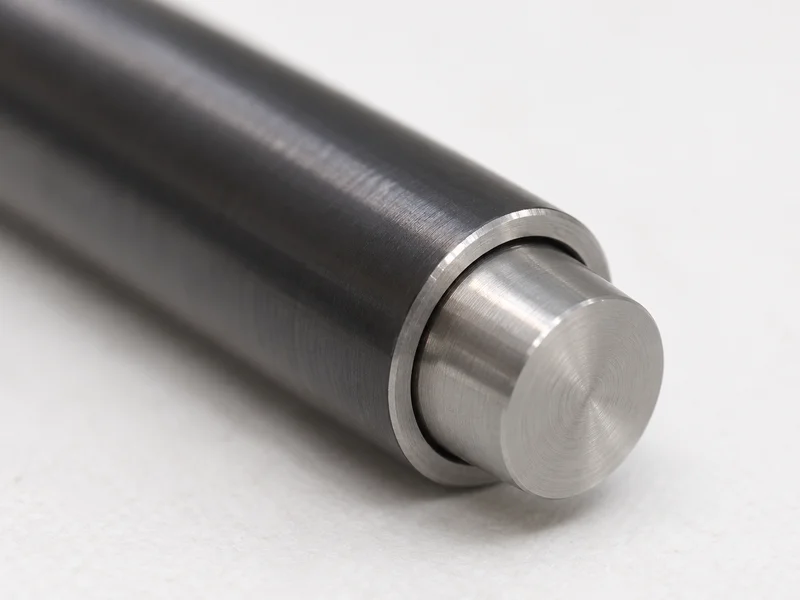
Fits:
- Sleeve to core pin: small clearance to prevent flash
- Sleeve to plate bore: guided sliding fit
- Clearance by resin: tighter for low-viscosity resins such as PA and LCP
Materials:
- Hardened tool steel, often through-hardened or nitrided
- Surface treatments: nitriding, DLC for wear and galling resistance
- Core pins: hardened and ground
For example, a sleeve for a glass-filled PA66 boss may be nitrided to resist abrasive wear. Our guide to cylindrical grinding explains how sleeves and pins are finished.
Key Takeaway: Overall, fit clearance depends on the resin’s flash tendency.
What Problems Occur With Sleeve Ejection?
Problems with ejector sleeves usually come from fits, alignment and heat.
| Problem | Typical cause | Fix |
|---|---|---|
| Flash into sleeve | Excess clearance, wear | Replace sleeve or pin, tighter fit |
| Galling or seizing | Too tight, poor lubrication, misalignment | Correct fit, coatings, alignment |
| Bent core pin | Insufficient support | Larger pin, better fixing |
| Boss sticking | Insufficient draft or polish | Draft, polish along draw |
| Uneven ejection | Sleeve length mismatch | Grind to length |
For example, a sleeve that seizes after the mold warms up may have too little clearance for thermal expansion. Our guide to mold polishing explains draw-direction polishing.
Key Takeaway: Equally, check sleeve fits at operating temperature.
How Should Sleeves Be Maintained?
Ejector sleeves should be maintained by cleaning, lubricating and replacing worn parts.
Maintenance:
- Clean residue from sleeves and pins
- Lubricate with suitable high-temperature grease where specified
- Inspect for wear and flash marks
- Replace sleeves and pins together when worn
- Keep spares for critical bosses
For example, replacing a worn sleeve and pin pair as a set restores the original fit. Our guide to maintenance of molds covers ejector maintenance. Paid spare parts, including sleeves and pins, are available on request.
Key Takeaway: As a rule, treat sleeves and core pins as matched wear parts.
How Should Ejector Sleeves Be Specified?
Ejector sleeves should be specified with standard, size, treatment and spares.
Specification items:
- Component standard, such as HASCO, DME or MISUMI
- Sleeve and core pin dimensions
- Hardness and surface treatment
- Spare quantities
- Lubrication requirements
For example, a mold specification may require “standard ejector sleeves to HASCO, nitrided, with two spare sets per boss size”. Our injection mold manufacturing service builds molds to HASCO, Meusburger, DME or MISUMI standards. Component interchangeability is supported by standards such as those from ISO for ejector components.
Key Takeaway: Finally, standard components shorten repair time.
FAQ
- Q: What is an ejector sleeve?
- A hollow ejector that slides over a fixed core pin and pushes on the ring around a boss.
- Q: When is an ejector sleeve used?
- For bosses, posts and round features that need even ejection.
- Q: Why do ejector sleeves flash?
- Too much clearance or wear between sleeve and core pin.
- Q: What material are ejector sleeves made of?
- Hardened tool steel, often nitrided or coated.
- Q: Should sleeves be replaced with core pins?
- Yes, replacing them together restores the correct fit.
Conclusion
An ejector sleeve ejects bosses and round features evenly when it has a sturdy wall, precise fits and hard surfaces. Maintain sleeves and pins as matched sets and use standard components. To review ejection in your mold, send your 3D model and 2D drawing to our engineers.