
High Temperature Injection Molding: Materials and Molds
High temperature injection molding covers molding parts from plastics that must survive continuous heat, often above 150 °C, such as PPS, PEEK, LCP, PPA, PEI and high-heat grades of PA and PBT. These parts appear in connectors near engines, sensor housings, lighting components, appliance heaters, electrical insulators and fluid parts. The resins themselves need high melt and mold temperatures, careful drying and molds built to handle the heat.
Moving to a high-temperature resin changes the whole project, not just the material line. For example, a connector switched from PBT to PPS may need a hotter mold with insulated plates, harder steel for glass-filled abrasion and redesigned walls to manage flash. In this guide, we explain high temperature injection molding: materials and their heat ratings, how heat performance is measured, processing demands, mold design for hot molds, part design, testing and how to specify heat requirements. For heat-resistant material choices, see our guide to best plastics for hot temperatures.
High temperature injection molding uses resins such as PPS, PEEK, LCP, PPA, PEI and high-heat PA/PBT grades, which need melt temperatures roughly 300–400 °C and mold temperatures often 120–200 °C to reach full crystallinity and properties. Heat performance is described by heat deflection temperature (HDT), continuous use temperature (RTI) and glass transition. Molds need heated and insulated designs, wear-resistant steels for filled grades, precise venting and thermal management. Parts should be designed for low flash risk, uniform walls and dimensional stability, and validated at the real service temperature.
In short: high-heat resins need hot, well-built molds and careful processing; specify the real temperature and duration.
Key points:
- Materials: PPS, PEEK, LCP, PPA, PEI.
- Process: high melt and mold temperatures.
- Molds: heated, insulated, wear-resistant.
What Is High Temperature Injection Molding?
High temperature injection molding is molding parts from resins designed to keep their properties at elevated temperatures.
Typical applications:
- Connectors and sockets near heat sources
- Sensor and actuator housings in engines and equipment
- Lighting reflectors and lamp parts
- Electrical insulators and coil bobbins
- Pump and fluid parts with hot media
For example, a connector that must pass reflow soldering often uses LCP or PPA because standard nylons would distort. Our plastic injection molding service molds PPS, PEEK, LCP and PPA grades.
Key Takeaway: Above all, high temperature molding starts with the service temperature, not the resin name.
Which Materials Are Used in High Temperature Injection Molding?
Materials used in high temperature injection molding differ in heat resistance, flow and cost.
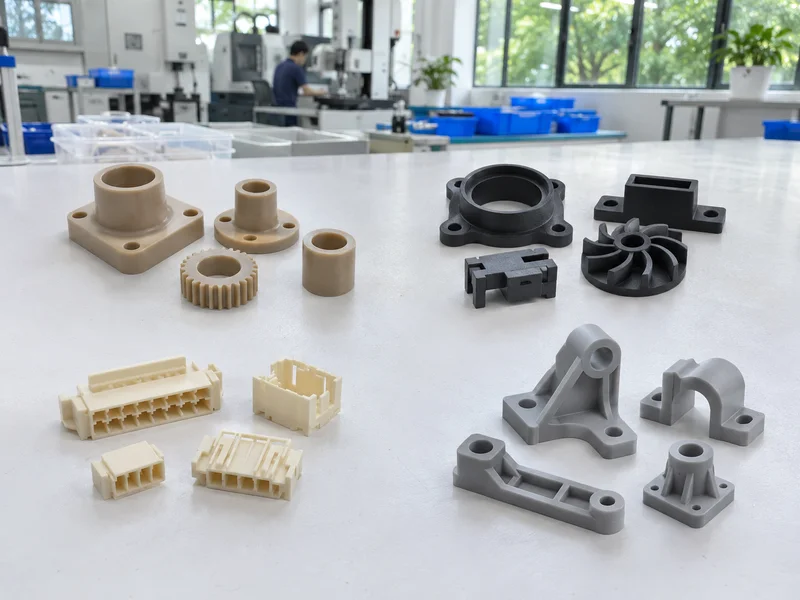
| Material (typical) | HDT (filled grades, approx.) | Key strengths |
|---|---|---|
| PPS (GF40) | ~260 °C | Chemical resistance, dimensional stability, inherently flame resistant |
| LCP (GF) | ~260–300 °C | Very thin-wall flow, reflow resistant |
| PPA (GF) | ~280 °C | High stiffness, cost-effective vs PEEK |
| PEEK (GF30) | ~315 °C | Highest overall performance, chemical resistance |
| PEI (GF) | ~210 °C | Amorphous, transparent amber unfilled grades |
| High-heat PA46 / PA6T | ~250–290 °C | Strength at temperature |
For example, a thin-wall SMT connector often uses LCP, while a chemical pump housing may use PPS or PEEK. Our guide to PEEK injection molding explains PEEK processing, and PPS injection molding covers PPS.
Key Takeaway: In other words, choose by temperature, chemicals, wall thickness and cost together.
How Is Heat Performance Measured?
Heat performance is measured by several properties, each describing a different limit.
- HDT (heat deflection temperature): temperature at which a loaded bar deflects a set amount; short-term
- RTI (relative thermal index): long-term continuous use temperature from aging tests
- Glass transition temperature (Tg): where amorphous regions soften
- Melting point (Tm): for semi-crystalline resins
- Ball pressure test: for electrical parts
For example, a material with HDT 260 °C may have an RTI of about 200 °C, which is more relevant for continuous service. Test methods are published by ASTM International and UL (RTI).
Key Takeaway: For this reason, use RTI for long-term service and HDT for short exposures.
What Processing Does High Temperature Injection Molding Need?
High temperature injection molding needs precise drying, high melt and mold temperatures and suitable machine equipment.
Processing needs:
- Drying: many grades need thorough drying at high temperature
- Melt temperature: roughly 300–400 °C depending on resin
- Mold temperature: often 120–200 °C for full crystallinity
- Barrel and screw suitable for high temperatures and filled grades
- Short residence time to avoid degradation
For example, PPS molded in a cold mold may look fine but post-crystallize and shrink later at temperature. A hot mold avoids this. Our guide to plastic resin drying explains drying.
Key Takeaway: Overall, a cold mold gives unstable parts in high-heat resins.
How Should Molds Be Built for High Temperature Resins?
Molds for high temperature resins should be built to run hot, stay stable and resist wear.
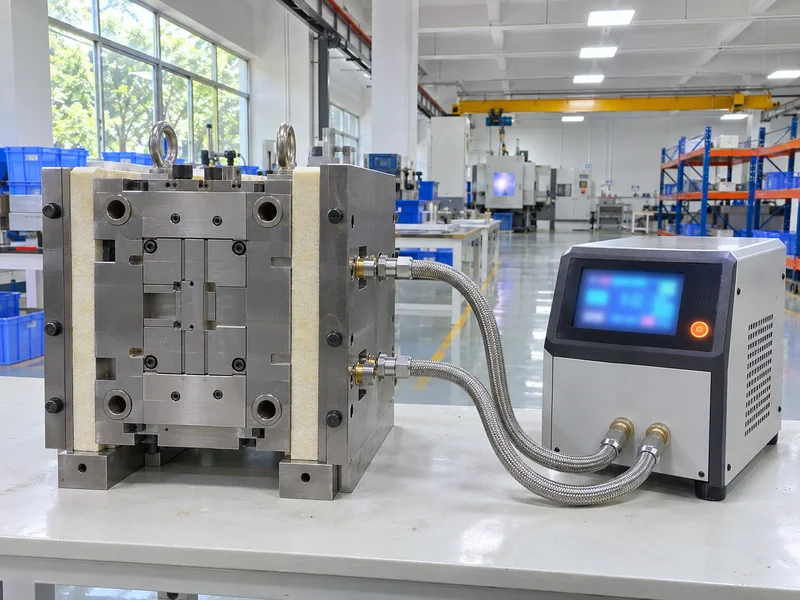
Mold features:
- Oil or high-temperature water heating with mold temperature controllers
- Insulation plates between mold and press platens
- Wear-resistant, hardened steels for glass-filled grades
- Precise shut-offs and venting because low-viscosity resins flash easily
- Thermal expansion allowances for moving parts and slides
For example, a PPS connector mold may use hardened inserts, insulation plates and an oil temperature controller at 140 °C. Our guide to mold temperature controller explains heating options.
Key Takeaway: Equally, design the mold for the operating temperature from the first concept.
How Should Parts Be Designed for High Temperature Resins?
Parts for high temperature resins should be designed for low flash, uniform walls and stable dimensions.
Design tips:
- Uniform walls to limit warpage
- Tight shut-off design and avoiding thin knife edges
- Generous radii for brittle, highly filled grades
- Gate location for consistent fiber orientation
- Allow for thermal expansion in assemblies
For example, a PPS part with a thin flange may flash because PPS flows easily at high temperature; thicker, simpler shut-offs help. Our guide to injection molding flash explains causes.
Key Takeaway: As a rule, design for flash control when using low-viscosity high-heat resins.
How Should High Temperature Requirements Be Specified?
High temperature requirements should be specified with temperature, duration, load and environment.
Specification items:
- Maximum continuous temperature and duration
- Peak or short-term temperature (for example reflow)
- Mechanical load at temperature
- Chemical exposure at temperature
- Flame rating and electrical properties if relevant
- Validation tests such as heat aging and dimensional checks
For example, “continuous 150 °C for 5,000 h, peak 260 °C reflow 3 × 10 s, dimensional change ≤0.05 mm” is clear. Our quality control and inspection process records heat aging checks when specified.
Key Takeaway: Finally, specify the real temperature profile, not just “high temperature”.
FAQ
- Q: What is high temperature injection molding?
- Molding parts from resins such as PPS, PEEK, LCP and PPA that keep properties at high temperatures.
- Q: Which plastic is best for high temperatures?
- It depends on temperature, chemicals and cost; PEEK is highest overall, PPS and LCP are common choices.
- Q: Why do high temperature resins need hot molds?
- Hot molds give full crystallinity and stable dimensions.
- Q: What is the difference between HDT and RTI?
- HDT is short-term deflection temperature; RTI is long-term continuous use temperature.
- Q: Do high temperature molds need special steel?
- Often yes, hardened steels for abrasive glass-filled grades.
Conclusion
High temperature injection molding succeeds when the resin matches the real temperature profile, the mold is built to run hot and resist wear, and parts are designed for flash control and stability. To review a high-heat part, send your 3D model and 2D drawing to our engineers.