
PPS Injection Molding: Grades, Settings and Mold Design
PPS injection molding produces stiff, dimensionally stable, chemically resistant parts that keep their properties at high temperatures. Polyphenylene sulfide, usually glass- or glass-mineral-filled, is inherently flame resistant and resists fuels, solvents and hot water, which makes it a common choice for small precision parts in pumps, sensors, connectors, electrical components and automotive-style systems.
PPS is demanding to mold well. For example, a glass-filled PPS sensor housing molded in a cold mold may look acceptable but continue crystallizing in service, shrinking and changing dimensions, while a correctly heated mold gives stable parts from the start. In this guide, we explain PPS injection molding: material grades and properties, applications, processing, mold design, flash control, part design and how to specify PPS parts. For other heat-resistant options, see our guide to high temperature injection molding.
PPS injection molding uses polyphenylene sulfide grades, mostly 30–40% glass-filled or glass/mineral-filled, with melt temperatures around 300–340 °C and mold temperatures around 130–150 °C to reach full crystallinity. PPS offers high heat deflection temperature (about 260 °C for GF40), excellent chemical resistance, inherent flame resistance (UL 94 V-0) and low moisture absorption, but it is brittle compared with nylon and flows easily, so it flashes readily. Molds need hot, well-insulated designs, hardened wear-resistant steel, tight shut-offs and fine venting.
In short: PPS gives stable, heat- and chemical-resistant parts when molded hot in robust, tight molds.
Key points:
- Properties: heat, chemicals, flame resistance, stability.
- Process: hot molds for full crystallinity.
- Mold: hardened steel, tight shut-offs, good venting.
What Is PPS Injection Molding?
PPS injection molding is the molding of polyphenylene sulfide, a semi-crystalline high-performance thermoplastic.
Key properties (typical, filled grades):
- High heat deflection temperature: about 260 °C (GF40)
- Chemical resistance: fuels, oils, solvents, hot water
- Inherent flame resistance: often UL 94 V-0 without additives
- Dimensional stability: low moisture absorption and creep
- Electrical insulation
For example, a pump impeller handling hot coolant can be molded in PPS-GF40 for heat and chemical resistance. Our plastic injection molding service molds PPS grades. Flame ratings follow UL 94.
Key Takeaway: Above all, PPS combines heat, chemical and flame resistance with stability.
Which PPS Grades Are Common?
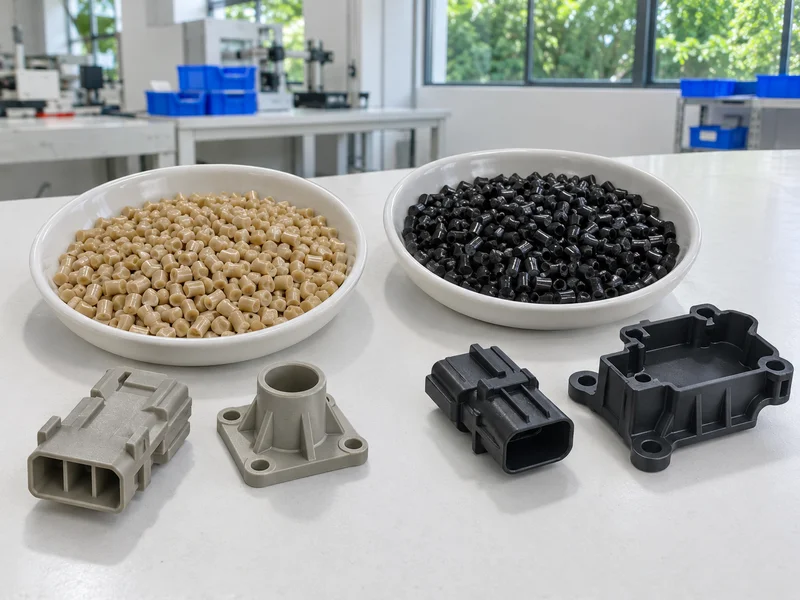
Common PPS grades differ by filler and toughness.
| Grade (typical) | Properties | Typical uses |
|---|---|---|
| PPS-GF40 | High stiffness, heat resistance | Pump parts, sensor housings |
| PPS-GF/MD 65 (glass/mineral) | Lower warpage, very stable | Precision electrical parts |
| Toughened PPS | Better impact | Clips, snap features |
| Unfilled PPS | Lower stiffness | Films, fibers (rarely molded) |
For example, a flat electrical component that must not warp may use a glass/mineral grade. Our guide to chemical resistance of plastics compares PPS with other resins.
Key Takeaway: In other words, glass/mineral grades reduce warpage; toughened grades help snaps.
Where Is PPS Injection Molding Used?
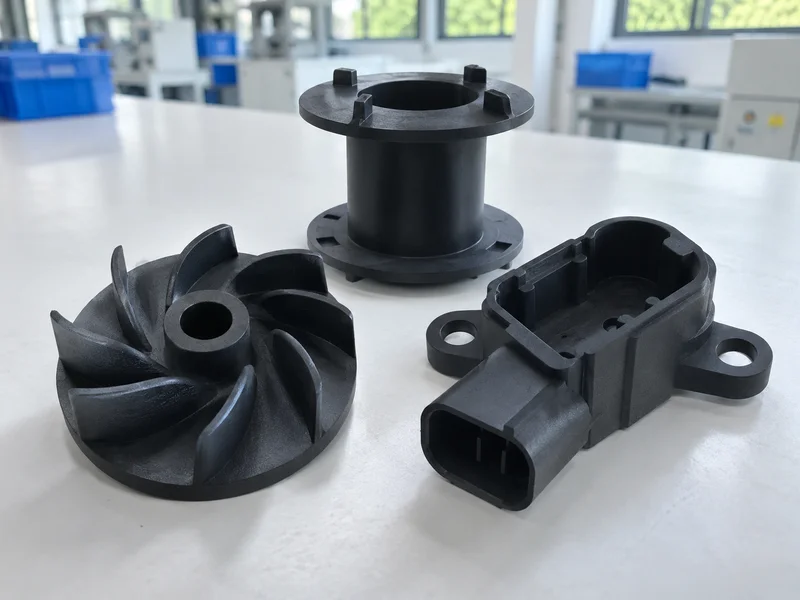
PPS injection molding is used where heat, chemicals and stability matter together.
Typical applications:
- Pump housings and impellers
- Sensor and actuator housings
- Connectors and coil bobbins
- Fuel and coolant system parts
- Appliance parts near heaters
- Precision electrical insulators
For example, a coolant temperature sensor housing benefits from PPS stability in hot glycol. Our guide to flame retardant plastics explains flame requirements.
Key Takeaway: For this reason, consider PPS when nylons absorb too much moisture or soften too much.
What Settings Does PPS Injection Molding Need?
PPS injection molding runs at high temperatures with careful drying and mold heating.
Processing guidance (typical, confirm per grade):
- Drying: often about 3–4 h at 130–150 °C to remove surface moisture and volatiles
- Melt temperature: about 300–340 °C
- Mold temperature: about 130–150 °C for full crystallinity
- Injection speed: fast, for thin walls and glass orientation
- Short residence time to limit degradation and gas
For example, molding PPS at 80 °C mold temperature gives a less crystalline skin that may shrink later in service. Our guide to mold temperature controller explains how hot molds are run.
Key Takeaway: Overall, a hot mold is essential for stable PPS parts.
How Should Molds Be Designed for PPS?
Molds for PPS should be designed for heat, wear and flash control.
Mold design points:
- Hardened, wear-resistant steel for glass-filled grades
- Corrosion-resistant steel or coatings against off-gassing
- Tight shut-offs and fine fits, because PPS flashes easily
- Fine, well-maintained vents
- Insulation plates and oil or pressurized water heating
- Gate design for consistent fiber orientation
For example, PPS can flash into gaps of a few hundredths of a millimeter, so parting line and ejector fits must be very tight. Our guide to injection molding flash explains causes.
Key Takeaway: Equally, build PPS molds with flash control in mind from the start.
How Should Parts Be Designed for PPS?
Parts should be designed for PPS with its stiffness and brittleness in mind.
Design tips:
- Uniform walls, often about 1–3 mm
- Generous radii to reduce notch sensitivity
- Limited snap-fit strain (about 1% for filled grades)
- Gate location for consistent orientation and weld line control
- Thread inserts for repeated assembly
For example, a PPS clip designed with nylon-like strain may crack; shortening deflection or using a toughened grade helps. Our guide to snap fit design explains allowable strain.
Key Takeaway: As a rule, design PPS parts like stiff, brittle parts.
How Should PPS Parts Be Specified?
PPS parts should be specified with grade, properties, flame rating and dimensional requirements.
Specification items:
- Grade, such as PPS-GF40 or glass/mineral filled
- Flame rating and thickness
- Operating temperature and chemicals
- Critical dimensions and conditioning
- Flash limits on functional edges
- Material certificates
For example, “PPS-GF40, UL 94 V-0 at 0.8 mm, continuous 180 °C in coolant, flash ≤0.05 mm on sealing edge” is complete. Our quality control and inspection process records critical checks when specified.
Key Takeaway: Finally, include flash limits for PPS sealing and mating edges.
FAQ
- Q: What is PPS injection molding?
- Molding polyphenylene sulfide, a heat- and chemical-resistant semi-crystalline plastic.
- Q: What mold temperature does PPS need?
- Typically about 130–150 °C for full crystallinity.
- Q: Is PPS flame resistant?
- Yes, many grades are inherently UL 94 V-0.
- Q: Why does PPS flash easily?
- It has very low viscosity at melt temperature.
- Q: Is PPS brittle?
- Compared with nylon, yes; toughened grades improve impact.
Conclusion
PPS injection molding delivers stable, heat-, chemical- and flame-resistant parts when molds run hot, resist wear and control flash, and parts are designed for a stiff, brittle resin. To review a PPS part, send your 3D model and 2D drawing to our engineers.