
High Volume Injection Molding: Tooling, Cost and Control
High volume injection molding is the production of plastic parts in quantities from tens of thousands to millions per year, using hardened multi-cavity molds, stable processes and planned quality control to keep cost per part low and quality consistent. It is where injection molding is most economical, because the mold cost is spread over many parts and cycle time becomes the main cost driver.
Moving from samples to mass production changes the questions. For example, a housing that ran well as 500 pilot parts in a single-cavity mold may need a 4-cavity hardened tool, a hot runner and an automated take-out to hit a target price at 300,000 parts a year. In this guide, we explain what counts as high volume, the tooling it needs, cost drivers, process control, quality checks, supply planning and how to move from pilot to mass production. For small runs, see our guide to low volume injection molding.
High volume injection molding usually means about 100,000 or more parts per year from one part number. It relies on hardened steel molds (often SPI Class 101 or 102), multiple cavities, hot runners where suitable, short optimized cycle times, automation for part removal and stable process windows documented through validation. Cost per part falls with more cavities and shorter cycles, while quality is held through first article approval, in-process checks, statistical control of critical dimensions and planned mold maintenance by shot count.
In short: high volume production trades higher tooling cost for lower, stable cost per part.
Key points:
- Tooling: hardened, multi-cavity, often hot runner.
- Cost driver: cycle time and cavities.
- Control: validated process plus SPC.
What Counts as High Volume Injection Molding?
High volume injection molding usually starts at about 100,000 parts per year for one part number.
| Volume band | Typical tooling | Typical focus |
|---|---|---|
| Up to 10,000 / year | Single-cavity, pre-hardened steel | Flexibility, low tool cost |
| 10,000–100,000 / year | 1–4 cavities, P20 or 718H | Balance of tool and part cost |
| 100,000–1,000,000 / year | 4–16 cavities, hardened steel | Cycle time, automation |
| Over 1,000,000 / year | 16+ cavities, hot runner, stack molds | Cost per part, uptime |
For example, a small clip at 2 million parts a year may run in a 16-cavity hot runner mold, while a large housing at 150,000 a year may still use 2 cavities. Our guide to SPI mold classification explains the tool classes.
Key Takeaway: Above all, define annual volume and life volume before choosing the mold.
What Tooling Does Mass Production Need?
Mass production needs tooling built for long life, short cycles and easy maintenance.
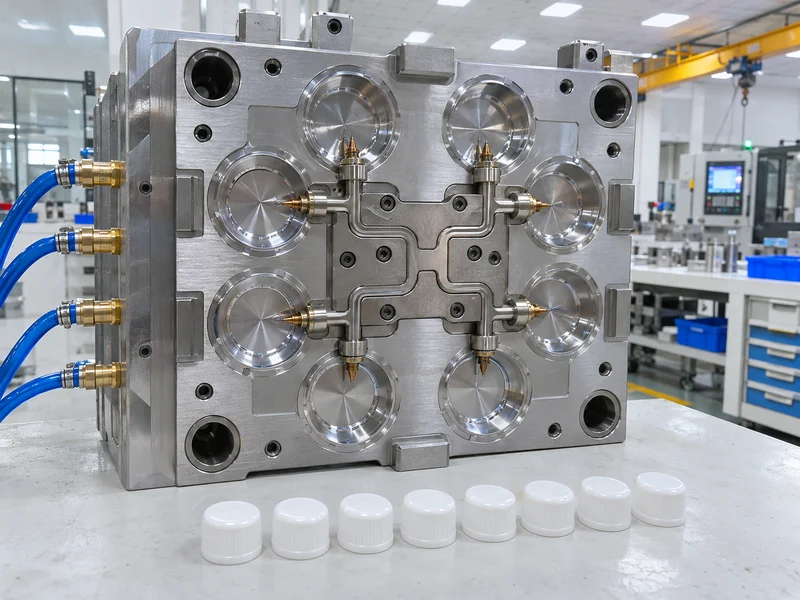
- Hardened steel cavities and cores, such as H13 or S136 at 48–52 HRC
- Multiple cavities balanced for even filling
- Hot runner or valve gates to remove runner scrap
- Efficient cooling, sometimes with conformal cooling inserts
- Replaceable wear parts at gates, shutoffs and slides
- Mold counter and maintenance records
For example, a hot runner on a 8-cavity cap mold can cut cycle time and remove runner regrind entirely. Our multi-cavity injection molds page and guides to hot runner systems and conformal cooling explain these choices.
Key Takeaway: In other words, high volume molds are designed for uptime, not just for the first sample.
What Drives Cost in High Volume Injection Molding?
Cost in high volume injection molding is driven mainly by resin, cycle time and cavities.
| Cost element | What changes it |
|---|---|
| Resin | Part weight, runner waste, resin grade |
| Machine time | Cycle time ÷ cavities × machine rate |
| Labor | Manual vs automated take-out and packing |
| Scrap | Process stability, startup losses |
| Tool amortization | Tool cost ÷ life volume |
| Secondary operations | Assembly, printing, inserts |
| Packaging and freight | Part size, packing density |
For example, cutting cycle time from 30 to 24 seconds on a 4-cavity mold raises output by 25% on the same press. Our guides to estimating molding cycle time and how to estimate injection molding cost give the formulas.
Key Takeaway: For this reason, compare quotes by cost per part over the full volume, not tool price alone.
How Is the Process Controlled at High Volume?
The process is controlled at high volume by validating a window and then monitoring it.
- Scientific molding to set fill, pack and cooling
- Process window tested at high and low settings
- Locked parameters with change control
- Resin drying and material lot records
- Machine monitoring of cushion, pressure and cycle time
- Planned maintenance by shot count
For example, a cushion alarm can stop a press before short shots reach the packing line. Our guides to scientific molding, decoupled molding and shot count explain each step.
Key Takeaway: Overall, a validated window protects quality when material lots and shifts change.
How Is Quality Checked in Mass Production?
Quality in mass production is checked at approval, during the run and before shipping.
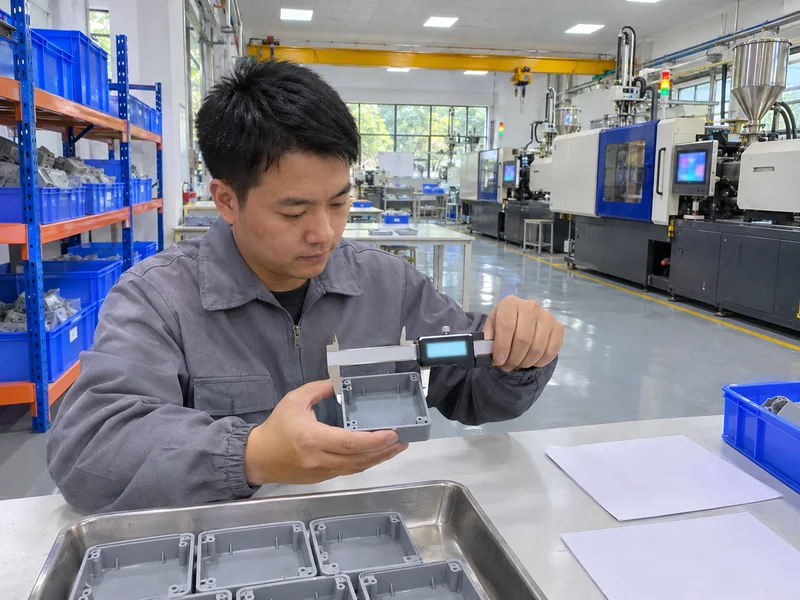
| Stage | Typical checks |
|---|---|
| Approval | First article inspection, CMM report, PPAP when required |
| Startup | First-off parts against limit samples |
| In process | Critical dimensions, visual checks at set intervals |
| Statistics | SPC on key features, Cpk targets |
| Final | AQL sampling, packing and labels |
For example, a connector housing may have three critical dimensions checked every two hours with SPC charts, plus a visual check every hour. Our guides to first article inspection reports, process capability Cpk and control plans explain these tools. Quality management principles are described by ISO.
Key Takeaway: Equally, agree the critical features and check plan before the first production lot.
How Should Supply Be Planned for High Volume Parts?
Supply for high volume parts should be planned around forecasts, capacity and risk.
- Forecast: rolling 3–12 month demand with firm orders
- Capacity: press time reserved for the part
- Safety stock for long sea freight
- Second cavity set or second mold for very high volumes
- Spare wear parts at the molding site
- Packaging spec to avoid damage and mixing
For example, a buyer shipping by sea from China often holds 4–6 weeks of safety stock. Our guide to mold maintenance explains spare parts planning.
Key Takeaway: As a rule, share forecasts early so capacity and resin are ready.
How Do You Move From Pilot Run to High Volume Injection Molding?
You move from pilot run to high volume injection molding through staged validation.
- Prototype or bridge tool to confirm design
- Production tool built for the target volume
- T1–T3 trials with dimensional and functional checks
- Process validation and capability study
- Pilot lot of a few thousand parts
- Ramp-up with close monitoring
- Steady production with routine checks
For example, a housing may move from a single-cavity bridge tool to a 4-cavity hardened mold after the pilot confirms fit. Our plastic injection molding page explains how our Shenzhen molding plant takes parts from T1 trial to volume production, and our guide to bridge tooling covers the step in between.
Key Takeaway: Finally, freeze the design before the production mold, because changes in hardened steel are slow and costly.
FAQ
- Q: What is high volume injection molding?
- Producing about 100,000 or more parts a year from one part number.
- Q: Which mold is used for mass production?
- A hardened steel, multi-cavity mold, often with a hot runner.
- Q: How can cost per part be reduced?
- More cavities, shorter cycle time, less runner waste and automation.
- Q: How is quality controlled?
- With process validation, SPC on critical features and AQL final checks.
- Q: When should I move from pilot to mass production?
- After the pilot lot confirms design, fit and process capability.
Conclusion
High volume injection molding pays off when tooling, process control and supply planning are designed for the full volume. Define volume, critical features and cost targets early. To plan production for your part, send your 3D model and 2D drawing to our engineers.