
Laser Marking Plastic: Laser Types, Materials, Contrast
Laser marking plastic is a non-contact process that uses a focused laser beam to change the color, foam or surface of a plastic part to create permanent text, logos, serial numbers, data matrix codes and symbols without inks or consumables. It is widely used on molded housings, connectors, buttons and automotive and electrical parts that need durable, traceable markings.
Results depend more on the resin and additives than on the laser. For example, a natural PP part may give only a faint mark, while the same part molded with a laser-sensitive additive gives a sharp dark code that scans every time. In this guide, we explain how laser marking plastic works, which laser types and plastics suit it, how to get contrast, what can be marked, how it compares with other methods and how to specify it. For molding materials, see our injection molding material selection guide.
Laser marking plastic changes the material in a thin surface layer by carbonizing (dark marks), foaming (light marks), color change of pigments or ablation of a top coat. Fiber lasers (about 1064 nm) suit most filled and pigmented plastics, CO2 lasers (10.6 µm) suit organic materials and some plastics, and UV lasers (355 nm) give fine, cold marks on sensitive or white plastics. ABS, PC, PBT, PA and POM usually mark well; PE, PP and some white grades need laser additives. Contrast, depth and readability are approved on molded samples.
In short: choose the resin, additive and laser together to get a clear, permanent mark.
Key points:
- Mechanisms: carbonizing, foaming, color change, ablation.
- Lasers: fiber, CO2, UV.
- Contrast key: resin color and laser additives.
How Does Laser Marking Plastic Work?
Laser marking plastic works by heating a thin surface layer so its color or structure changes.
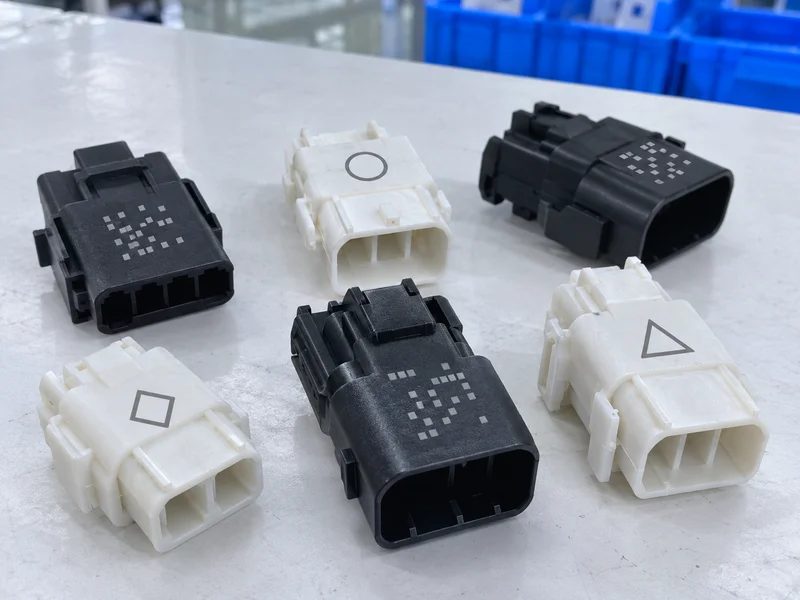
| Effect | What happens | Typical result |
|---|---|---|
| Carbonizing | Polymer darkens from heat | Dark mark on light parts |
| Foaming | Tiny gas bubbles form | Light, slightly raised mark on dark parts |
| Color change | Pigments react to the beam | Colored or light marks |
| Ablation | A top layer is removed | Day-night symbols on painted or 2K parts |
For example, a black PBT connector usually marks light grey by foaming, while a white ABS housing marks dark by carbonizing. Laser safety requirements are set out in IEC 60825-1.
Key Takeaway: Above all, the base color decides whether the mark will be dark or light.
Which Laser Types Are Used to Mark Plastic?
Fiber, CO2 and UV lasers are used to mark plastic, each with strengths.
- Fiber lasers (1064 nm): fast, good on pigmented and filled plastics
- CO2 lasers (10.6 µm): good on some plastics, paper and organics, coarser marks
- UV lasers (355 nm): fine detail, little heat, good on white and sensitive plastics
- Green lasers (532 nm): for some sensitive materials
For example, a small data matrix on a white PC medical-type part is often marked with a UV laser to avoid burning. Our manufacturing capabilities page lists the laser marking equipment in our Dongguan factory.
Key Takeaway: In other words, match the laser wavelength to the material and the detail needed.
Which Plastics Are Best for Laser Marking?
The best plastics for laser marking absorb the beam well and change color cleanly.
| Plastic | Laser marking result |
|---|---|
| ABS | Good dark marks on light colors |
| PC, PC/ABS | Good contrast, careful heat control |
| PBT, PBT GF | Good light marks on dark parts |
| PA6, PA66 | Good, glass fill helps contrast |
| POM | Good with laser grade, can foam |
| PP, PE | Poor without additives |
| PMMA | Weak without additives |
For example, adding a laser additive to a PP cap can turn a faint mark into a clear dark one. Our guides to ABS injection molding and PBT injection molding explain these resins.
Key Takeaway: For this reason, ask the resin supplier for a laser-markable grade when contrast matters.
How Do You Get Good Contrast When Laser Marking Plastic?
You get good contrast when laser marking plastic by tuning material, color and laser settings together.
- Laser additives in the resin or masterbatch
- Color choice: mid and dark colors often foam light; light colors carbonize dark
- Power, speed and frequency tuned on samples
- Focus height fixed by a jig
- Surface: clean, dry, no mold release on the area
For example, a dark grey PA66 part may need a slower pass and slight defocus to get an even light mark. Our guide to masterbatch explains how additives are added to resin.
Key Takeaway: Overall, approve contrast on molded parts from the production resin, not on test plates.
What Can Be Laser Marked on Molded Parts?
Many kinds of information can be laser marked on molded parts.
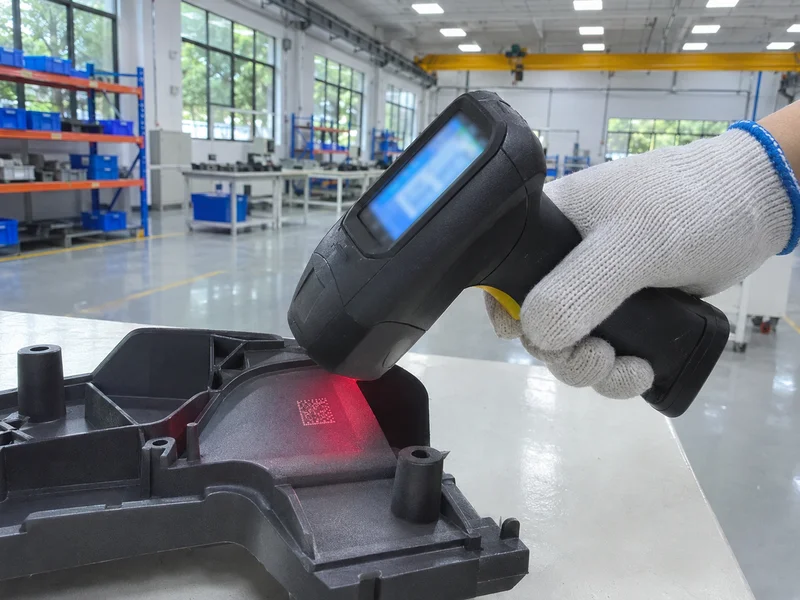
- Logos and part numbers
- Serial numbers for traceability
- Data matrix and QR codes
- Date and lot codes that change each lot
- Safety and rating symbols
- Scales and graduations
For example, a connector housing can carry a lot code and a small 2D code linked to its material lot. Our guide to first article inspection reports explains how marks are checked.
Key Takeaway: Equally, laser marking suits changing data that molded-in text cannot provide.
How Does Laser Marking Compare With Other Methods?
Laser marking compares with other methods by durability, flexibility and cost.
| Method | Strength | Limit |
|---|---|---|
| Laser marking | Permanent, no consumables, variable data | Contrast depends on material |
| Pad printing | Many colors, curved surfaces | Ink, can wear off |
| Molded-in text | No extra step | Fixed data, cost to change |
| Hot stamping | Metallic finishes | Foil cost, flat areas |
| Labels | Cheap, flexible | Can peel off |
For example, a date code changes every lot, so laser marking is better than molded-in text. Our plastic injection molding page covers secondary operations included with molding.
Key Takeaway: As a rule, laser marking wins when data changes or the mark must not wear off.
How Should Laser Marking Plastic Be Specified?
Laser marking plastic should be specified with content, location, size and acceptance criteria.
- Content: text, logo files and code data
- Location and size on the 2D drawing
- Color target: dark or light, contrast level
- Code grade: for example, a minimum ISO/IEC 15415 grade for 2D codes
- Durability tests: rub, chemical or abrasion if required
- Approval samples in the production resin
For example, “2D code 6 × 6 mm, grade B or better, on the flat area beside the latch” is clear. Our quality control & inspection page explains how markings are checked.
Key Takeaway: Finally, approve the marking on the first production lot and keep a limit sample.
FAQ
- Q: Can all plastics be laser marked?
- Most can; PE, PP and some white grades need laser additives.
- Q: Which laser is best for plastic?
- Fiber lasers for most parts; UV lasers for fine marks on sensitive plastics.
- Q: Is laser marking permanent?
- Yes, the mark is part of the surface and does not rub off like ink.
- Q: Can a laser mark a light color on dark plastic?
- Yes, foaming gives light marks on many dark plastics.
- Q: Can serial numbers be laser marked?
- Yes, laser marking handles changing text and codes for each part.
Conclusion
Laser marking plastic gives permanent, flexible marks when resin, color and laser settings are chosen together and approved on real parts. Specify content, size and acceptance up front. To plan marking for your molded parts, send your 3D model and 2D drawing to our engineers.