
Industrial CNC Machined Parts: Materials and Spares
Industrial CNC machined parts are the precision components inside machines, automation lines, instruments, pumps, valves, robots, test equipment and electrical systems. Most of them are small and medium parts, such as brackets, housings, manifolds, shafts, bushings, fixtures and adapter plates, that must fit, survive their environment and be replaceable years later. Buying them well means balancing accuracy, material, finish, documentation and repeatability.
Industrial buyers often focus on unit price and overlook the things that cause line stoppages. For example, a replacement bracket that is cheaper but made from a different alloy or finish may corrode or wear in months. In this guide, we explain industrial CNC machined parts: common types, materials and finishes for industrial environments, tolerances and documentation, how to source spare and replacement parts, quality and traceability, and how to choose a supplier. Our focus is small and medium precision parts. For process control, see our guide to precision CNC machining services industrial production reliability.
Industrial CNC machined parts are precision metal and plastic components for machinery and equipment, typically made from aluminum, carbon and alloy steel, stainless steel, brass, copper and engineering plastics. Good industrial parts match the environment (corrosion, wear, temperature, chemicals), use finishes such as anodizing, nickel or zinc plating, black oxide or passivation, carry tolerances based on function, and come with the documentation the application needs, such as material certificates and inspection reports. Repeatability over years depends on controlled drawings, revisions and processes.
In short: choose material and finish for the environment, tolerance by function and keep drawings and processes controlled for repeat orders.
Key points:
- Environment: drives material and finish.
- Function: drives tolerances.
- Repeatability: depends on documentation and revision control.
What Are Industrial CNC Machined Parts?
Industrial CNC machined parts are components machined to drawing for industrial equipment.
Common types:
- Brackets and mounting plates
- Housings and enclosures
- Manifolds and valve bodies
- Shafts, pins and bushings
- Fixtures, jigs and gauge parts
- Adapter plates and spacers
- Electrical parts: bus bars, terminals, insulators
For example, an automation line may contain hundreds of small machined parts, from sensor brackets to gripper fingers. Our CNC machining services focus on small and medium precision parts like these.
Key Takeaway: Above all, industrial parts are judged by fit, durability and replaceability.
Which Materials Suit Industrial CNC Machined Parts?
Materials for industrial CNC machined parts should match load, environment and cost.
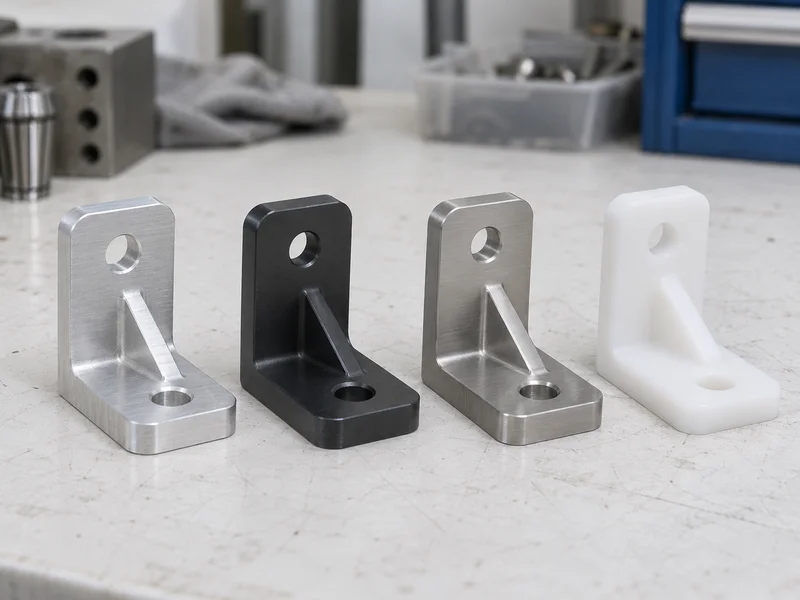
| Material (typical) | Strengths | Typical industrial uses |
|---|---|---|
| 6061 / 7075 aluminum | Light, machinable, anodizes well | Brackets, housings, plates |
| 1045 / C45 carbon steel | Low cost, strong | Shafts, pins, bases |
| 4140 / 42CrMo4 alloy steel | High strength, hardenable | Loaded shafts, gears |
| 303 / 304 / 316 stainless | Corrosion resistance | Food, chemical, outdoor parts |
| Brass / copper | Machinable, conductive | Fittings, electrical parts |
| POM, nylon, PEEK | Low friction, insulating | Wear parts, insulators |
For example, a washdown-area bracket in a food plant is usually 304 or 316 stainless, not anodized aluminum. Our guide to 304 stainless steel versus 316 stainless steel compares them.
Key Takeaway: In other words, the environment usually decides the material before strength does.
Which Finishes Protect Industrial CNC Machined Parts?
Finishes protect industrial CNC machined parts against corrosion, wear and handling.
- Anodizing / hard anodizing: aluminum parts
- Zinc or nickel plating: steel parts
- Black oxide: steel parts in dry environments, with oil
- Passivation: stainless steel
- Powder coating: covers and frames
- Electroless nickel: uniform protection in holes
For example, a 4140 shaft in a humid factory may need nickel plating, while a dry indoor shaft may only need black oxide and oil. Our guide to black oxide coating explains its limits.
Key Takeaway: For this reason, specify the finish together with the material.
How Should Tolerances and Documentation Be Set?
Tolerances and documentation should be set by function and by the application’s risk.
Tolerances:
- General tolerance for most features
- Tight tolerances for fits, locations and seals
- GD&T for positions and flatness
Documentation:
- Material certificates for critical parts
- First article inspection report for new parts
- Dimensional reports for critical features
- Revision control on drawings
For example, a spare gear for a production machine may need a material certificate and hardness report to match the original. Our quality control and inspection process supplies reports on request.
Key Takeaway: Overall, match documentation to the cost of failure.
How Do You Source Spare and Replacement Parts?
You source spare and replacement parts by recreating complete, controlled drawings and verifying fit.
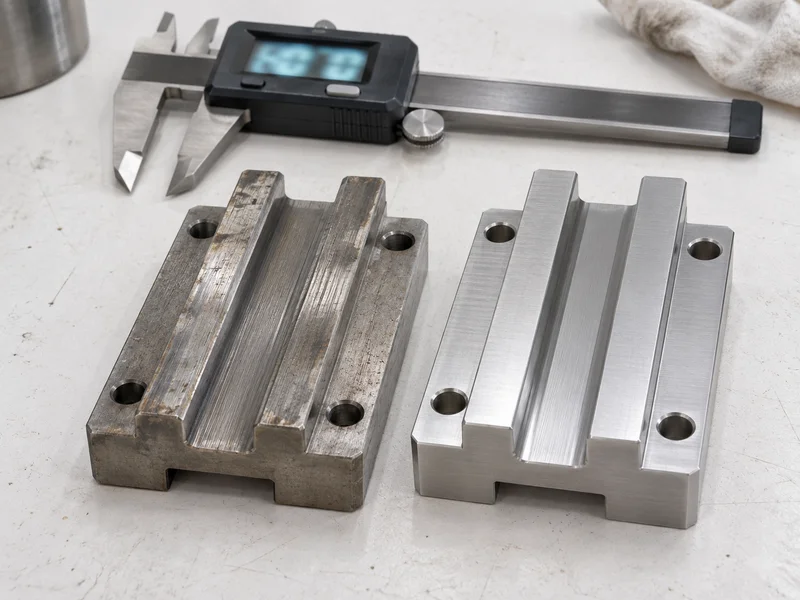
Steps:
- Collect the original drawing or reverse-engineer a sample.
- Confirm material and finish from records or testing.
- Identify critical fits and wear surfaces.
- Make a first article and test fit in the machine.
- Store the approved drawing and program for future orders.
For example, a worn guide block without a drawing can be measured, modeled and remade, with its sliding surfaces upgraded to a harder material. Our guide to low-volume CNC machining covers small spare batches.
Key Takeaway: Equally, every replacement part should leave behind a controlled drawing.
How Are Quality and Traceability Maintained?
Quality and traceability are maintained through controlled processes and records.
Practice:
- Approved drawing revision for each order
- Frozen program and setup for repeat parts
- Material lot traceability
- Inspection records per lot
- Change notification for any material or process change
For example, recording the bar lot and inspection results for each batch lets a failure be traced to its source. Traceability principles are described in quality standards from ISO.
Key Takeaway: As a rule, traceability turns a field problem into a solvable one.
How Do You Choose a Supplier for Industrial CNC Machined Parts?
You choose a supplier for industrial CNC machined parts by capability fit, process control and communication.
Check:
- Part size and type fit: small and medium precision parts
- Materials and finishes offered
- Inspection capability for your tolerances
- Process and revision control
- Repeat-order handling
- Communication and lead times
For example, a supplier that keeps your programs, fixtures and approved samples can deliver repeat parts that match the first lot. Our guide to the supplier audit checklist lists audit points.
Key Takeaway: Finally, choose suppliers whose focus matches your part size and precision.
FAQ
- Q: What are industrial CNC machined parts?
- Precision components machined to drawing for machinery and equipment.
- Q: Which materials are common for industrial machined parts?
- Aluminum, carbon and alloy steel, stainless steel, brass, copper and engineering plastics.
- Q: Which finish is best for industrial steel parts?
- It depends on the environment: zinc or nickel plating for humidity, black oxide for dry areas.
- Q: How are replacement parts made without drawings?
- By measuring a sample, confirming material and finish, and approving a first article.
- Q: What documents should industrial parts come with?
- Material certificates and inspection reports when the application requires them.
Conclusion
Industrial CNC machined parts succeed when material and finish match the environment, tolerances match function and drawings and processes stay controlled for years of repeat orders. To source precision industrial parts, send your 3D model and 2D drawing to our engineers.