
Metal Surface Finishing Techniques Compared
Metal surface finishing techniques change the surface of a machined part to improve corrosion resistance, wear, appearance, conductivity or cleanliness. For small and medium precision parts, the finish is often specified last but affects dimensions, cost, lead time and how the part performs. Choosing well means matching the finish to the base metal, the environment and the function.
Finishes are frequently chosen by habit. For example, a steel bracket may be zinc plated because the last design was, even though black oxide and oil would be enough indoors, or electroless nickel would be needed in a humid plant. In this guide, we explain the main metal surface finishing techniques: mechanical finishes, conversion and anodic finishes, plating, coatings and stainless steel treatments, how to choose between them, their dimensional effects and how to specify them. For aluminum-specific choices, see our guide to aluminum powder coating vs anodizing.
Metal surface finishing techniques fall into five groups: mechanical finishes (bead blasting, polishing, brushing, tumbling), conversion and anodic finishes (anodizing, chemical conversion coating, black oxide, phosphating), plating (zinc, nickel, electroless nickel, chrome, copper, tin, silver), organic coatings (powder coating, painting) and stainless treatments (passivation, electropolishing). Each has typical base metals, thickness effects and purposes. Choose by base metal, environment, wear, conductivity, appearance and dimensional tolerance, and specify the standard, type, thickness and masking.
In short: pick the finish family by base metal and function, then specify it precisely.
Key points:
- Base metal: narrows the options first.
- Function: corrosion, wear, appearance, conductivity.
- Dimensions: some finishes add tens of microns.
What Are the Main Metal Surface Finishing Techniques?
The main metal surface finishing techniques are grouped by how they change the surface.
| Group | Examples | Main purpose |
|---|---|---|
| Mechanical | Bead blasting, polishing, brushing, tumbling | Appearance, deburring, texture |
| Conversion / anodic | Anodizing, chem film, black oxide, phosphating | Corrosion, paint base, color |
| Plating | Zinc, nickel, EN, chrome, copper, tin, silver | Corrosion, wear, conductivity |
| Organic coatings | Powder coating, painting | Color, weather protection |
| Stainless treatments | Passivation, electropolishing | Corrosion, cleanliness |
For example, a stainless fitting is usually passivated, an aluminum housing anodized and a steel shaft plated or black oxided. Our CNC machining services offer these finishes through our qualified finishing suppliers.
Key Takeaway: Above all, start with the group that suits the base metal.
Which Metal Surface Finishing Techniques Suit Each Base Metal?
Metal surface finishing techniques suit each base metal differently.
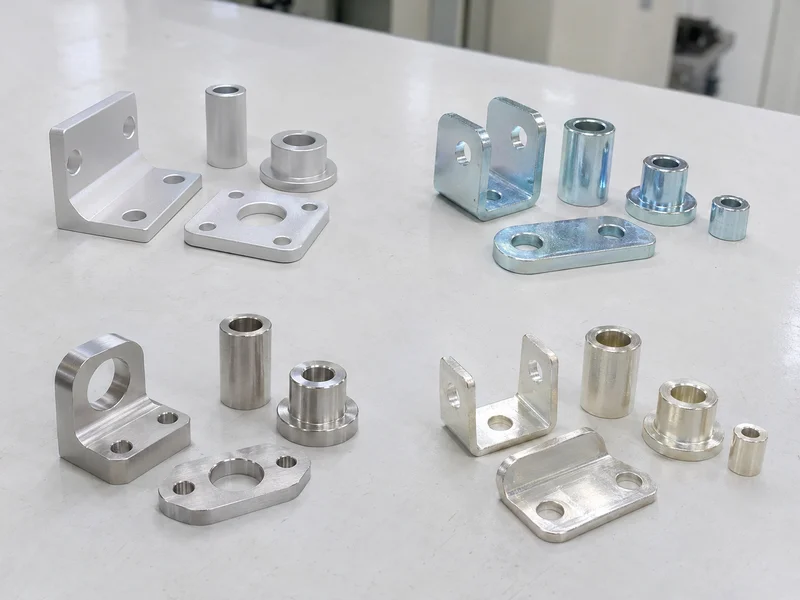
- Aluminum: anodizing, hard anodizing, chem film, powder coating, bead blasting
- Carbon and alloy steel: zinc plating, nickel, electroless nickel, black oxide, phosphating, powder coating
- Stainless steel: passivation, electropolishing, bead blasting
- Brass and copper: nickel, tin, silver, clear lacquer
- Titanium: anodizing (color), passivation, bead blasting
For example, a brass connector may be tin plated for solderability, while a copper bus bar may be silver plated for contact. Our guide to copper and nickel plating explains plating systems.
Key Takeaway: In other words, the base metal narrows the finish list quickly.
How Do Mechanical Finishes Work?
Mechanical finishes work by changing surface texture without adding a chemical layer.
- Bead blasting: uniform matte texture
- Polishing: smooth, reflective surfaces
- Brushing: directional satin lines
- Tumbling / vibratory finishing: deburring and edge rounding
For example, a bead-blasted aluminum cover gives an even matte look before anodizing. Our guide to bead blast texture explains consistency control.
Key Takeaway: For this reason, mechanical finishes are often the first step before a protective finish.
How Do Conversion, Plating and Coating Finishes Compare?
Conversion, plating and coating finishes compare by thickness, durability and purpose.
| Finish (typical) | Thickness | Conductive | Main benefit |
|---|---|---|---|
| Chem film (aluminum) | <1 µm | Yes | Corrosion, paint base |
| Anodizing Type II | 5–25 µm | No | Corrosion, color |
| Hard anodizing | 25–75 µm | No | Wear |
| Black oxide (steel) | ~1 µm | Yes | Appearance, mild protection with oil |
| Zinc plating | 5–25 µm | Yes | Corrosion on steel |
| Electroless nickel | 5–25 µm | Yes | Uniform corrosion and wear |
| Powder coating | 50–120 µm | No | Color, weather |
For example, a steel part needing uniform coverage inside holes is better electroless nickel than zinc. Our guide to black oxide coating explains its limits.
Key Takeaway: Overall, compare thickness and conductivity before choosing.
What Do Passivation and Electropolishing Do for Stainless Steel?
Passivation and electropolishing improve stainless steel’s natural corrosion resistance.
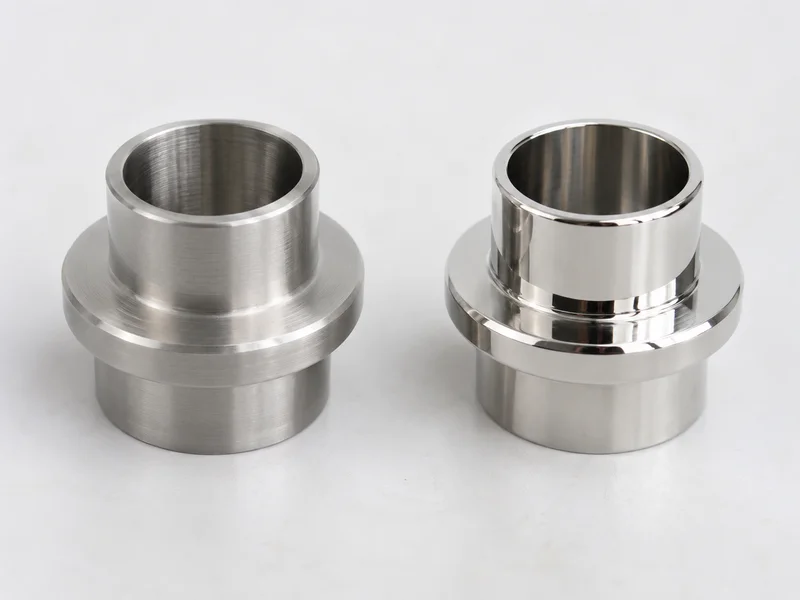
- Passivation: chemically removes free iron and contamination, strengthening the chromium oxide layer; no dimensional change.
- Electropolishing: electrochemically removes a thin surface layer, smoothing and brightening the surface; slight dimensional change.
- Uses: food, medical-style, semiconductor and fluid parts.
For example, a 316 fitting for a clean fluid system may be passivated, while a sanitary part may also be electropolished. Passivation specifications such as ASTM A967 are published by ASTM International.
Key Takeaway: Equally, passivate machined stainless parts that face corrosive environments.
How Do Finishes Affect Dimensions and Tolerances?
Finishes affect dimensions and tolerances by adding or removing material.
- Negligible: passivation, chem film, black oxide
- Small: Type II anodizing, thin plating
- Significant: hard anodizing, thick plating, powder coating
- Removal: electropolishing, polishing
Practice:
- State whether dimensions apply before or after finishing
- Mask threads, fits and contact faces
- Allow for coating in machining tolerances
For example, an H7 bore that will receive 10 µm electroless nickel should be machined about 20 µm larger. Our guide to tight tolerance machining covers allowances.
Key Takeaway: As a rule, plan finish allowances in the machining tolerances.
How Should Metal Surface Finishing Techniques Be Specified?
Metal surface finishing techniques should be specified with standard, type, thickness, color and masking.
Specification items:
- Finish and standard, such as “anodize MIL-A-8625 Type II, Class 2, black”
- Thickness range
- Masking areas with dimensions
- Dimension status: before or after finish
- Appearance standard or reference sample
- Tests: thickness, adhesion, salt spray if required
For example, “Zinc plate ISO 2081, 8–12 µm, clear trivalent passivation, mask M5 threads” is complete. Our quality control and inspection process checks coating thickness when specified.
Key Takeaway: Finally, a finish callout needs a standard and a thickness to be complete.
FAQ
- Q: What are the main metal surface finishing techniques?
- Mechanical finishes, conversion and anodic finishes, plating, organic coatings and stainless treatments.
- Q: Which finish is best for aluminum?
- Anodizing for most parts; chem film for conductivity; powder coating for color.
- Q: Which finish is best for steel parts?
- Zinc or nickel plating for corrosion; electroless nickel for uniform coverage; black oxide for dry indoor use.
- Q: Does passivation change dimensions?
- No, its dimensional effect is negligible.
- Q: How should a finish be specified?
- With standard, type, thickness, color, masking and dimension status.
Conclusion
Metal surface finishing techniques should be chosen by base metal, environment and function, then specified with standard, thickness and masking. Plan finish allowances into machining tolerances. To review finishing on your part, send your 3D model and 2D drawing to our engineers.