
Swiss Machining: When to Use It and Design Tips
Swiss machining is a CNC turning method in which bar stock slides through a guide bushing while the tools cut close to the support point. Because the part is supported right next to the cut, Swiss-type lathes can turn long, slender, small-diameter parts to tight tolerances that would deflect on a conventional lathe. Pins, shafts, screws, connector contacts, medical-style components, valve stems and instrument parts are typical Swiss parts.
Swiss machining is not always the cheapest choice. For example, a short, stubby bushing may run faster on a conventional CNC lathe, while a 3 mm diameter pin 40 mm long with grooves and cross holes is ideal for a Swiss machine. In this guide, we explain Swiss machining: how it works, when it is the right process, typical parts and materials, achievable precision, design tips, cost factors and how it compares with conventional turning. For general turning accuracy, see our guide to high precision CNC turning.
Swiss machining uses a sliding-headstock lathe where bar stock moves axially through a guide bushing while stationary tools cut close to the bushing. This support allows long, slender parts (length-to-diameter ratios well above 4:1) to be turned accurately, typically on bar stock up to about 20–32 mm diameter. Live tools, sub-spindles and multiple tool groups let complex small parts be finished complete in one cycle. Swiss machining suits high-volume small precision parts in stainless steel, brass, aluminum, titanium and plastics, but needs ground bar stock and longer setups.
In short: choose Swiss machining for small, long, complex turned parts made in volume.
Key points:
- Guide bushing: supports the part close to the cut.
- Slender parts: high length-to-diameter ratios.
- Complete machining: live tools and sub-spindle.
How Does Swiss Machining Work?
Swiss machining works by moving the bar stock through a guide bushing while tools cut next to it.
Key elements:
- Sliding headstock: feeds the bar along the Z-axis
- Guide bushing: supports the bar near the cutting zone
- Gang tools: turning tools positioned close to the bushing
- Live tools: milling, drilling and cross-hole operations
- Sub-spindle: finishes the back side of the part
For example, a long stainless pin is turned in short sections as the bar slides out, so deflection stays low along the whole length. Our CNC turning service covers small precision turned parts.
Key Takeaway: Above all, Swiss machining keeps the cut close to the support.
When Is Swiss Machining the Right Choice?
Swiss machining is the right choice for small, slender and complex parts in medium to high volume.
Good fits:
- Length-to-diameter ratio above about 4:1
- Small diameters, typically under about 20–32 mm
- Many features: grooves, threads, flats, cross holes
- High volumes where setup time is spread over many parts
Less suitable:
- Short, large-diameter parts
- Very low volumes with long setups
- Parts needing non-ground bar stock
For example, a 2 mm connector contact with a slot and a cross hole is a classic Swiss part. Our guide to multi axis CNC turning covers conventional mill-turn options.
Key Takeaway: In other words, slender and complex points to Swiss.
Which Parts and Materials Suit Swiss Machining?
Parts and materials suited to Swiss machining are small precision parts in machinable bar stock.
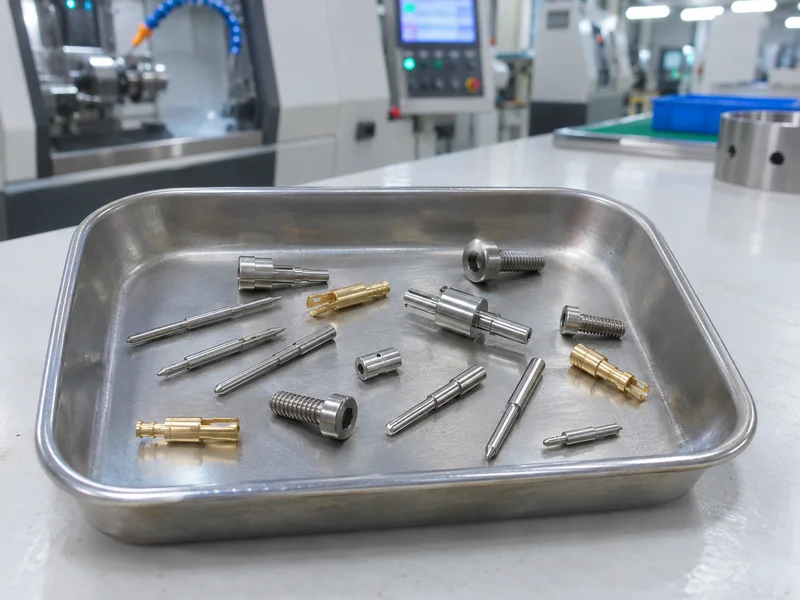
Typical parts:
- Pins, shafts and spindles
- Screws and threaded connectors
- Electrical contacts
- Valve stems and fluid fittings
- Medical-style and instrument components
Typical materials:
- Stainless steel: 303, 304, 316, 17-4PH
- Brass and copper alloys
- Aluminum
- Titanium
- Plastics: POM, PEEK
For example, 303 stainless and free-cutting brass run especially well because they break chips easily. Our guide to 303 vs 304 stainless compares machinability.
Key Takeaway: For this reason, free-machining grades give the best Swiss results.
How Precise Are Swiss-Type Lathes?
Swiss machining is very precise on small parts because deflection and setup error are low.
Typical results (process-dependent):
- Diameter tolerances of a few microns on small features
- Low runout because features are completed in one cycle
- Good surface finish on small diameters
- Consistent repeatability over long runs
Machine capability is not finished-part tolerance; achievable values depend on the part, material and process and are confirmed per drawing. Our guide to tight tolerance machining explains tolerance planning.
Key Takeaway: Overall, completing the part in one cycle is the main accuracy advantage.
How Should Parts Be Designed for Swiss Machining?
Parts should be designed for Swiss machining with bar size, features and tooling in mind.
Design tips:
- Use standard bar diameters, ideally ground stock
- Keep the largest diameter close to the bar size
- Standard thread sizes and groove widths
- Avoid deep, small blind holes where possible
- Allow cut-off space and a small cut-off mark
- Group cross features for live tools
For example, designing a pin from 6 mm bar with a 5.98 mm finished diameter avoids turning the full length. Our guide to design for CNC machining covers general rules.
Key Takeaway: Equally, design around the bar size to save cycle time.
What Drives Sliding-Headstock Part Cost?
Swiss machining cost is driven by setup, cycle time, material and volume.
Cost factors:
- Setup time: tooling and guide bushing setup
- Cycle time: number of operations
- Bar stock: ground bar costs more
- Volume: spreads setup cost
- Secondary operations: deburring, finishing
For example, a part costing too much on a conventional lathe because of multiple setups may cost less on a Swiss machine at 10,000 pieces. Our guide to high volume CNC machined parts explains volume effects.
Key Takeaway: As a rule, Swiss pays off as volume and complexity rise.
How Does Swiss Machining Compare With Conventional CNC Turning?
Swiss machining compares with conventional CNC turning by part shape, volume and setup.
| Factor | Swiss machining | Conventional CNC turning |
|---|---|---|
| Best part shape | Long, slender, small | Short, larger diameters |
| Deflection control | Excellent | Limited on long parts |
| Setup time | Longer | Shorter |
| Complexity in one cycle | High | Moderate (higher with mill-turn) |
| Typical volume | Medium to high | Prototype to high |
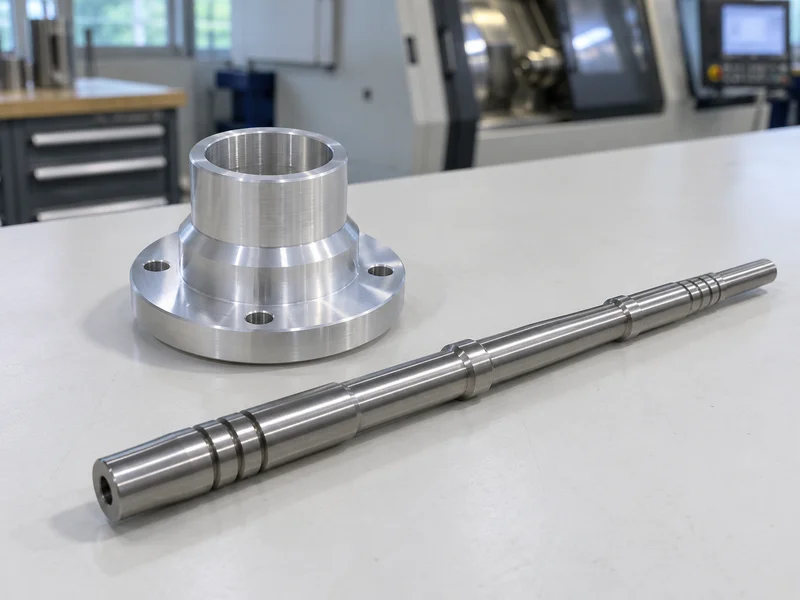
For example, a 30 mm flange bushing is cheaper on a conventional lathe, while a 3 mm × 50 mm pin belongs on a Swiss machine. Turning terminology is described in standards from ISO.
Key Takeaway: Finally, match the lathe type to the part’s length-to-diameter ratio.
FAQ
- Q: What is Swiss machining?
- CNC turning where bar stock slides through a guide bushing while tools cut close to the support.
- Q: What parts are made by Swiss machining?
- Small, slender, complex parts such as pins, screws, contacts and valve stems.
- Q: Is Swiss machining more accurate?
- For long, slender parts, yes, because deflection is lower.
- Q: What materials suit Swiss machining?
- Stainless steel, brass, aluminum, titanium and plastics such as POM and PEEK.
- Q: Is Swiss machining expensive?
- Setup is longer, but cost per part is low at volume.
Conclusion
Swiss machining turns small, slender, complex parts accurately by supporting the bar at the cut and finishing parts in one cycle. Use it for volume parts with high length-to-diameter ratios, and design around standard bar sizes. To review a turned part, send your 3D model and 2D drawing to our engineers.