
Injection Mold Repair: Methods, Process and Prevention
Injection mold repair restores a damaged or worn mold so it makes good parts again. Common repairs include welding and re-machining damaged steel, replacing worn ejector pins and inserts, re-fitting shutoffs that flash, cleaning and re-cutting vents, repairing hot runner heaters and re-polishing cavities. A good repair starts with diagnosis and ends with a trial and a record.
Repair or rebuild is often the real question. For example, a cracked core insert in a small precision mold can usually be replaced from the original design data within days, while a mold with worn plates, loose guides and many patched areas may cost less to rebuild than to keep repairing. In this guide, we explain injection mold repair: common damage, repair methods, the repair process, preventing damage, when to rebuild and how to plan repair support. For routine care, see our guide to maintenance of molds.
Injection mold repair covers diagnosis, repair and verification of mold damage or wear. Typical problems are flash from worn shutoffs, broken or bent pins, cracked inserts, damaged parting lines, blocked vents and cooling, worn gates, galling slides, rust and hot runner faults. Methods include laser or TIG welding with re-machining, insert and pin replacement, EDM re-cutting, re-fitting, polishing and component replacement. After repair, the mold is trialed and the change recorded. Rebuild is considered when damage is widespread, the base is worn or repeated repairs no longer hold.
In short: diagnose first, repair with the right method, then trial and record.
Key points:
- Common damage: flash, broken pins, cracks, rust, hot runner faults.
- Methods: welding, replacement, EDM, fitting, polishing.
- Finish: trial and repair record.
What Damage Needs Injection Mold Repair?
Several types of damage need injection mold repair.
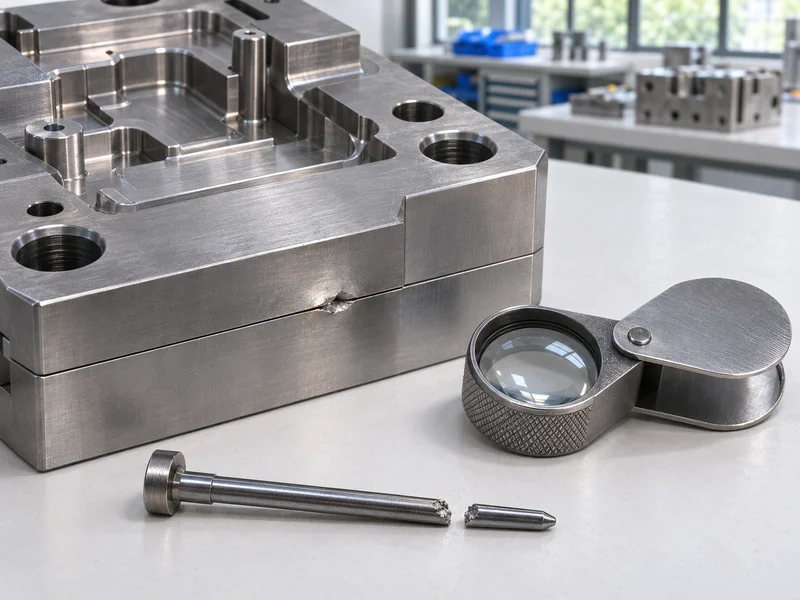
| Problem | Typical cause |
|---|---|
| Flash at parting line or shutoffs | Wear, damage, clamp issues |
| Broken or bent core and ejector pins | Overload, misalignment, part stuck |
| Cracked inserts | Fatigue, sharp corners, overheating |
| Damaged parting line | Trapped parts, closing on debris |
| Blocked vents | Residue buildup |
| Worn gates | Abrasive resins |
| Galling slides | Poor lubrication, heat |
| Rust | Condensation, poor storage |
| Hot runner faults | Heater or thermocouple failure, leaks |
For example, a part left in the mold during closing can dent the parting line and cause flash on every following shot. Our guides to injection molding flash and ejector pins explain two common issues.
Key Takeaway: Above all, identify the cause before the repair, or the damage returns.
Which Methods Are Used for Injection Mold Repair?
Different methods are used for injection mold repair depending on the damage.
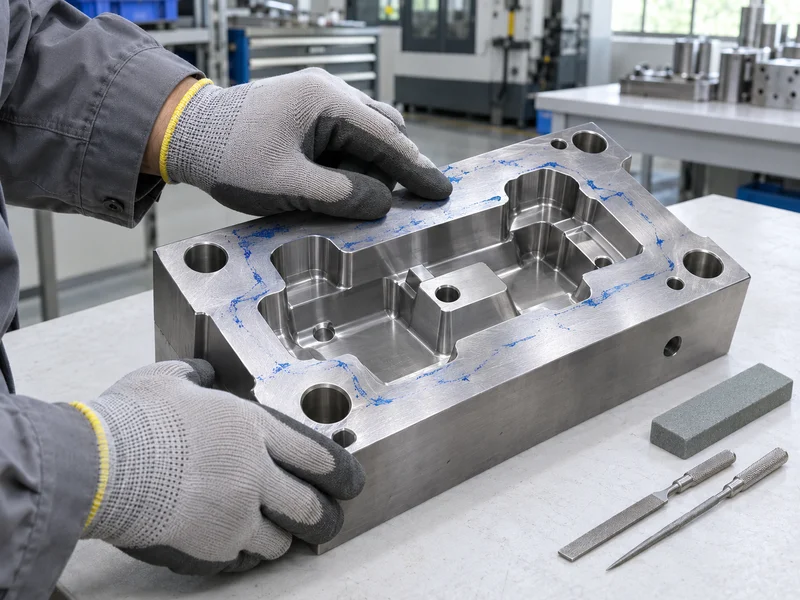
- Laser welding: small, precise repairs with low heat input
- TIG welding: larger build-up of steel
- Re-machining and EDM: restore geometry after welding
- Insert replacement: new insert from design data
- Pin and component replacement: standard parts
- Re-fitting: spot shutoffs and slides with blue
- Polishing and texture repair: restore surface finish
For example, a chipped shutoff edge is laser-welded, re-cut by EDM and fitted again. Our guides to sinker EDM and mold polishing explain the finishing steps.
Key Takeaway: In other words, choose the smallest repair that restores the original geometry.
What Is the Injection Mold Repair Process?
The injection mold repair process follows a clear sequence.
- Report the problem with parts, photos and shot count.
- Inspect the mold and find the root cause.
- Plan the repair and agree time and cost.
- Repair the steel or components.
- Measure repaired features.
- Trial the mold and check parts.
- Record the repair and update drawings.
For example, a repair record showing three weld repairs on the same corner suggests a design change, such as adding a radius. Our guide to mold inspection standards covers inspection. Welding filler and steel grades are specified by ASTM International.
Key Takeaway: For this reason, every repair should end with a trial and a record.
How Can Mold Damage Be Prevented?
Mold damage can be prevented with design choices, process control and maintenance.
- Mold protection settings on the press
- Part removal checks before closing
- Replaceable inserts for wear areas
- Radii instead of sharp corners in steel
- Scheduled vent cleaning and lubrication
- Proper storage with rust protection
For example, setting low-pressure mold protection stops the press when a part is left in the cavity. Our guide to injection mold venting explains vent maintenance.
Key Takeaway: Overall, prevention costs less than the smallest repair.
When Should a Mold Be Rebuilt Instead of Repaired?
A mold should be rebuilt when repair no longer restores stable production.
- Widespread wear of plates, guides and shutoffs
- Repeated repairs in the same areas
- Cracks in main plates or large inserts
- Design changes that the old tool cannot take
- Volume growth needing more cavities
For example, an old mold with worn guide bushings and patched shutoffs may never hold flash-free parts; a new mold base and inserts restore it. Our guide to injection molding tool design explains rebuild decisions.
Key Takeaway: Equally, compare repair cost over the next year with rebuild cost.
How Should Repair Support Be Planned?
Repair support should be planned when the mold is ordered.
- Spare parts for pins, sleeves, springs and heaters
- Design data kept for insert replacement
- Remote support for diagnosis
- Return-to-factory repair for major damage
- Maintenance schedule agreed with the plant
For molds we build, after-sales support includes remote technical support, problem analysis, modifications, spare parts and return-to-factory repair. Our injection mold manufacturing team supplies spare part lists with export molds.
Key Takeaway: Finally, keep spares and data ready before the first repair is needed.
FAQ
- Q: What are common injection mold repairs?
- Welding and re-machining, pin and insert replacement, re-fitting shutoffs, vent cleaning and hot runner repair.
- Q: Can hardened mold steel be welded?
- Yes, with suitable filler, preheat and post-weld treatment.
- Q: How long does a mold repair take?
- From hours for pin replacement to days for welding and re-cutting.
- Q: When is it better to rebuild a mold?
- When wear is widespread or repeated repairs no longer hold.
- Q: How do you prevent mold damage?
- Use mold protection, maintenance, replaceable inserts and proper storage.
Conclusion
Injection mold repair restores worn or damaged molds when it starts with diagnosis, uses the right method and ends with a trial and record. Prevent damage where possible and plan spares and support early. To discuss a mold we built or a new mold project, send your 3D model and 2D drawing to our engineers.