
VDI 3400 Texture Chart: Grades and Draft Requirements
VDI 3400 is the German surface roughness standard that mold makers use to specify matte EDM textures on injection molds. Each grade, from VDI 0 to VDI 45, stands for an average roughness value, so “VDI 27” on a drawing means a defined Ra of about 2.24 µm rather than a vague “light texture”. It is the most common way to call out spark-eroded finishes on housings, covers and technical parts.
A VDI grade also changes the mold design. For example, a VDI 33 texture on a PC/ABS housing side wall needs much more draft than a VDI 18 texture, or the part will drag and scuff on ejection. In this guide, we explain VDI 3400: what it is, the chart and Ra values, how textures are made on mold steel, draft by grade, how VDI compares with SPI and chemical textures, which grades suit which parts and how to specify the finish. For texture types in general, see our guide to mold texture.
VDI 3400 is a standard from the Association of German Engineers (VDI) that defines surface roughness grades for spark-eroded surfaces. The grade number N relates to roughness by Ra = 0.1 × 10^(N/20) µm, so VDI 12 is about 0.40 µm Ra, VDI 24 about 1.6 µm, VDI 30 about 3.15 µm and VDI 45 about 18 µm. Textures are made by sinker EDM directly in the mold steel. Coarser grades hide marks and give a matte look but need more draft, typically about 0.5° for fine grades up to 5–6° for the coarsest, depending on resin and wall depth.
In short: the VDI number defines roughness, and roughness defines appearance and draft.
Key points:
- Range: VDI 0 to VDI 45.
- Most used: VDI 18 to VDI 33.
- Design impact: coarser texture needs more draft.
What Is VDI 3400?
VDI 3400 is a guideline from the Verein Deutscher Ingenieure for describing spark-eroded surfaces.
- Publisher: VDI, the Association of German Engineers
- Original purpose: describing EDM surface finishes
- Mold use: specifying matte textures on molded parts
- Reference: grade numbers tied to Ra and comparison plates
For example, many European automotive and appliance drawings call out “VDI 3400 Ref. 27” for interior and housing surfaces. Our guide to injection molding surface finishes explains how this fits with other finish systems.
Key Takeaway: Above all, VDI turns a texture description into a measurable number.
What Does the VDI 3400 Chart Show?
The VDI 3400 chart shows each grade with its average roughness.
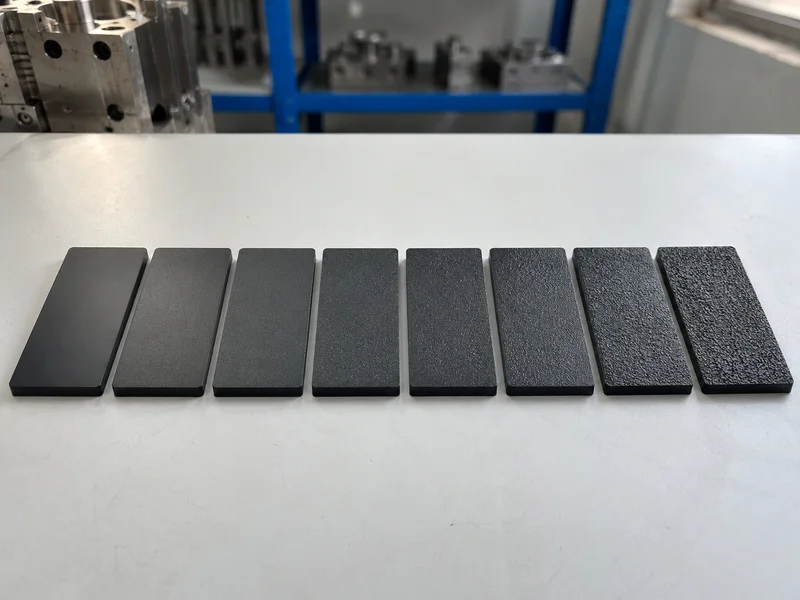
| VDI grade | Ra (µm) | Typical look |
|---|---|---|
| VDI 12 | 0.40 | Very fine satin |
| VDI 15 | 0.56 | Fine satin |
| VDI 18 | 0.80 | Fine matte |
| VDI 21 | 1.12 | Light matte |
| VDI 24 | 1.60 | Matte |
| VDI 27 | 2.24 | Medium matte |
| VDI 30 | 3.15 | Medium-coarse |
| VDI 33 | 4.50 | Coarse |
| VDI 36 | 6.30 | Coarse, grip feel |
| VDI 39 | 9.00 | Very coarse |
| VDI 42 | 12.50 | Very coarse |
| VDI 45 | 18.00 | Roughest |
The values follow Ra = 0.1 × 10^(N/20) µm, so every 6 grades roughly doubles the Ra. Roughness measurement follows ISO profile methods from ISO. Our guide to CNC machining surface finish explains Ra.
Key Takeaway: In other words, each step of three grades raises roughness by about 40%.
How Is a VDI Texture Made on Mold Steel?
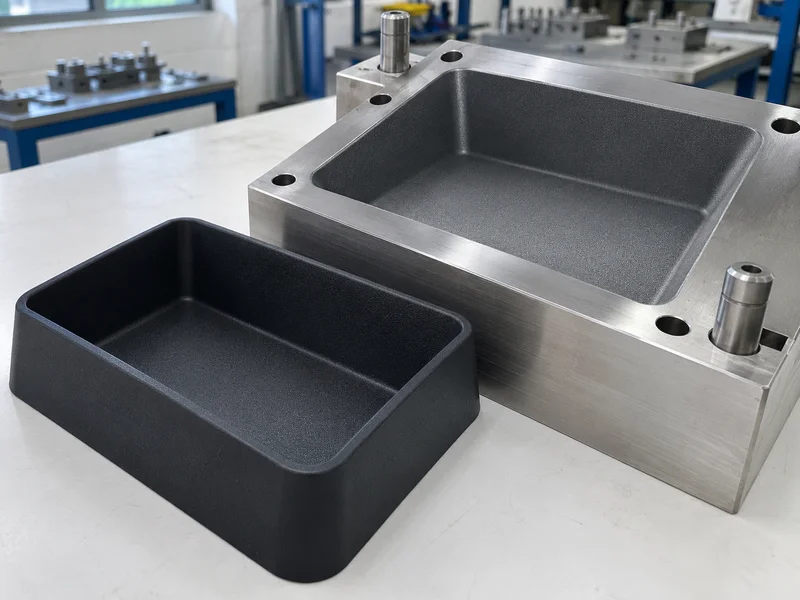
A VDI texture is made by sinker EDM on the finished cavity surface.
- Electrodes: graphite or copper, shaped to the cavity
- Settings: spark energy chosen for the target grade
- Sequence: rough to fine passes for even texture
- Check: comparison with VDI reference plates and Ra measurement
- Steel: uniform, clean steels give even results
For example, a 718H cavity may be milled, then EDM-textured to VDI 27 in one setup so the texture is consistent over the whole face. Our guides to sinker EDM and P20 steel explain the process and steel.
Key Takeaway: For this reason, plan EDM texture before final machining, not after trials.
How Much Draft Does Each VDI 3400 Grade Need?
Each VDI 3400 grade needs more draft as roughness rises.
| VDI grade | Typical minimum draft per side |
|---|---|
| VDI 12–18 | about 0.5–1° |
| VDI 21–24 | about 1–1.5° |
| VDI 27 | about 1.5–2° |
| VDI 30 | about 2–2.5° |
| VDI 33 | about 2.5–3.5° |
| VDI 36–39 | about 3.5–5° |
| VDI 42–45 | about 5–6° or more |
These are typical starting values. Stiff resins such as PC and PC/ABS need more draft than PP, and deep walls need more than shallow ones. For example, a 40 mm deep PC/ABS wall with VDI 30 may need 3° to eject without scuffing. Our guide to draft angle guidelines covers the basics.
Key Takeaway: Overall, confirm draft for the chosen grade at DFM, before the cavity is cut.
How Does VDI Compare With SPI and Chemical Textures?
VDI compares with SPI finishes and chemical textures by method and look.
| System | Method | Typical result |
|---|---|---|
| VDI 3400 | EDM texture | Uniform matte, Ra-defined |
| SPI A, B, C | Polishing, paper, stone | Gloss to semi-gloss |
| SPI D | Bead or grit blast | Dull matte |
| Chemical / pattern textures | Photo-etching | Leather, grain, geometric patterns |
For example, a lens window uses SPI A-2 polish, while the housing around it uses VDI 24 matte. Our guides to mold polishing and bead blast texture explain the other finishes.
Key Takeaway: Equally, combine systems on one part when faces have different jobs.
Which Grade Suits Which Part?
The right grade depends on appearance, handling and resin.
- VDI 12–18: fine satin for consumer electronics and visible covers
- VDI 21–27: general housings, appliance parts, interior trim
- VDI 30–33: industrial housings that must hide scratches
- VDI 36–45: grips and functional surfaces
For example, a handheld tool housing often uses VDI 27 on the body and VDI 36 on the grip area. Resin also changes the look; the same VDI grade appears glossier in PP than in ABS. Our precision mold making page explains how small cosmetic parts are finished.
Key Takeaway: As a rule, choose a grade on a molded sample in the real resin, not on steel plates.
How Should a VDI Finish Be Specified?
A VDI finish should be specified with grade, area, draft and approval method.
- Grade and standard, such as “VDI 3400 Ref. 27”
- Area, marked on the 2D drawing or 3D model
- Draft confirmed for that grade
- Resin and color used for approval
- Approval sample or reference plaque
For example, “A-side VDI 27, side walls min. 2° draft, approved on black PC/ABS T1 sample” gives a clear basis. Our injection mold manufacturing team arranges EDM, laser and chemical textures through qualified finishing suppliers.
Key Takeaway: Finally, mark the textured area and approve it on a molded part.
FAQ
- Q: What is VDI 3400?
- A German standard that defines roughness grades for EDM-textured surfaces.
- Q: What is the Ra of VDI 27?
- About 2.24 µm.
- Q: How much draft does VDI 30 need?
- Typically about 2–2.5° per side, more for stiff resins and deep walls.
- Q: Is VDI the same as SPI?
- No, VDI covers EDM matte textures; SPI covers polished and blasted finishes.
- Q: Can VDI texture be repaired?
- Yes, small areas can be re-EDM’d, but matching the surrounding texture needs care.
Conclusion
VDI 3400 gives a measurable way to specify matte mold textures. Pick the grade on a molded sample, set draft to match it and mark the textured area clearly. To review texture and draft on your part, send your 3D model and 2D drawing to our engineers.