
In Mold Labeling (IML) vs In-Mold Decoration (IMD)
In mold labeling (IML) is a decoration process in which a pre-printed plastic label is placed into the injection mold and becomes part of the molded product as the melt fuses with it. In-mold decoration (IMD) is the wider family that also uses decorated films and foils, either transferring an ink layer from a carrier foil or molding behind a formed film. Both put durable graphics on parts in one molding step, without printing or labeling afterwards.
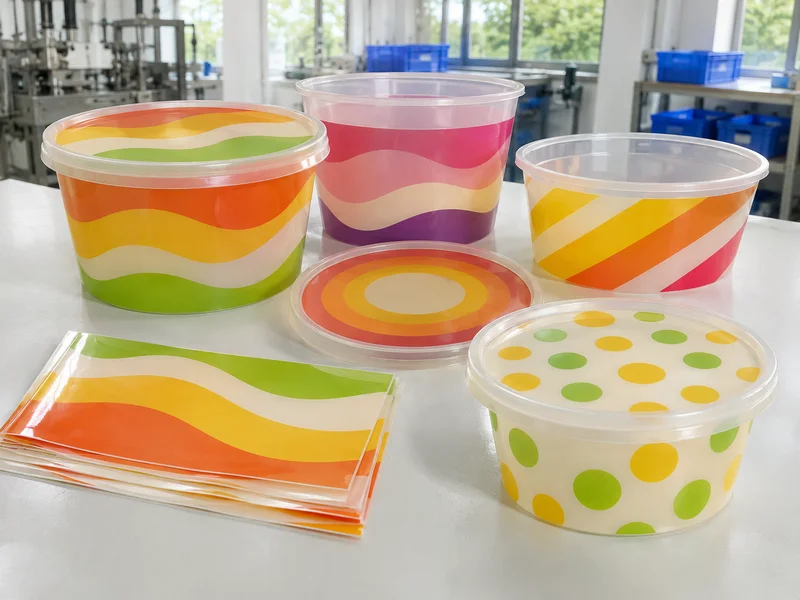
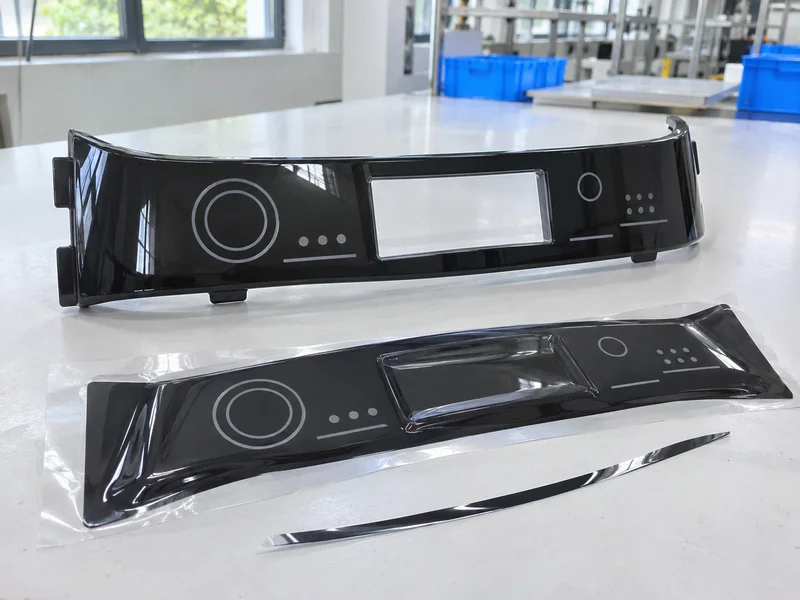
The two are often confused. For example, a printed yogurt tub uses in mold labeling with a polypropylene label, while a washing machine control panel with a scratch-resistant window usually uses a formed film insert. In this guide, we explain how in mold labeling works, how IMD differs, where each is used, design rules, cost and volume, and how to specify them. For other decoration methods, see our guide to pad printing.
In mold labeling uses a printed label, usually polypropylene film for PP packaging, that a robot places into the open mold, where static charge or vacuum holds it until the melt fuses with it. IMD covers in-mold roller transfer (IMR), where an ink layer is transferred from a carrier foil, and insert molding film (IMF, also called INS or FIM), where a printed PC or PET film is formed, trimmed and overmolded. Graphics sit under or inside the surface, so they resist wear and chemicals better than printed ink. These processes need robots, extra mold features and film supply, so they usually suit higher volumes.
In short: IML suits packaging and simple shapes; IMD film suits durable panels and 3D surfaces.
Key points:
- IML: printed label fused in the mold.
- IMR: ink transferred from a foil.
- IMF: formed film overmolded.
How Does In Mold Labeling Work?
In mold labeling works by placing a label in the mold before every shot.
- Print labels on film, usually by offset or digital printing
- Cut labels to shape and stack them
- Robot picks a label and places it on the mold surface
- Hold the label by static charge or vacuum
- Inject plastic, which fuses with the label back
- Eject the part with the label as part of the wall
For example, a thin-wall PP food tub may cycle in a few seconds with a side-entry robot inserting a wrap-around label each shot. Our guide to injection molding automation explains the robots involved.
Key Takeaway: Above all, in mold labeling is an automated process, so the robot and mold are designed together.
What Is In-Mold Decoration?
In-mold decoration is the group of processes that decorate parts with films or foils during molding.
| Process | How it works | Typical parts |
|---|---|---|
| IMR (in-mold roller) | Foil carries ink layer; ink transfers, carrier is rewound | Laptop and appliance covers, flat or gently curved |
| IMF / INS / FIM | Printed film is formed, trimmed and overmolded | Control panels, automotive trim, display windows |
| IML | Printed label fused into the part | Packaging, containers, lids |
For example, an IMF control panel keeps the printed ink between a hard-coated film and the molded resin, so symbols cannot wear off under fingers. Our guide to appliance injection molding covers typical panels.
Key Takeaway: In other words, IMD with a film protects the graphics, while IMR leaves a thin top layer.
Where Are IML and IMD Used?
IML and IMD are used where decoration must be durable or where labeling would add cost.
- Food packaging: tubs, lids, cups and buckets with IML
- Appliances: control panels, front covers, decorative trims
- Automotive interiors: trim, switch panels and display surrounds
- Electronics: device covers and keypads
- Consumer goods: cosmetic cases and household products
For example, packaging makers use in mold labeling to replace a separate labeling line, and the label also adds stiffness to thin walls. Our pages on automotive plastic parts and custom plastic enclosures show related parts.
Key Takeaway: For this reason, consider IML or IMD when graphics, durability and volume all matter.
How Should Parts Be Designed for In Mold Labeling?
Parts should be designed for in mold labeling and IMD with film limits and gating in mind.
| Factor | Design guidance |
|---|---|
| Label material | Match resin, for example PP label on PP part |
| Draw depth | Films stretch only so far; avoid sharp, deep corners |
| Gate position | Avoid washing ink off the film; gate on the opposite side |
| Wall thickness | Even walls for even fusion and no wrinkles |
| Label location | Keep away from parting lines and ejector pins |
| Radii | Generous radii on formed films |
For example, gating directly onto the printed side of a film can wash out the ink, so gates are placed behind the film. Our guide to injection molding gate types explains the options.
Key Takeaway: Overall, involve the film supplier and mold designer at the same time.
What Do IML and IMD Cost?
IML and IMD cost more in tooling and setup, but can cost less per part at high volume.
- Mold: label holding features, vacuum or static, film location
- Automation: robot and label magazine, or foil feeder for IMR
- Film: printed labels or films with minimum order quantities
- Forming and trimming: for IMF films
- Savings: no secondary printing or labeling, fewer handling steps
For example, a short run of a few thousand parts is usually cheaper with pad printing, while a container made in millions per year often saves money with in mold labeling. Our guide to high volume injection molding explains volume economics.
Key Takeaway: Equally, compare total cost per part at your real annual volume.
What Are the Limits of IML and IMD?
The limits of IML and IMD come from films, design changes and volume.
- Design changes: new artwork means new labels or films
- Shape limits: deep draws and sharp edges can tear or wrinkle films
- Material match: label and resin must bond
- Recycling: mixed films can complicate recycling
- Lead time: film printing adds a supply step
For example, a product with many artwork versions may suit IMR or digital printing better than formed films. Our guide to two-shot molding covers another way to add color in the mold.
Key Takeaway: As a rule, choose IML or IMD for stable designs at high volume.
How Should In Mold Labeling Be Specified?
In mold labeling and IMD should be specified with process, film, artwork and tests.
- Process: IML, IMR or IMF
- Film: material, thickness, hard coat if needed
- Artwork: colors, windows, back-lit areas
- Position: label location and tolerance
- Tests: adhesion, abrasion, chemical and light-fastness
- Volume: annual quantity and number of artwork versions
For example, “IMF panel, 0.175 mm hard-coated PC film, back-lit icons, PC resin, Taber abrasion and alcohol rub per agreed spec” gives a clear basis. Abrasion methods such as Taber testing are published by ASTM. We build the mold and produce IML or IMD parts through specialized partner factories, coordinating films, molding and inspection as one project; see our plastic injection molding page for how projects start.
Key Takeaway: Finally, state the process type, because IML, IMR and IMF need different molds.
FAQ
- Q: What is in mold labeling?
- A process that fuses a pre-printed label into a part during injection molding.
- Q: What is the difference between IML and IMD?
- IML uses labels; IMD uses decorative foils or formed films.
- Q: What material are IML labels?
- Often polypropylene film, matched to PP parts.
- Q: Is IMD durable?
- Yes, especially film inserts, where ink sits under a protective film.
- Q: When is IML cost-effective?
- At high volume with stable artwork.
Conclusion
In mold labeling and in-mold decoration put durable graphics on parts in one step, but they need robots, films and mold features planned from the start. Choose the process by shape, durability and volume. To review a decorated molded part, send your 3D model and 2D drawing to our engineers.