
Aerospace CNC Machining: Materials, Tolerances, Quality
Aerospace CNC machining is the precision milling, turning and grinding of parts for aircraft, spacecraft, drones and their ground equipment, usually in aluminum, titanium, stainless steel and high-performance plastics. It combines tight tolerances, thin walls and complex 5-axis shapes with strict documentation: material traceability, first article inspection and, for flight hardware, suppliers approved under AS9100 and the customer’s own quality system.
Not every aerospace part carries the same requirements. For example, a flight-critical bracket bought by an aircraft maker needs an AS9100 supplier and Nadcap-approved special processes, while a test fixture, a prototype housing or a ground support tool may simply be built to print with an inspection report. In this guide, we explain which parts are involved, materials, tolerances and features, quality requirements, how to choose a supplier, the limits of a non-certified shop and how to specify aerospace parts. For machining basics, see our guide to 5-axis milling.
Aerospace CNC machining uses mainly 7075, 2024 and 6061 aluminum, Ti-6Al-4V titanium, 17-4 PH and 15-5 PH stainless steels and plastics such as PEEK. Flight hardware suppliers are normally certified to AS9100, follow AS9102 first article inspection, keep full material traceability and use Nadcap-approved suppliers for heat treatment, plating and testing. Export-controlled designs under ITAR or EAR may not be shared with foreign suppliers. Non-flight parts such as fixtures, tooling, prototypes and test equipment are often bought with lighter, build-to-print requirements.
In short: the part’s role decides the requirements, and the requirements decide which supplier can make it.
Key points:
- Materials: aluminum, titanium, PH stainless steel.
- Documents: AS9102 FAI and traceability.
- Flight parts: AS9100 suppliers.
Which Parts Use Aerospace CNC Machining?
The parts that use aerospace CNC machining range from structural parts to tooling.
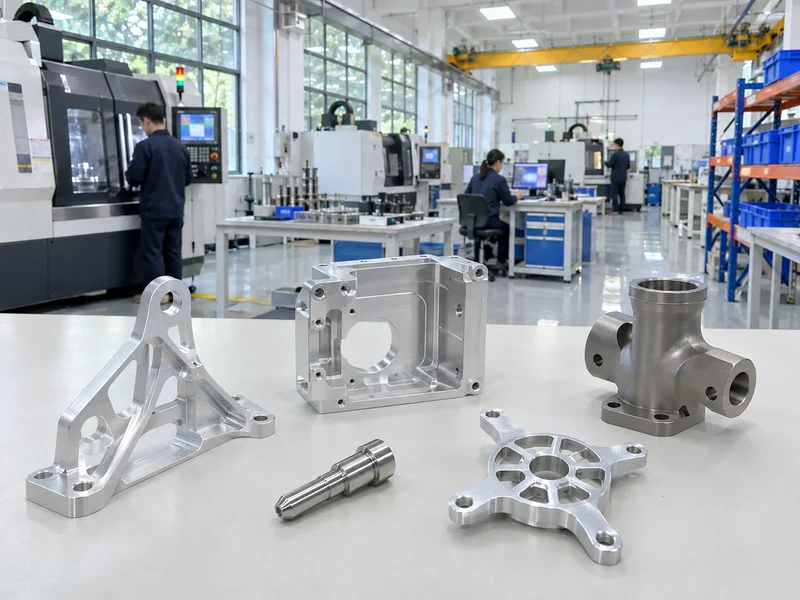
- Structural parts: brackets, ribs, fittings and frames
- Housings: avionics enclosures and connector bodies
- Engine and system parts: valve bodies, manifolds, shafts
- UAV and drone parts: frames, motor mounts, gimbal parts
- Ground support equipment: test rigs, handling tools
- Manufacturing tooling: fixtures, jigs and gauges
For example, an assembly jig used to hold panels in an aircraft factory is aerospace tooling, but it never flies, so its requirements differ from those of the panels themselves. Our guide to CNC machining fixtures covers this kind of part.
Key Takeaway: Above all, separate flight hardware from tooling and test equipment early.
Which Materials Are Used?
The materials used in aerospace CNC machining are chosen for strength-to-weight ratio, fatigue and corrosion resistance.
| Material | Typical use | Note |
|---|---|---|
| 7075-T6/T73 aluminum | Structural fittings | High strength, less corrosion resistant |
| 2024-T3 aluminum | Skins, fatigue-critical parts | Good fatigue, needs protection |
| 6061-T6 aluminum | Housings, tooling | Easy to machine and anodize |
| Ti-6Al-4V | Engine, high-load fittings | Strong, light, harder to machine |
| 17-4 PH stainless | Shafts, fittings | Strength plus corrosion resistance |
| PEEK | Insulators, light parts | High-temperature plastic |
For example, a bracket may move from 6061 to 7075 when strength matters, and to titanium when temperature or space is tight. Our guides to 7075 aluminum, 2024 aluminum and 17-4 PH stainless steel cover these grades.
Key Takeaway: In other words, specify the temper and material standard, not only the alloy.
What Tolerances and Features Does Aerospace CNC Machining Require?
Aerospace CNC machining requires tight tolerances on interfaces and careful control of thin walls and pockets.
| Feature | Challenge | Common approach |
|---|---|---|
| Thin walls and webs | Vibration and distortion | Balanced roughing, light finishing passes |
| Deep pockets | Tool reach and chatter | Short tools, 5-axis access |
| Bores and interfaces | Position and fit | Finish in one setup, CMM check |
| Complex surfaces | Tool access | 5-axis machining |
| Residual stress | Part moves after cutting | Stress-relieved plate, staged roughing |
Many drawings for aerospace CNC machining use GD&T with positions of a few hundredths of a millimeter on critical features. For example, removing 90% of a plate to make a thin-walled rib often causes warping unless roughing is spread across both sides and the part is released before finishing. Our guides to GD&T position tolerance and multi-axis CNC machining explain both topics.
Key Takeaway: For this reason, review distortion and setups before quoting tight tolerances.
What Quality Requirements Apply?
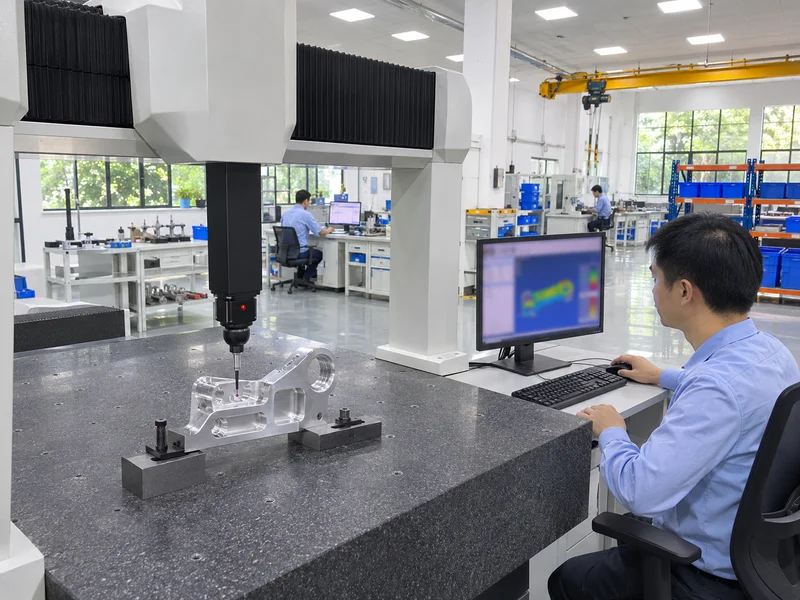
The quality requirements that apply depend on whether the part flies and who buys it.
| Requirement | What it means |
|---|---|
| AS9100 | Quality management system for aviation, space and defense suppliers |
| AS9102 FAI | Full first article inspection record |
| Material traceability | Certificates linked to heat and lot |
| Nadcap | Approval for special processes such as heat treatment and plating |
| Counterfeit and FOD control | Prevent wrong material and foreign objects |
| ITAR / EAR | Export controls on certain designs |
For example, a prime contractor may accept non-certified suppliers for prototypes and tooling but require AS9100 and approved processors for production flight parts. AS9100 is published by SAE International. Our guides to first article inspection reports and CMM measurement explain the inspection side.
Key Takeaway: Overall, read the purchase order’s quality clauses before choosing a supplier.
How Do You Choose an Aerospace CNC Machining Supplier?
Choosing an aerospace CNC machining supplier starts with matching certificates and capability to the part.
- Classify the part: flight, non-flight or tooling
- Check certificates the purchase order requires
- Check machines: 5-axis capacity and part size
- Check inspection: CMM and FAI reporting
- Check material sourcing and certificates
- Check special processes: who anodizes, plates or heat treats
- Run a sample before batch orders
For example, a drone maker buying motor mounts may choose a build-to-print supplier with 5-axis machines and CMM reports, while an airline maintenance shop needs certified sources. Our guide to low volume CNC machining covers small batches.
Key Takeaway: Equally, the cheapest supplier is the wrong one if it cannot meet the purchase order’s quality clauses.
What Can a Non-Certified Shop Make?
A non-certified shop can make parts where the customer’s requirements allow build-to-print supply without AS9100.
- Suitable: prototypes, test fixtures, assembly jigs, gauges, ground support parts, commercial drone parts and lab equipment
- Suitable with documents: parts needing CMM or FAI reports and material certificates
- Not suitable: flight-critical parts that require AS9100, Nadcap processes or customer source approval
- Not suitable: ITAR or EAR controlled data
For aerospace CNC machining, WOKE Molds does not hold AS9100 or any other system certification. We machine parts to drawing on 3- and 5-axis machining centers and supply CMM reports and material certificates when agreed per project. Machine capability is not finished-part tolerance; tolerances are confirmed per drawing. Our 5-axis CNC machining services page explains our milling capability.
Key Takeaway: As a rule, use build-to-print suppliers only where the part’s requirements allow it.
How Should Aerospace Parts Be Specified?
Aerospace parts should be specified with material, tolerances, processes and documents.
- Material: alloy, temper and standard
- Drawing: GD&T on critical features
- Finish: anodizing, conversion coating or passivation with standard
- Inspection: FAI format, CMM report, sampling
- Traceability: certificates and lot marking
- Part class: flight or non-flight
For example, “7075-T7351 plate per AMS-QQ-A-250/12, Type II anodize, FAI per AS9102, non-flight test fixture” tells a supplier exactly what is needed. Our guides to chemical conversion coating vs anodizing and passivation explain finishes.
Key Takeaway: Finally, state the part class on the drawing or purchase order.
FAQ
- Q: What is aerospace CNC machining?
- Precision machining of parts for aircraft, spacecraft, drones and ground equipment.
- Q: Which materials are common?
- 7075, 2024 and 6061 aluminum, Ti-6Al-4V, 17-4 PH stainless steel and PEEK.
- Q: Do aerospace suppliers need AS9100?
- Usually for flight hardware; tooling and prototypes may not require it.
- Q: What is AS9102?
- The standard format for aerospace first article inspection.
- Q: Is WOKE Molds AS9100 certified?
- No. We machine non-flight parts to drawing with agreed inspection documents.
Conclusion
Aerospace CNC machining covers everything from flight hardware to fixtures, and the part’s class decides the material, documents and supplier. Classify each part before you quote it. To review non-flight aerospace parts, prototypes or tooling, send your 3D model and 2D drawing to our engineers.