
7075 Aluminum: Properties, Tempers and Machining
7075 aluminum is a high-strength aluminum-zinc alloy, strengthened with magnesium and copper, whose T6 temper reaches a tensile strength of about 570 MPa, close to many mild steels at about one-third of the weight. It is used for aerospace-type structures, high-load brackets, fixtures, sporting goods and precision machined parts where strength-to-weight matters more than corrosion resistance or weldability.
7075 is strong but less forgiving than 6061. For example, a 7075-T6 bracket can be thinner and lighter than a 6061-T6 one, but it should not be welded and needs anodizing or another finish in wet environments to avoid corrosion. In this guide, we explain 7075 aluminum: composition, properties, tempers, machining, anodizing and finishing, comparisons with other alloys and how to specify it. For a direct comparison, see our guide to 6061-T6 vs 7075-T6.
7075 aluminum contains about 5.1–6.1% zinc, 2.1–2.9% magnesium and 1.2–2.0% copper. In T6 temper it has a typical tensile strength of about 570 MPa, yield of about 500 MPa, elongation around 11% and hardness about 150 HB, with a density of 2.81 g/cm³. It machines very well, anodizes well, but has lower corrosion resistance than 6061, is prone to stress corrosion cracking in T6, and is not suitable for fusion welding. T73 and T7351 tempers trade some strength for better stress corrosion resistance.
In short: use 7075 when high strength per weight justifies higher cost and lower corrosion resistance.
Key points:
- Strength: about 570 MPa tensile in T6.
- Machining: excellent.
- Limits: corrosion, welding, cost.
What Is 7075 Aluminum?
7075 aluminum is a 7000-series wrought alloy based on aluminum, zinc, magnesium and copper.
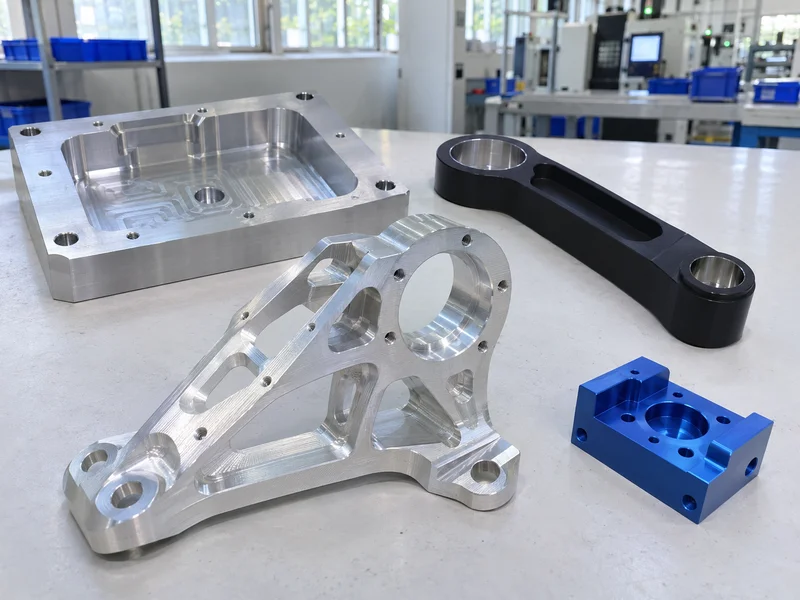
| Element | Typical content |
|---|---|
| Zinc | 5.1–6.1% |
| Magnesium | 2.1–2.9% |
| Copper | 1.2–2.0% |
| Chromium | 0.18–0.28% |
| Aluminum | Balance |
For example, the high zinc and magnesium content allows strong precipitation hardening in the T6 temper. Alloy designations are maintained by the Aluminum Association. Our guide to aluminium alloy 6061 properties covers the most common general alloy.
Key Takeaway: Above all, zinc and magnesium give 7075 its strength.
What Are the Properties of 7075 Aluminum?
The properties of 7075 aluminum in T6 temper place it among the strongest common aluminum alloys.
| Property | 7075-T6 (typical) |
|---|---|
| Tensile strength | about 570 MPa |
| Yield strength | about 500 MPa |
| Elongation | about 11% |
| Hardness | about 150 HB |
| Density | 2.81 g/cm³ |
| Thermal conductivity | about 130 W/m·K |
| Modulus | about 72 GPa |
For example, 7075-T6 has almost twice the yield strength of 6061-T6, but about the same stiffness, so a thinner part may deflect more even if it does not yield. Our guide to titanium strength vs aluminum compares other light metals.
Key Takeaway: In other words, 7075 adds strength, not stiffness, so check deflection as well as stress.
Which Tempers of 7075 Aluminum Are Used?
Several tempers of 7075 aluminum are used, each balancing strength and corrosion resistance.
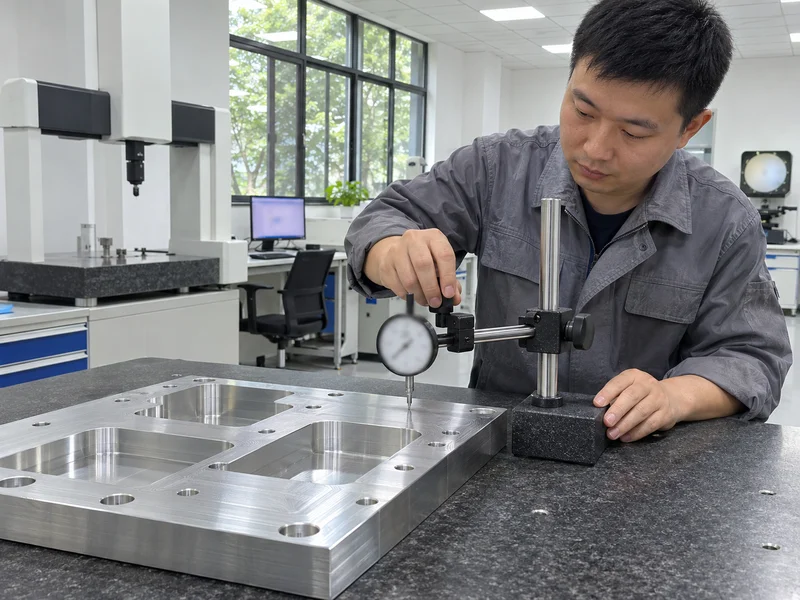
- O: annealed, soft, for forming
- T6: maximum strength, lower stress corrosion resistance
- T651: T6 plate stress relieved by stretching, best for machining
- T73 / T7351: over-aged, better stress corrosion resistance, about 10–15% lower strength
- T76: better exfoliation corrosion resistance
For example, thick plate machined into a large frame is usually ordered as 7075-T651 to limit distortion as material is removed. Our guide to metals for large CNC machined parts explains stress-relieved plate.
Key Takeaway: For this reason, order T651 or T7351 plate for machined parts.
How Is the Alloy Machined?
The alloy machines very well, with good chip control and surface finish.
| Factor | Good practice |
|---|---|
| Tools | Sharp uncoated or DLC carbide, polished flutes |
| Speeds | High spindle speeds |
| Chips | Short, easy to evacuate |
| Distortion | Use T651 plate, symmetric roughing, stress relief |
| Thin walls | Leave stock, finish in light passes |
| Finish | Good as-machined finish |
For example, a pocketed 7075-T651 fixture plate is roughed on both sides, rested, then finished to keep it flat. Our guides to 5-axis milling and CNC machining fixtures cover related work.
Key Takeaway: Overall, 7075 is easy to cut; distortion control is the main task.
How Is the Alloy Finished?
The alloy is finished mainly by anodizing, conversion coating or painting.
- Type II anodizing: decorative and corrosion protection
- Type III hard anodizing: wear resistance, slightly darker tone
- Chemical conversion coating: conductive corrosion protection
- Painting or powder coating: over conversion coating
- Avoid: fusion welding, which cracks and weakens 7075
For example, a 7075 part that must stay electrically conductive at mounting points can be chem-filmed there and anodized elsewhere. Our guides to hard anodizing and chemical conversion coating vs anodizing explain these finishes.
Key Takeaway: Equally, always protect 7075 parts used in wet or salty conditions.
How Does 7075 Compare With Other Aluminum Alloys?
7075 compares with other aluminum alloys by strength, corrosion resistance and weldability.
| Alloy | Strength | Corrosion | Weldability | Typical use |
|---|---|---|---|---|
| 6061-T6 | Medium | Good | Good | General parts, frames |
| 7075-T6 | High | Fair | Poor | High-load parts |
| 2024-T3 | High | Poor | Poor | Fatigue-loaded parts |
| 5052-H32 | Low-medium | Very good | Good | Sheet metal |
| 6063 | Low-medium | Good | Good | Extrusions |
For example, a robot arm link may use 7075 for stiffness-to-weight under load, while its covers use 5052 sheet. Our guides to 5052 vs 6061 and 6063 vs 6061 aluminum compare the others.
Key Takeaway: As a rule, choose 6061 by default and 7075 only when strength is the limit.
How Should the Alloy Be Specified?
The alloy should be specified with temper, form, finish and certificates.
- Alloy and temper: 7075-T651 or 7075-T7351
- Form: plate, bar or extrusion
- Standard: for example, ASTM B209 or AMS specification for plate
- Finish: anodize type and color, or conversion coating
- Masking: conductive or precision areas
- Certificates: mill test certificate
For example, “7075-T651 plate, Type II black anodize, mask bores, mill certificate required” gives a complete basis. Our CNC milling page explains how we machine aluminum parts to drawing.
Key Takeaway: Finally, name the temper on the drawing, because “7075” alone can mean very different properties.
FAQ
- Q: What is 7075 aluminum?
- A high-strength aluminum-zinc-magnesium-copper alloy.
- Q: How strong is 7075-T6?
- About 570 MPa tensile and 500 MPa yield.
- Q: Can 7075 aluminum be welded?
- Not by normal fusion welding; it cracks and loses strength.
- Q: Is 7075 better than 6061?
- It is stronger, but 6061 resists corrosion better and welds well.
- Q: Can 7075 be anodized?
- Yes, both Type II and Type III anodizing work well.
Conclusion
7075 aluminum gives very high strength per weight and excellent machinability, with lower corrosion resistance and no fusion welding. Order the right temper and protect the surface. To quote 7075 aluminum parts, send your 3D model and 2D drawing to our engineers.