
Automotive Clips: Types, Materials, Design and Testing
Automotive clips are small molded plastic fasteners that hold trim panels, door cards, wiring, hoses, liners and covers to a vehicle body, usually by pushing into a hole and locking with flexible legs or barbs. Most are injection molded in POM or PA66, and custom clips must hold firmly through heat, cold, vibration and repeated service without rattling or breaking.
Clip design is a balance of insertion and retention force. For example, a POM push clip with thin legs may go in easily but pull out under door vibration, while thicker legs hold well but crack the panel boss during assembly. In this guide, we explain the main types of automotive clips, materials, design rules, how clip molds are built, testing, sourcing custom clips and how to specify them. For the wider vehicle context, see our automotive plastic parts page.
Automotive clips include push-type trim clips, Christmas tree clips, fir-tree wire clips, door panel clips, edge clips, hose and cable clips, and rivet-style clips. Typical materials are POM for stiffness and low creep, PA66 for toughness and heat, and PP for low-cost liners. Design depends on panel hole size and thickness, insertion force, retention force, temperature range and noise requirements. Clips are molded in multi-cavity molds with slides or lifters for undercuts and are tested for push-in, pull-out, cycle and temperature performance.
In short: a good clip goes in easily, holds firmly and stays quiet for the life of the vehicle.
Key points:
- Materials: POM, PA66, PP.
- Key forces: insertion and retention.
- Tests: push-in, pull-out, heat aging, vibration.
What Types of Automotive Clips Are Used?
Many types of automotive clips are used, each for a different mounting job.
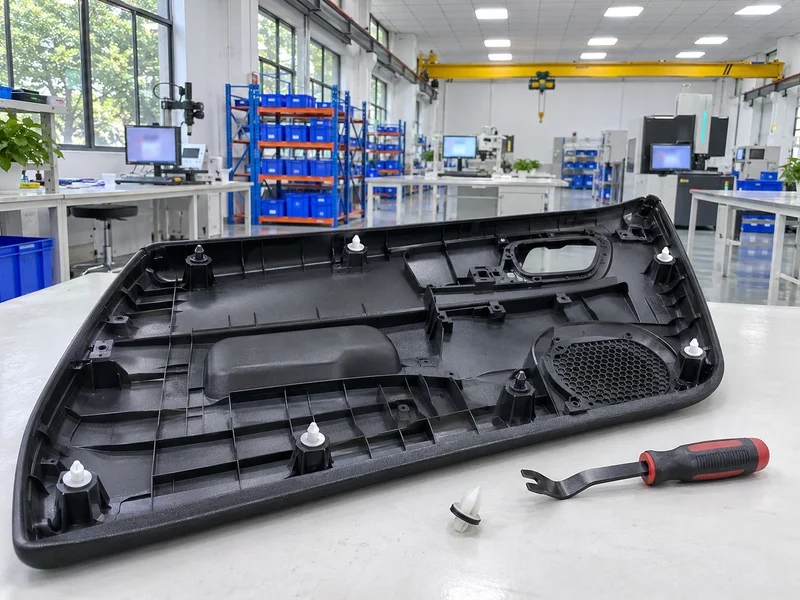
| Clip type | Typical use |
|---|---|
| Push-type trim clip | Interior trim, wheel arch liners |
| Christmas tree (fir-tree) clip | Insulation, carpets, wiring |
| Door panel clip | Door cards to inner door |
| Edge clip | Holding to a sheet metal edge |
| Hose and cable clip | Routing pipes and harnesses |
| Push rivet | Bumper covers, splash shields |
| Moulding clip | Exterior trim strips |
For example, a door panel clip is often molded into or onto the panel, while a wheel arch liner uses push rivets. Our guide to automotive injection molding covers related parts.
Key Takeaway: Above all, the panel, hole and service needs define the clip type.
Which Materials Are Used for Clips?
Vehicle clips are mainly molded from POM, PA66 and PP.
- POM: stiff, low creep, good spring back; common for trim clips
- PA66: tough, higher heat; absorbs moisture, which changes force
- PA66 GF: higher stiffness for structural clips
- PP: low cost, flexible; for liners and low-load clips
- TPE seals: added to reduce rattles or seal holes
For example, a POM trim clip holds its retention force better over years of summer heat than an unfilled PA6 clip. Our guides to POM injection molding and Delrin vs nylon compare these resins.
Key Takeaway: In other words, POM suits most trim clips, and PA66 suits higher heat and impact.
How Are Automotive Clips Designed?
Automotive clips are designed around the panel hole, forces and environment.
| Design input | Typical consideration |
|---|---|
| Hole size and shape | Round, square or slot, with tolerance |
| Panel thickness range | Grip range of the clip |
| Insertion force | Ergonomic limit for assembly workers |
| Retention force | Must exceed service and crash loads |
| Temperature | Often −40 °C to +85 °C or higher |
| Noise | No rattle or squeak |
For example, a clip for a 0.7–2.0 mm sheet metal panel needs legs that grip across the whole thickness range. Our guide to snap fit design explains the strain rules behind clip legs.
Key Takeaway: For this reason, define hole, panel range and forces before modeling the clip.
How Is a Clip Mold Built?
Clips are molded in precise multi-cavity molds with mechanisms for undercuts.
- Multi-cavity layout: 8–32 cavities for high volume clips
- Slides or lifters: form barbs and undercuts on the legs
- Hot runner or balanced cold runner for even filling
- Gate position away from flexing legs
- Tight process control so leg thickness stays constant
For example, a 0.1 mm change in leg thickness can noticeably change retention force, so cavity-to-cavity balance matters. Our multi-cavity injection molds page and guides to side action injection molding and injection molding lifters explain these tools.
Key Takeaway: Overall, cavity balance and stable leg thickness keep clip forces consistent.
Which Tests Prove Clip Performance?
Clips are tested for forces, durability and environment.
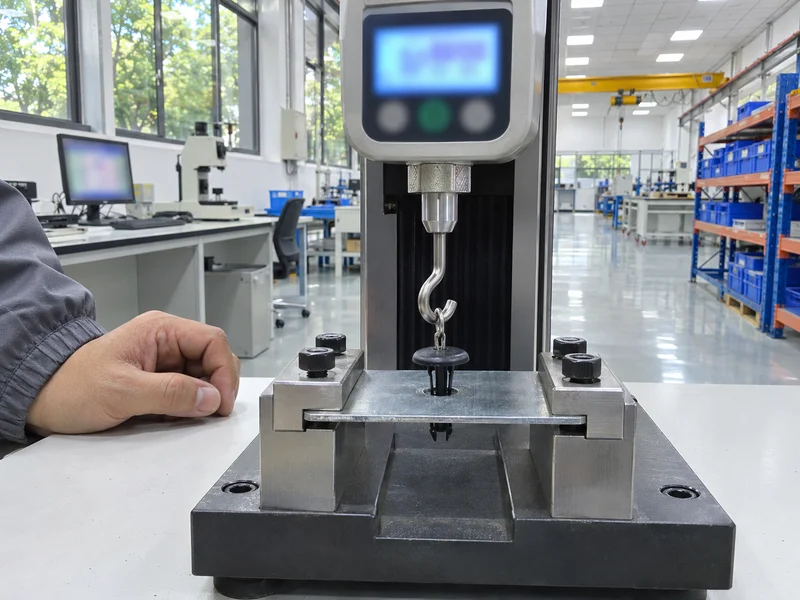
| Test | What it shows |
|---|---|
| Push-in force | Ease of assembly |
| Pull-out force | Holding strength |
| Repeated insertion | Reuse during service |
| Heat aging | Force after high temperature |
| Cold impact | No cracking at low temperature |
| Vibration and noise | No rattle or loosening |
| Conditioning | PA clips tested at defined moisture |
For example, a PA66 clip may be conditioned before pull-out testing because dry and wet parts give very different forces. Test methods are often based on customer standards and ISO or SAE procedures. Our guide to creep deformation explains long-term force loss.
Key Takeaway: Equally, test clips in the real panel and in the agreed conditioning state.
How Do You Source Custom Automotive Clips?
You source custom automotive clips by matching supplier tooling and testing to your clip.
- Standard vs custom: catalog clips for common holes, custom clips for special panels
- Tooling: multi-cavity molds with slides and lifters
- Material control: named grades and lot traceability
- Testing: push-in and pull-out on every approval
- Documents: FAI, dimensional reports and PPAP elements when required
For example, a custom clip for a new EV battery cover may need a non-standard slot and a TPE seal, which catalog parts do not offer. Our plastic injection molding page explains how we produce custom parts to drawing, without claiming direct supply to vehicle makers.
Key Takeaway: As a rule, use catalog clips where possible and custom clips where the panel demands it.
What Should a Clip Drawing Include?
A clip drawing should state geometry, material, forces and tests.
- 3D model and 2D drawing with critical leg dimensions
- Panel hole size, shape and thickness range
- Material grade and color
- Insertion and retention force limits
- Temperature range and conditioning
- Test plan and approval documents
- Annual volume and packaging
For example, “POM, black, insertion ≤ 50 N, retention ≥ 200 N in a 7 mm hole in 1.0 mm steel, −40 to +85 °C” gives a clear basis. Our guide to PPAP levels explains approval documents.
Key Takeaway: Finally, write force limits and test conditions on the drawing, not only in emails.
FAQ
- Q: What are automotive clips made of?
- Mostly POM, PA66 or PP.
- Q: What is a push-type trim clip?
- A clip pushed into a panel hole that locks with flexible legs.
- Q: How is clip strength measured?
- With push-in and pull-out force tests in the real panel.
- Q: Why do nylon clips change force?
- PA absorbs moisture, which softens it and lowers stiffness.
- Q: Can custom clips be molded in small volumes?
- Yes, with fewer cavities, though cost per part is higher.
Conclusion
Automotive clips must balance easy insertion, firm retention and quiet service across the vehicle’s temperature range. Define the panel, forces and tests first, then build the mold. To quote custom clips, send your 3D model and 2D drawing to our engineers.