
Caps and Closures: Materials, Threads and Seal Design
Caps and closures are the molded plastic tops that seal bottles, jars, tubes and containers, including screw caps, flip-top caps, dispensing closures, push-pull caps and child-resistant closures. Most are injection molded in PP or HDPE, often in multi-cavity molds with unscrewing cores or stripper rings, and they must seal, open, reclose and sometimes show tampering reliably over millions of parts.
Small design details decide whether a closure leaks. For example, a PP screw cap with a well-designed inner seal ring can seal a carbonated or liquid product, while the same cap without enough interference may leak after transport vibration. In this guide, we explain the main types of caps and closures, materials, thread and seal design, how closure molds release threads, flip-top and child-resistant designs, quality checks and how to plan a closure project. For thread release, see our unscrewing injection molds page.
Caps and closures are usually molded in PP for hinged flip-tops and many screw caps, and in HDPE or LDPE for flexible liners, plugs and some screw caps. Common thread standards come from bottle finish systems such as GPI/SPI and neck finishes like PCO 1881 for beverages. Molds release threads by stripping (for flexible, shallow threads), collapsible cores or unscrewing mechanisms, and high volume caps run in 8 to 64 or more cavities with hot runners. Key checks include application and removal torque, leak tests, hinge life and tamper band function.
In short: closures are precision seals, so thread, seal and mold release must be designed together.
Key points:
- Materials: PP and HDPE for most closures.
- Thread release: stripping, collapsible core or unscrewing.
- Key tests: torque, leak, hinge and tamper function.
What Types of Caps and Closures Are Molded?
Many types of caps and closures are injection molded for different products.
| Type | Typical use |
|---|---|
| Continuous thread screw cap | Bottles, jars, chemicals |
| Flip-top (hinged) cap | Personal care, sauces |
| Disc-top cap | Shampoo, lotion |
| Push-pull cap | Sports bottles, dish soap |
| Dispensing closure with valve | Squeeze bottles |
| Child-resistant (CR) cap | Pharmaceuticals, household chemicals |
| Tamper-evident cap | Food, beverage, medicine |
For example, a ketchup bottle often uses a PP flip-top with a silicone valve, while a cleaning product may use a child-resistant push-and-turn cap. Our guide to living hinge design explains flip-top hinges.
Key Takeaway: Above all, the product and user decide the closure type before the mold is designed.
Which Materials Are Used for Caps and Closures?
Caps and closures are mainly molded from polyolefins because they seal and flex well.
- PP: most screw caps and all living-hinge flip-tops
- HDPE: screw caps for chemicals, beverage caps
- LDPE: plugs, liners and flexible inserts
- TPE / silicone: valves and soft seals
- Food-contact grades where required by regulations
For example, a hinged flip-top needs PP because a PP hinge can survive many thousands of openings. Food-contact rules are published by the FDA in the US and under EU law on EUR-Lex. Our guides to polypropylene injection molding and polypropylene vs polyethylene compare the resins.
Key Takeaway: In other words, PP covers most closures, and HDPE covers many screw caps.
How Are Threads and Seals Designed on Closures?
Threads and seals on closures are designed to match the container neck and hold the product.
| Feature | Design point |
|---|---|
| Thread | Match the neck finish (diameter, pitch, turns) |
| Seal | Inner plug, bore seal, top seal or liner |
| Interference | Enough to seal after shrinkage and aging |
| Tamper band | Breaks on first opening |
| Knurling | Grip and torque transfer |
For example, a 28 mm cap for a beverage neck must match its standard finish so it seals on every bottle supplier’s neck. Our guide to molded threads explains thread geometry.
Key Takeaway: For this reason, design the closure against the real neck drawing and its tolerances.
How Do Closure Molds Release Threads?
Closure molds release threads by stripping, collapsing or unscrewing the core.
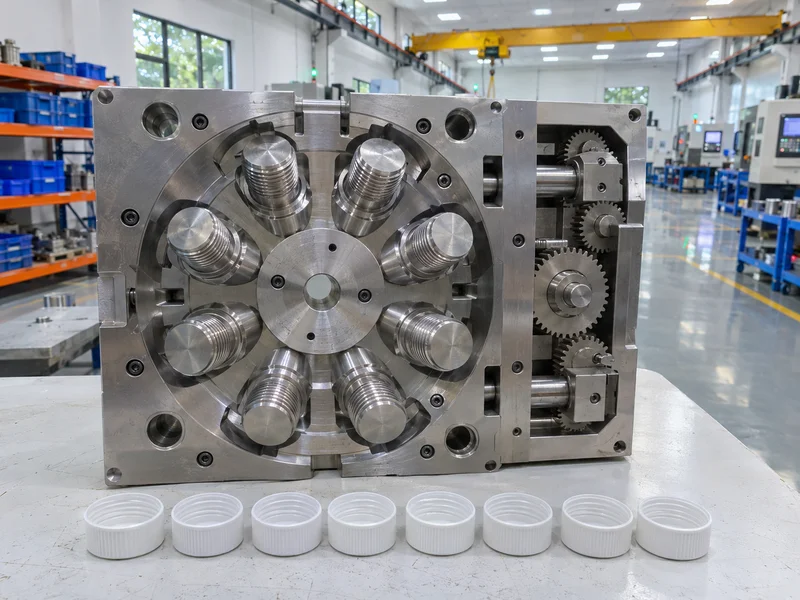
- Stripping: a stripper ring pushes a flexible cap off shallow threads
- Collapsible core: core segments fold inward to release internal threads
- Unscrewing: gear- or rack-driven cores rotate out of the thread
- Side actions: for some external features
For example, a PP cap with a shallow round thread can be stripped off, while a deep, sharp thread in a stiffer resin needs an unscrewing mold. Our guide to unscrewing injection mold design and collapsible core explain these mechanisms.
Key Takeaway: Overall, thread depth and resin stiffness decide how the mold releases the cap.
How Are Flip-Top and Child-Resistant Closures Designed?
Flip-top and child-resistant closures are designed around hinge life and safe opening.
- Flip-top hinge: thin PP living hinge or snap hinge, molded open
- Snap action: holds the lid open and closed
- Child-resistant: push-and-turn or squeeze-and-turn two-piece designs
- Senior-friendly: opening forces suit adults
- Testing: CR closures follow protocols such as ISO 8317
For example, a flip-top is usually molded open and closed by an in-mold or post-mold closing station. Child-resistant packaging requirements are described by ISO 8317 and national rules. Our multi-cavity injection molds page shows high-cavitation tooling.
Key Takeaway: Equally, test hinge and opening forces on molded parts, not only in CAD.
Which Quality Checks Apply to Caps and Closures?
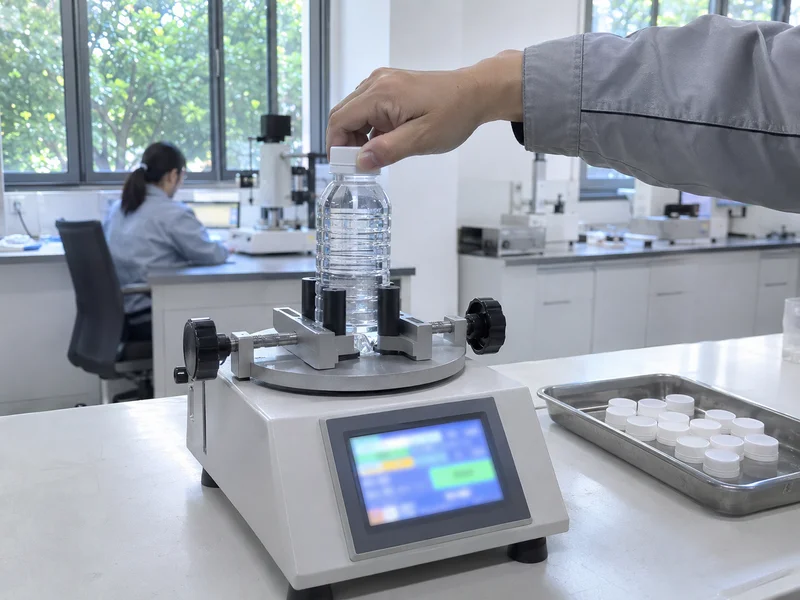
Quality checks for caps and closures focus on sealing and function.
| Check | Purpose |
|---|---|
| Application and removal torque | Seals without being too tight |
| Leak or vacuum test | No leakage after closing |
| Tamper band break | Shows first opening |
| Hinge cycle test | Flip-top life |
| Dimensions by cavity | Threads and seal features |
| Visual | Short shots, flash, color |
For example, removal torque is checked on samples from every cavity because one worn cavity can make caps too tight. Our guides to AQL sampling and CMM measurement explain lot checks and dimensions.
Key Takeaway: As a rule, test closures on the real bottle, filled with the real product where possible.
How Should a Caps and Closures Project Be Planned?
A caps and closures project should be planned from neck, product and volume.
- Container neck drawing and finish standard
- Product: liquid, viscosity, carbonation, chemicals
- Closure type and features (tamper, CR, dispensing)
- Material and food-contact needs
- Volume to set cavities and mold type
- Validation tests and acceptance limits
For example, 5 million caps a year may justify a 16-cavity hot runner unscrewing mold, while 200,000 may run in a 4-cavity mold. Our injection mold manufacturing page explains how we build small and medium precision molds.
Key Takeaway: Finally, size the mold to the real volume and validate on filled containers.
FAQ
- Q: What plastic are caps made of?
- Mostly PP and HDPE, with LDPE, TPE or silicone for liners and valves.
- Q: How are threaded caps removed from the mold?
- By stripping, collapsible cores or unscrewing mechanisms.
- Q: Why are flip-top caps made of PP?
- PP forms durable living hinges.
- Q: What tests do closures need?
- Torque, leak, tamper band and, for flip-tops, hinge cycle tests.
- Q: How many cavities does a cap mold have?
- From 1–4 for low volume up to 64 or more for very high volume.
Conclusion
Caps and closures depend on matched threads, seals, materials and molds that release them cleanly. Plan around the neck, the product and the real volume. To quote a closure mold or molding project, send your 3D model and 2D drawing to our engineers.