
CNC Engraving vs Laser Marking: Tools and Design Rules
CNC engraving is a machining process that cuts text, logos, scales, serial numbers and patterns into a part with a small rotating tool, usually a V-shaped engraving cutter or a ball end mill, guided by a CNC program. It creates permanent, raised or recessed marks that can be filled with paint and survive wear, cleaning and coatings that would remove printed or surface marks.
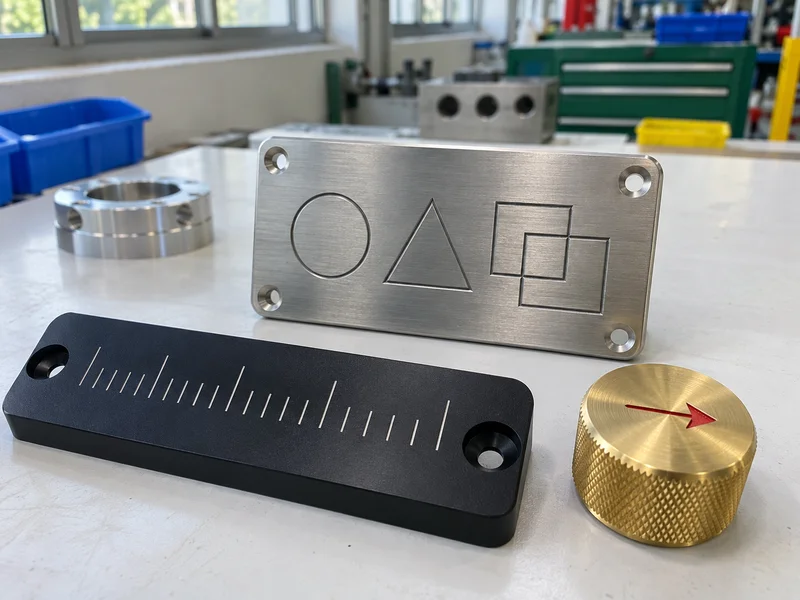
Engraving and laser marking solve different problems. For example, a control knob scale that operators touch thousands of times can be engraved 0.2 mm deep and paint-filled so it never wears off, while a small serial number on an anodized plate is usually laser marked because it is faster and changes on every part. In this guide, we explain how the process works, tools and depths, which materials engrave well, engraving vs laser marking, design rules for text and logos, finishing and how to specify it. For marking on plastics, see our guide to laser marking plastic.
CNC engraving uses a V-bit, ball end mill or small flat end mill on a CNC mill or engraving machine to cut marks along programmed paths, typically 0.05–0.5 mm deep. It works on aluminum, brass, copper, steel, stainless steel, titanium and engineering plastics. Engraved marks can be color filled with paint and stay readable after anodizing, plating or heavy wear. Compared with laser marking, engraving is slower and needs a larger minimum text size, but it gives true depth and works without special laser-sensitive surfaces. Text height of about 1.5–2 mm or more is a common practical minimum.
In short: engrave when marks must be deep, tactile or wear-proof; laser mark when speed and small variable text matter.
Key points:
- Depth: about 0.05–0.5 mm.
- Tools: V-bits, ball and small end mills.
- Strength: durable, tactile marks.
How Does CNC Engraving Work?
CNC engraving cuts marks by moving a small tool along text or graphic paths.
- Create artwork: text, logo or scale in CAD
- Program paths: single-line fonts or outlines
- Choose tool: V-bit angle and tip size, or ball end mill
- Set depth: constant depth or V-carve
- Engrave: on the CNC mill, often in the same setup as machining
- Deburr and fill: clean edges, optional paint fill
For example, a part number on a fixture plate can be engraved in the same setup that machines the plate, so it adds only a minute. Our guide to design for CNC machining covers how features are added to a part.
Key Takeaway: Above all, engraving in the machining setup avoids a second operation.
Which Tools and Depths Are Used?
Tools and depths are chosen for text size, material and look.
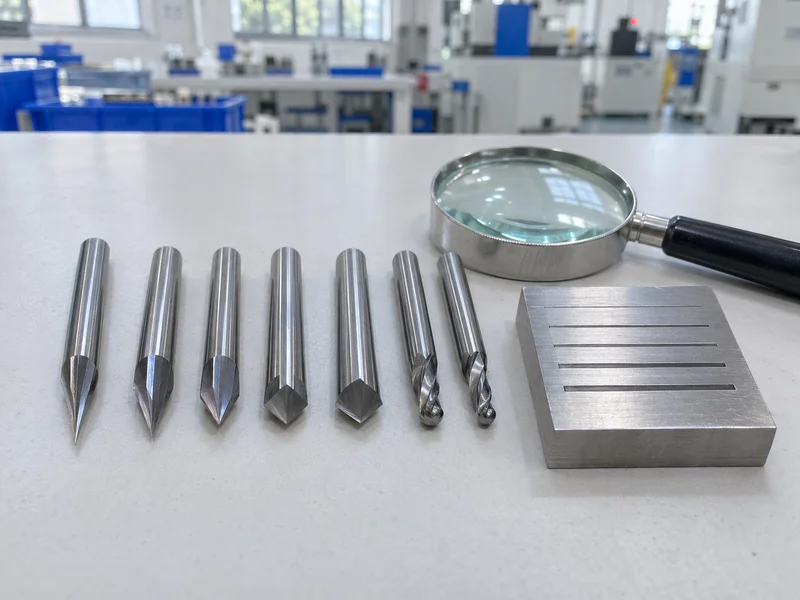
| Tool | Typical use | Note |
|---|---|---|
| V-bit (30–90°) | Sharp text and logos | Width changes with depth |
| Ball end mill | Rounded, smooth grooves | Good for scales |
| Small flat end mill | Recessed areas, raised text | Flat bottom |
| Diamond drag tool | Light marking on hard metals | Very shallow |
For example, a 60° V-bit cutting 0.15 mm deep makes a line about 0.17 mm wide plus the tip width, which is fine for 3 mm text. Our guide to CNC machining materials explains tool choice by material.
Key Takeaway: In other words, depth and V-angle together set the line width.
Which Materials Engrave Well?
Most machinable materials engrave well, with some differences in finish.
- Aluminum: clean, fast, often engraved before anodizing
- Brass and copper: crisp, decorative results
- Stainless steel: durable, slower, needs sharp tools
- Tool steel: for molds and dies, often engraved before hardening
- Titanium: possible with care
- Plastics: POM, PEEK and nylon engrave cleanly
For example, logos in mold cavities are often engraved or EDM-sparked so they appear raised on the molded part. Our guides to 304 stainless steel and machining acetal cover two common materials.
Key Takeaway: For this reason, engrave hard steels before heat treatment when possible.
How Does CNC Engraving Compare With Laser Marking?
The two compare by depth, speed, detail and durability.
| Factor | CNC engraving | Laser marking |
|---|---|---|
| Depth | True depth, 0.05–0.5 mm | Surface or shallow |
| Speed | Slower | Fast |
| Small text | Limited, about 1.5 mm and up | Very small possible |
| Variable data | Possible but slower | Easy, serials and codes |
| Paint fill | Yes | Usually not |
| Wear resistance | Excellent | Good, depends on depth |
For example, a front-panel scale is engraved and paint-filled, while a 2D code on the same part is laser marked. Our guide to laser marking plastic explains laser methods.
Key Takeaway: Overall, many parts use both methods for different marks.
What Design Rules Apply to Engraved Text and Logos?
Design rules for engraved text and logos keep marks readable and machinable.
- Text height: about 1.5–2 mm or larger
- Fonts: simple sans-serif or single-line fonts
- Line width: at least the tool tip width
- Depth: shallow for small text, deeper for paint fill
- Spacing: enough gap so letters do not merge
- Location: flat or gently curved surfaces with tool access
For example, a 1 mm logo with thin serifs may blur, while the same logo at 3 mm in a bold sans-serif engraves cleanly. Lettering on technical drawings follows ISO 3098 from ISO. Our guide to GD&T reference dimension explains how marks can be dimensioned on drawings.
Key Takeaway: Equally, simplify logos before engraving rather than forcing small detail.
How Are Engraved Parts Finished?
Engraved parts are finished to improve readability and protect the surface.
| Finish | Purpose |
|---|---|
| Deburring | Clean, sharp letter edges |
| Paint fill | Color contrast in the groove |
| Anodizing after engraving | Colored groove and surface |
| Anodize then engrave | Bright metal letters on colored surface |
| Plating | Protects steel parts |
For example, engraving after black anodizing gives bright aluminum letters on a black panel without paint fill. Our guides to anodizing colors and deburring explain these steps.
Key Takeaway: As a rule, decide whether engraving comes before or after the coating.
How Should CNC Engraving Be Specified?
CNC engraving should be specified with artwork, size, depth, location and finish.
- Artwork: vector file of text or logo
- Font and height
- Depth and tool type if critical
- Location on the drawing
- Finish: paint fill color, before or after coating
- Variable data: serial or lot numbers and their format
For example, “Engrave part number per artwork, 2.5 mm high, 0.15 mm deep, black paint fill, after clear anodize” is a clear callout. Our precision CNC machining services page explains how engraving is added to machined parts.
Key Takeaway: Finally, supply vector artwork so the engraving matches your brand exactly.
FAQ
- Q: What is CNC engraving?
- Cutting text, logos or patterns into a part with a CNC-guided tool.
- Q: How deep is CNC engraving?
- Usually about 0.05–0.5 mm.
- Q: Is engraving better than laser marking?
- It is deeper and more wear resistant; laser marking is faster for small and variable marks.
- Q: Which materials can be engraved?
- Aluminum, brass, copper, steels, titanium and many engineering plastics.
- Q: What is the smallest engraved text?
- About 1.5–2 mm high is a practical minimum for clean results.
Conclusion
CNC engraving gives deep, durable and tactile marks that survive wear and coatings, while laser marking handles small and variable marks. Plan size, depth and finish together. To quote engraved machined parts, send your 3D model and 2D drawing to our engineers.