
304 Stainless Steel: Properties, Machining and Welding
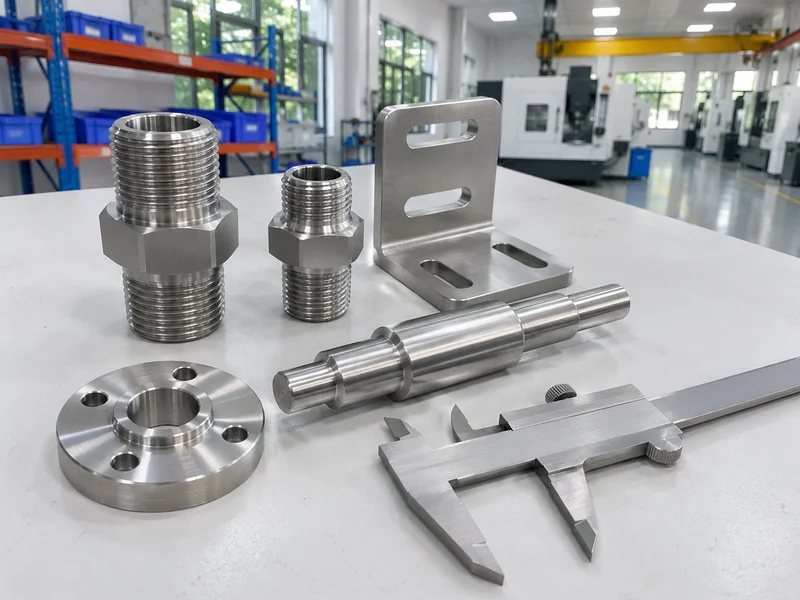
304 stainless steel is the most widely used austenitic stainless steel, an iron alloy with about 18% chromium and 8% nickel that resists corrosion in most indoor, food and general industrial environments. Known as UNS S30400, EN 1.4301 or “18-8”, it is non-magnetic when annealed, easy to form and weld, and used for machined parts, enclosures, fittings, food equipment and fasteners.
304 is versatile but not the right answer for every part. For example, a 304 bracket works well inside a machine, while the same bracket near a coastal or chlorinated environment may pit within months and should move to 316. In this guide, we explain 304 stainless steel: composition, properties, corrosion resistance, machining, welding and finishing, 304 vs 304L and other grades, and how to specify it. For grade comparisons, see our guide to 304 vs 316 stainless steel.
304 stainless steel contains about 18–20% chromium, 8–10.5% nickel and up to 0.08% carbon. Annealed sheet and plate to ASTM A240 has a minimum tensile strength of 515 MPa and minimum yield of 205 MPa, with high elongation and a density of about 7.9 g/cm³. It resists corrosion in fresh water, food and mild chemicals but is prone to pitting in chlorides. It work-hardens quickly, so machining needs sharp tools, rigid setups and steady feeds. 304L (≤0.03% C) is preferred for heavy welding.
In short: 304 is the default stainless grade for general parts, with 316 for chlorides and 303 for easy machining.
Key points:
- Composition: about 18% Cr, 8% Ni.
- Strength: ≥515 MPa tensile, ≥205 MPa yield (annealed).
- Limit: pitting in salt and chlorides.
What Is 304 Stainless Steel?
304 stainless steel is an austenitic chromium-nickel stainless steel.
| Designation | Value |
|---|---|
| UNS | S30400 |
| EN / W.Nr. | 1.4301 (X5CrNi18-10) |
| JIS | SUS304 |
| Common name | 18-8 stainless |
| Low-carbon version | 304L (S30403, 1.4307) |
For example, a drawing that calls out “SUS304” from an Asian supplier and “1.4301” from a European supplier describes essentially the same grade. Material standards are published by ASTM, and our guide to CNC machining materials lists other common grades.
Key Takeaway: Above all, check which standard the drawing uses, because the same grade has several names.
What Are the Properties of 304 Stainless Steel?
The properties of 304 stainless steel combine good strength, high ductility and corrosion resistance.
| Property | Typical value (annealed) |
|---|---|
| Tensile strength | ≥515 MPa |
| Yield strength (0.2%) | ≥205 MPa |
| Elongation | ≥40% |
| Hardness | ≤92 HRB |
| Density | about 7.9 g/cm³ |
| Thermal conductivity | about 16 W/m·K |
| Magnetism | Non-magnetic annealed, slightly magnetic after cold work |
For example, a cold-worked 304 part may attract a magnet slightly, which is normal and not a sign of the wrong grade. Our guide to is stainless steel a ferrous material explains magnetism.
Key Takeaway: In other words, 304 is strong and tough, but low thermal conductivity affects machining.
How Corrosion Resistant Is 304 Stainless Steel?
304 stainless steel is corrosion resistant in most mild environments but weak against chlorides.
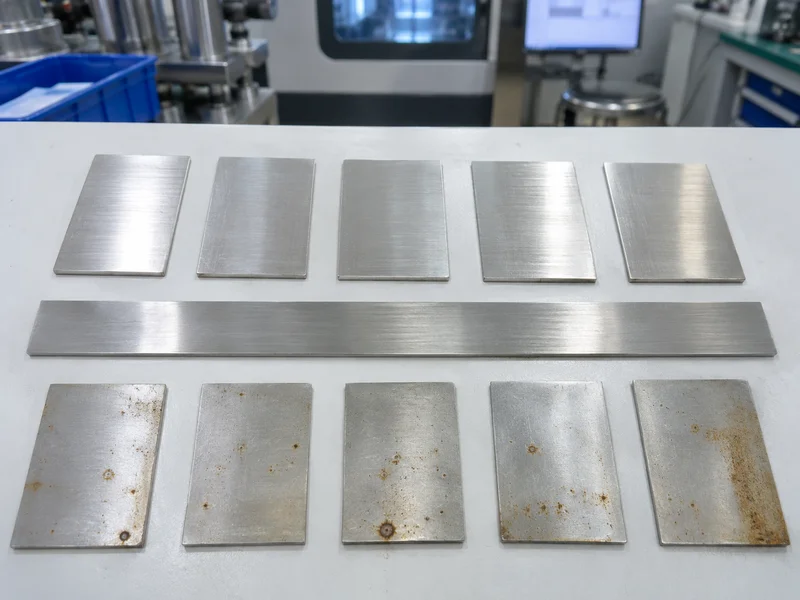
- Good: fresh water, food, most organic chemicals, indoor air
- Fair: mild outdoor exposure, some dilute acids
- Poor: salt water, chlorinated water, de-icing salts, hydrochloric acid
- Risk: pitting and crevice corrosion in chlorides
- Risk: stress corrosion cracking above about 60 °C in chlorides
For example, a 304 part in a swimming pool environment can show rust spots, while 316 with molybdenum resists much longer. Our guides to passivation and electropolishing explain how to improve surface corrosion resistance.
Key Takeaway: For this reason, choose 316 for parts exposed to salt, chlorine or coastal air.
How Is This Grade Machined?
This grade is machined with sharp tools and steady cutting because it work-hardens.
| Factor | Good practice |
|---|---|
| Tools | Sharp coated carbide, positive rake |
| Feed | Constant, never dwelling or rubbing |
| Depth of cut | Below the work-hardened layer |
| Coolant | Plenty of flood coolant |
| Chips | Chip breakers for stringy chips |
| Machinability | About 45% of free-machining steel; 303 is easier |
For example, a drill that pauses in a 304 hole can harden the bottom so the next pass skids and wears the tool. Our guides to 303 vs 304 stainless and threaded holes give more machining tips.
Key Takeaway: Overall, keep tools sharp and moving so the surface does not harden ahead of the cut.
How Is 304 Welded and Finished?
304 is welded and finished easily, with a few precautions.
- Welding: TIG and MIG with 308L filler
- Sensitization: carbide forms at 450–850 °C; use 304L for heavy welds
- Finishes: brushed, bead blasted, electropolished, passivated
- Heat tint: removed by pickling before passivation
- Avoid: carbon-steel tools and brushes that leave iron particles
For example, a welded 304 frame cleaned with a steel wire brush can rust along the welds until it is pickled and passivated. Our guides to bead blast texture and metal surface finishing techniques explain the options.
Key Takeaway: Equally, keep stainless away from carbon-steel contamination during fabrication.
How Does 304 Compare With Other Stainless Grades?
304 compares with other stainless grades by corrosion resistance, machinability and strength.
| Grade | Key difference from 304 | Typical use |
|---|---|---|
| 304L | Lower carbon, better after welding | Welded tanks and frames |
| 303 | Added sulfur, much easier to machine, less corrosion resistant | Turned parts, fittings |
| 316 / 316L | Molybdenum, better in chlorides | Marine, chemical, medical-type parts |
| 17-4 PH | Heat treatable to high strength | Shafts, high-load parts |
| 420 | Hardenable martensitic | Molds, blades |
For example, a fitting turned in large volume may use 303 for cost, unless it must be welded or sees chlorides. Our guides to 316L vs 316 and 17-4 PH stainless steel cover the alternatives.
Key Takeaway: As a rule, start with 304, then change grade only when corrosion, machining or strength demands it.
How Should This Grade Be Specified?
This grade should be specified with standard, form, condition and finish.
- Grade and standard: for example, ASTM A276 304 or EN 1.4301
- Form: bar, plate or sheet
- Condition: annealed or cold worked
- Finish: as machined, bead blasted, passivated, electropolished
- Certificates: mill test certificate if traceability is needed
- Tests: passivation or salt spray if required
For example, “304 bar to ASTM A276, annealed, passivated to ASTM A967, mill certificate required” gives a clear basis. Our CNC machining services page explains how we machine stainless steel parts to drawing.
Key Takeaway: Finally, write the finish and test method on the drawing, not just “stainless”.
FAQ
- Q: What is 304 stainless steel?
- An austenitic stainless steel with about 18% chromium and 8% nickel.
- Q: Is 304 stainless steel magnetic?
- Not when annealed, but it can become slightly magnetic after cold work.
- Q: Does 304 stainless steel rust?
- It resists rust in most mild environments but can pit in chlorides.
- Q: Is 304 easy to machine?
- It is harder to machine than 303 because it work-hardens.
- Q: What is the difference between 304 and 304L?
- 304L has lower carbon, which improves corrosion resistance after welding.
Conclusion
304 stainless steel is the standard choice for corrosion-resistant machined parts in mild environments, with 316 for chlorides and 303 for easier machining. Specify standard, condition and finish clearly. To quote 304 stainless parts, send your 3D model and 2D drawing to our engineers.