
Fixture Plate: Grid Layouts, Materials and Zero-Point Use
A fixture plate is a precision-machined base plate with a grid of threaded holes and accurate locating holes that holds parts, vises and fixtures on a CNC machine table in repeatable positions. Made from aluminum or steel and machined flat, it turns setup into a quick, repeatable job: clamps and locating pins go into known positions, so the same part lands in the same place every time.
A good fixture plate saves more time than it costs. For example, a shop that machines the same bracket every month can mount a dedicated fixture on a grid plate, drop it onto the table with two dowels and start cutting without indicating the part again. In this guide, we explain fixture plates: types, grid layouts, materials, design rules, how they are used with fixtures and zero-point systems, custom plates and how to specify one. For fixture design in general, see our guide to CNC machining fixtures.
A fixture plate (or grid plate, sub-plate) carries a regular pattern of tapped holes, such as M8, M10 or M12 on a 25–50 mm grid, plus precision dowel or bushing holes for location. Plates are made from 6061 or 7075 aluminum for light weight, or from steel or tool steel, sometimes hardened or nitrided, for wear. They are machined flat and parallel, often within a few hundredths of a millimeter. Variations include tombstones for horizontal machines, dovetail plates for 5-axis work and plates with zero-point clamping modules.
In short: a flat plate with known holes makes every setup faster and repeatable.
Key points:
- Layout: tapped holes on a grid plus locating holes.
- Materials: aluminum or steel.
- Benefit: repeatable, fast setups.
What Types of Fixture Plates Are Used?
Several types of plates are used, depending on the machine and part.
| Type | Description | Typical use |
|---|---|---|
| Grid fixture plate | Tapped and dowel holes on a grid | Vertical machining centers |
| Sub-plate | Plate dedicated to one job | Repeat production |
| Tombstone | Vertical multi-face fixture | Horizontal machining centers |
| Dovetail plate | Holds dovetailed stock | 5-axis machining |
| Zero-point base | Plate with quick-change modules | Fast changeover |
| Vacuum plate | Holds thin parts by vacuum | Plates and sheets |
For example, a 5-axis machine often uses a dovetail plate so the tool can reach five sides of the part. Workholding safety guidance is available from OSHA. Our guide to 5-axis milling explains why access matters.
Key Takeaway: Above all, match the plate type to the machine and the access the part needs.
How Are Fixture Plate Grids Laid Out?
Grids are laid out with tapped holes and locating holes on a fixed pitch.
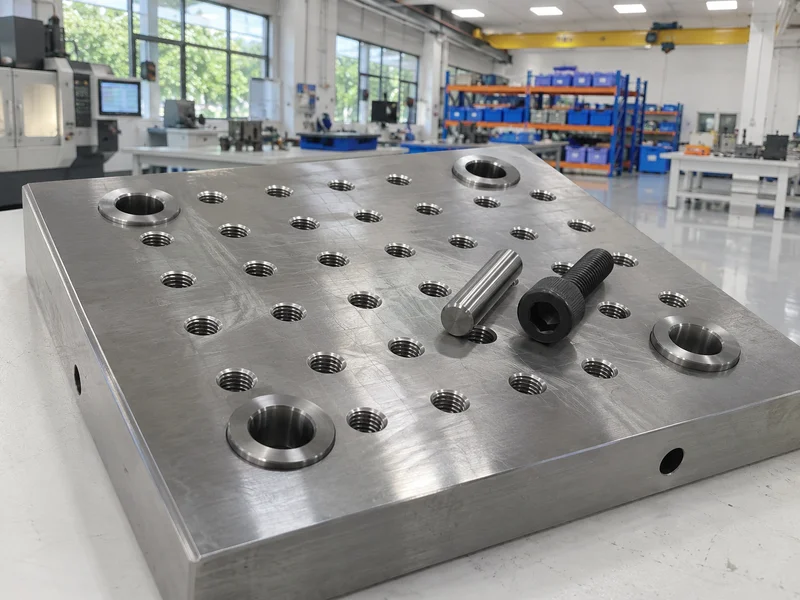
- Tapped holes: for example, M8, M10 or M12
- Grid pitch: often 25, 40 or 50 mm
- Locating holes: precision dowel holes or hardened bushings
- Reference edges: ground edges or datum pins
- Mounting: counterbored holes or slots for the machine table
- Marking: engraved rows and columns
For example, an M12 grid on 50 mm pitch with 12 mm dowel holes lets standard clamps and pins fit anywhere on the plate. Our guide to threaded holes covers thread choices, and thread milling explains cutting large threads.
Key Takeaway: In other words, a consistent grid lets every fixture and clamp fit any position.
Which Materials Are Used?
Grid plates are made from aluminum or steel, each with trade-offs.
| Material | Strengths | Limits |
|---|---|---|
| 6061-T651 aluminum | Light, easy to machine, low cost | Threads wear, dents easily |
| 7075-T651 aluminum | Stronger and more wear resistant | Higher cost |
| Pre-hardened steel (such as P20) | Durable threads, stiff | Heavy |
| Tool steel, hardened or nitrided | Very wear resistant | Cost, weight |
| Aluminum with steel thread inserts | Light with durable threads | Insert cost |
For example, an aluminum plate with steel thread inserts keeps weight low for daily handling while threads survive many clamping cycles. Our guides to 7075 aluminum and P20 steel explain these materials.
Key Takeaway: For this reason, choose steel or thread inserts where clamps are changed often.
How Should the Plate Be Designed?
The plate should be designed for flatness, rigidity and easy setup.
- Thickness: enough to stay flat, often 20–40 mm
- Flatness: machined or ground, for example within 0.02–0.05 mm
- Through holes: so chips and coolant can drain
- Locating: two dowel holes, one round and one slotted, to avoid over-constraint
- Clearance: under the plate for clamp bolts
- Weight: handles or lifting holes for heavy plates
For example, using one round and one diamond-shaped locating pin lets a plate locate accurately without binding. Our guide to CNC machining for assemblies explains dowel pin location.
Key Takeaway: Overall, design locating features so the plate locates once and does not bind.
How Are Plates Used With Fixtures and Zero-Point Systems?
Grid plates are used with fixtures and zero-point systems to cut setup time.
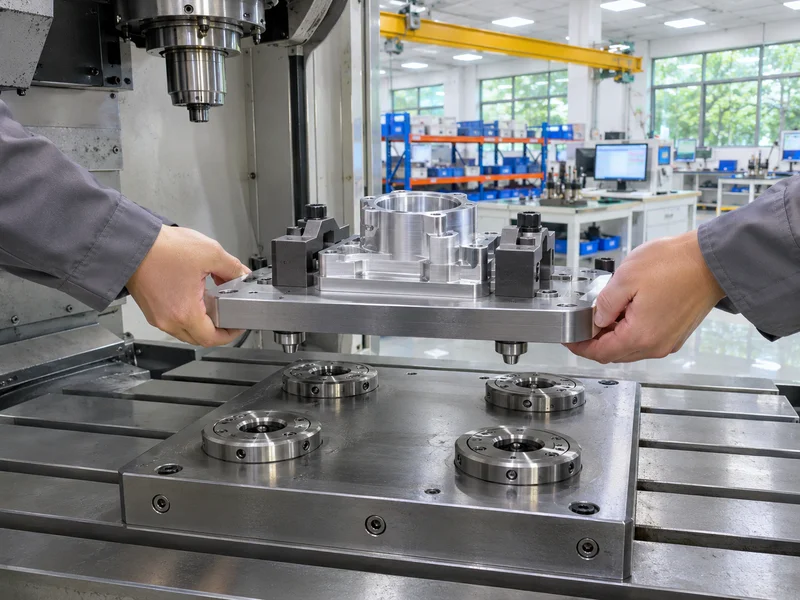
- Modular clamps bolt into the grid for one-off parts
- Dedicated fixtures dowel onto the plate for repeat parts
- Vises mount in fixed positions for consistent zeros
- Zero-point modules clamp pallets in seconds
- Offline setup: load the next part while the machine runs
For example, a zero-point system lets an operator swap a loaded pallet in under a minute, keeping the spindle cutting. Our guide to low-volume CNC machining explains why setup time drives cost on small batches.
Key Takeaway: Equally, the less time spent indicating parts, the lower the cost per part.
When Should You Order a Custom Plate?
You should order a custom plate when standard grids do not fit your parts or machine.
| Need | Custom solution |
|---|---|
| Repeat part family | Dedicated sub-plate with pockets and pins |
| Unusual table size | Plate machined to the table pattern |
| Thin or flexible parts | Vacuum or support pockets |
| Automation | Robot-friendly locating features |
| Inspection | CMM fixture plate with the same datums |
For example, a buyer may order matching fixture plates for machining and for CMM inspection so both use the same datums. Our CNC milling page explains how we machine custom plates and fixtures.
Key Takeaway: As a rule, a custom plate pays back fastest on repeat parts.
How Should the Plate Be Specified?
The plate should be specified with size, material, grid and accuracy.
- Size and thickness
- Material and condition, such as 7075-T651 or nitrided steel
- Grid: thread size, pitch and pattern
- Locating holes: diameter, tolerance and positions
- Flatness and parallelism
- Mounting: slot or bolt pattern for the machine table
- Finish: anodizing, nitriding or black oxide
For example, “400 × 300 × 25 mm, 7075-T651, M10 on 40 mm grid, 10H7 dowel holes, flatness 0.03 mm, clear anodize” is a clear basis. Our precision CNC machining services page explains how plates are made to drawing.
Key Takeaway: Finally, define locating hole tolerance and flatness, because they set the plate’s accuracy.
FAQ
- Q: What is a fixture plate?
- A flat plate with a grid of tapped and locating holes for holding work on a CNC machine.
- Q: What is a typical fixture plate grid?
- Tapped holes such as M10 or M12 on a 25–50 mm pitch plus dowel holes.
- Q: Aluminum or steel fixture plate?
- Aluminum is lighter; steel or thread inserts last longer under frequent clamping.
- Q: How flat should a fixture plate be?
- Often within about 0.02–0.05 mm, depending on size and use.
- Q: Can fixture plates be custom made?
- Yes, to match parts, machines, automation or inspection needs.
Conclusion
A fixture plate gives fast, repeatable setups when its grid, locating holes, material and flatness match the work. Order custom plates for repeat parts. To quote a fixture plate or fixture, send your 3D model and 2D drawing to our engineers.