
Thread Milling vs Tapping: Tools, Benefits and Limits
Thread milling is a CNC machining method that cuts internal or external threads with a rotating thread mill moving in a helical path, instead of a tap or die that matches the thread one-to-one. It gives better control of thread size, works well in hard materials and blind holes, and avoids the broken-tap risk that can scrap an expensive part late in the process.
The choice between thread milling and tapping is about risk and volume. For example, a single M6 hole in an aluminum bracket is tapped in seconds, while an M24 thread in a hardened steel mold plate is usually milled so the size can be adjusted and a tool failure never leaves a broken tap in the plate. In this guide, we explain how the process works, its tool types, advantages, limits, how it compares with tapping, which parts suit it and how to specify threads for it. For thread design basics, see our guide to threaded holes.
Thread milling uses a thread mill smaller than the hole, which enters to depth and follows a helical interpolation path, moving one pitch axially per revolution around the hole. Single-profile tools cut one thread form at a time and suit many diameters; multi-form tools cut several threads per orbit for speed. Benefits include adjustable thread size through tool radius offset, full threads close to the bottom of blind holes, good chip control, one tool for many sizes and right- or left-hand threads. Limits include longer cycle time on small holes and the need for a 3-axis helical capability.
In short: mill threads where size control and part value matter, tap them where speed and volume matter.
Key points:
- Motion: helical interpolation, one pitch per orbit.
- Strength: size control, hard materials, no broken taps.
- Limit: slower than tapping on small holes.
How Does Thread Milling Work?
The process cuts a thread by moving a rotating tool along a helix.
- Drill the hole to the minor diameter
- Position the thread mill at the hole center
- Move to depth without cutting
- Arc in to the thread diameter
- Interpolate one full circle while moving one pitch axially
- Arc out and retract
For example, an M20 × 2.5 thread is cut by a tool about 15 mm in diameter making one orbit that rises 2.5 mm. Thread standards are published by ISO and ASME. Our guide to design for CNC machining covers hole design.
Key Takeaway: Above all, the machine’s helical motion creates the pitch, not the tool length.
Which Tools Are Used for the Process?
Several tool types are used, each balancing flexibility and speed.
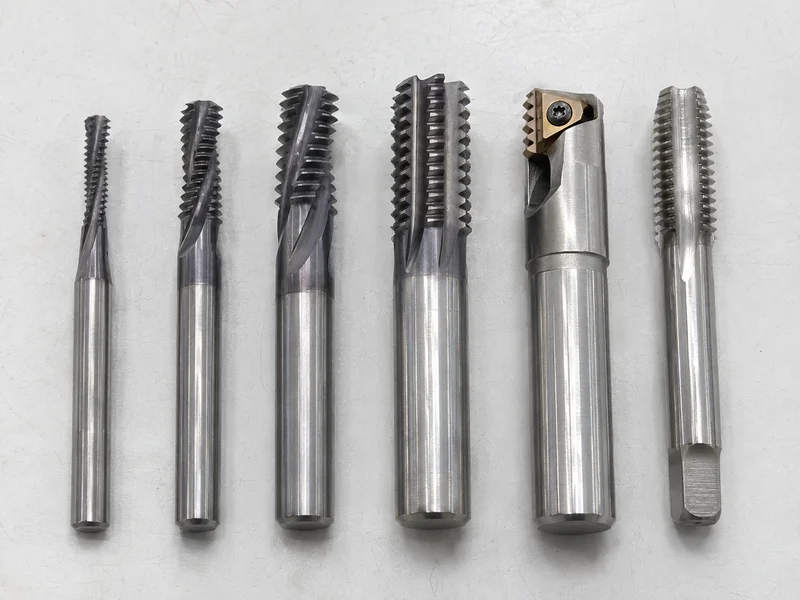
| Tool | How it cuts | Best for |
|---|---|---|
| Single-profile thread mill | One thread form per orbit, repeated in steps | Many diameters, deep threads |
| Multi-form thread mill | Several threads in one orbit | Production of one thread size |
| Indexable thread mill | Replaceable inserts | Large threads |
| Drill-thread mill | Drills, chamfers and threads | Aluminum, high volume |
For example, a single-profile tool can cut M8 to M30 threads of the same pitch, which is useful for low-volume parts. Our guide to CNC machining materials explains which materials suit carbide tooling.
Key Takeaway: In other words, single-profile tools give flexibility and multi-form tools give speed.
What Are the Advantages of Milled Threads?
Milled threads have advantages in control, safety and flexibility.
- Size control: adjust pitch diameter by tool offset
- No broken taps: a broken mill is easy to remove
- Hard materials: works in hardened steel and titanium
- Blind holes: full threads close to the bottom
- Flexibility: one tool for many diameters and both hands
- Chip control: small chips, no packing in the hole
For example, a gauge that shows a thread slightly tight can be fixed by changing the radius offset by a few microns. Our guides to thread gauge and 7075 aluminum cover inspection and a common workpiece.
Key Takeaway: For this reason, thread milling protects high-value parts late in the process.
What Are the Limits of the Method?
The method has limits in speed, small sizes and machine needs.
| Limit | Effect |
|---|---|
| Cycle time | Slower than tapping for small holes |
| Small threads | Tools below about M3 are fragile |
| Machine | Needs 3-axis helical interpolation |
| Programming | CAM or cycle setup required |
| Deep threads | Tool deflection on long reach |
For example, hundreds of M4 holes in an aluminum plate are usually faster to tap with a rigid tapping cycle. Our guide to multi-axis CNC machining explains machine capabilities.
Key Takeaway: Overall, choose taps for small, many and easy; choose milling for large, few and critical.
How Does Thread Milling Compare With Tapping?
Thread milling compares with tapping by speed, control and risk.
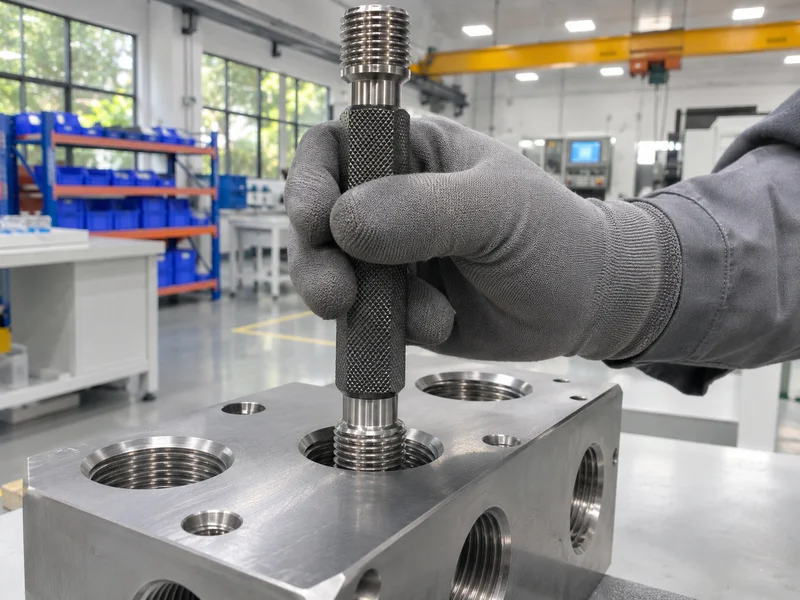
| Factor | Tapping | Thread milling |
|---|---|---|
| Speed | Fast | Slower |
| Size adjustment | Fixed by tap | Adjustable by offset |
| Tool breakage | Can scrap the part | Easy recovery |
| Hard materials | Difficult | Good |
| Blind hole depth | Needs thread relief | Threads closer to bottom |
| Tooling | One tap per size | One tool for many sizes |
For example, a stainless manifold with 20 large ports is often thread milled to avoid a broken tap in the last port. Our guide to 304 stainless steel explains why stainless is hard to tap.
Key Takeaway: Equally, many shops tap small threads and mill large or critical ones on the same part.
Which Parts Suit Milled Threads?
Milled threads suit parts where threads are large, critical or in difficult materials.
- Mold plates and inserts: large threads in hardened steel
- Hydraulic and pneumatic manifolds: port threads
- Stainless and titanium parts: hard-to-tap materials
- Large threads: above about M20
- Special threads: left-hand, non-standard pitches, NPT tapers
For example, a mold clamp plate with M16 threads in pre-hardened steel is often thread milled. Our guides to CNC milling titanium components and P20 steel cover these materials.
Key Takeaway: As a rule, consider thread milling whenever a broken tap would be costly.
How Should Threads Be Specified for Milling?
Threads should be specified with standard, size, class, depth and inspection.
- Standard and size: for example, M20 × 2.5 or 1/2-13 UNC
- Tolerance class: for example, 6H or 2B
- Full thread depth and hole depth
- Chamfer at the entry
- Inspection: go/no-go gauges
- Coating allowance if plated
For example, “M20 × 2.5-6H, full thread 30 mm, 90° chamfer, check with go/no-go gauge” gives a clear basis. Our CNC milling page explains how we machine threaded parts to drawing.
Key Takeaway: Finally, state full thread depth, because the machining method changes what is achievable.
FAQ
- Q: What is thread milling?
- Cutting threads with a rotating tool moving in a helical path.
- Q: Is thread milling better than tapping?
- It is safer and more adjustable; tapping is faster for small threads.
- Q: Can thread milling cut hardened steel?
- Yes, with suitable carbide tools.
- Q: Can one thread mill cut different sizes?
- Yes, if the pitch and thread form are the same.
- Q: What machine is needed for thread milling?
- A CNC machine with helical interpolation.
Conclusion
Thread milling gives adjustable, reliable threads in hard materials and high-value parts, while tapping remains faster for small, easy threads. Specify standard, class and depth clearly. To quote threaded machined parts, send your 3D model and 2D drawing to our engineers.